
Life, 1921-03-17 · page 23 of 40
Life — March 17, 1921 — page 23: what you’re looking at
What you’re looking at
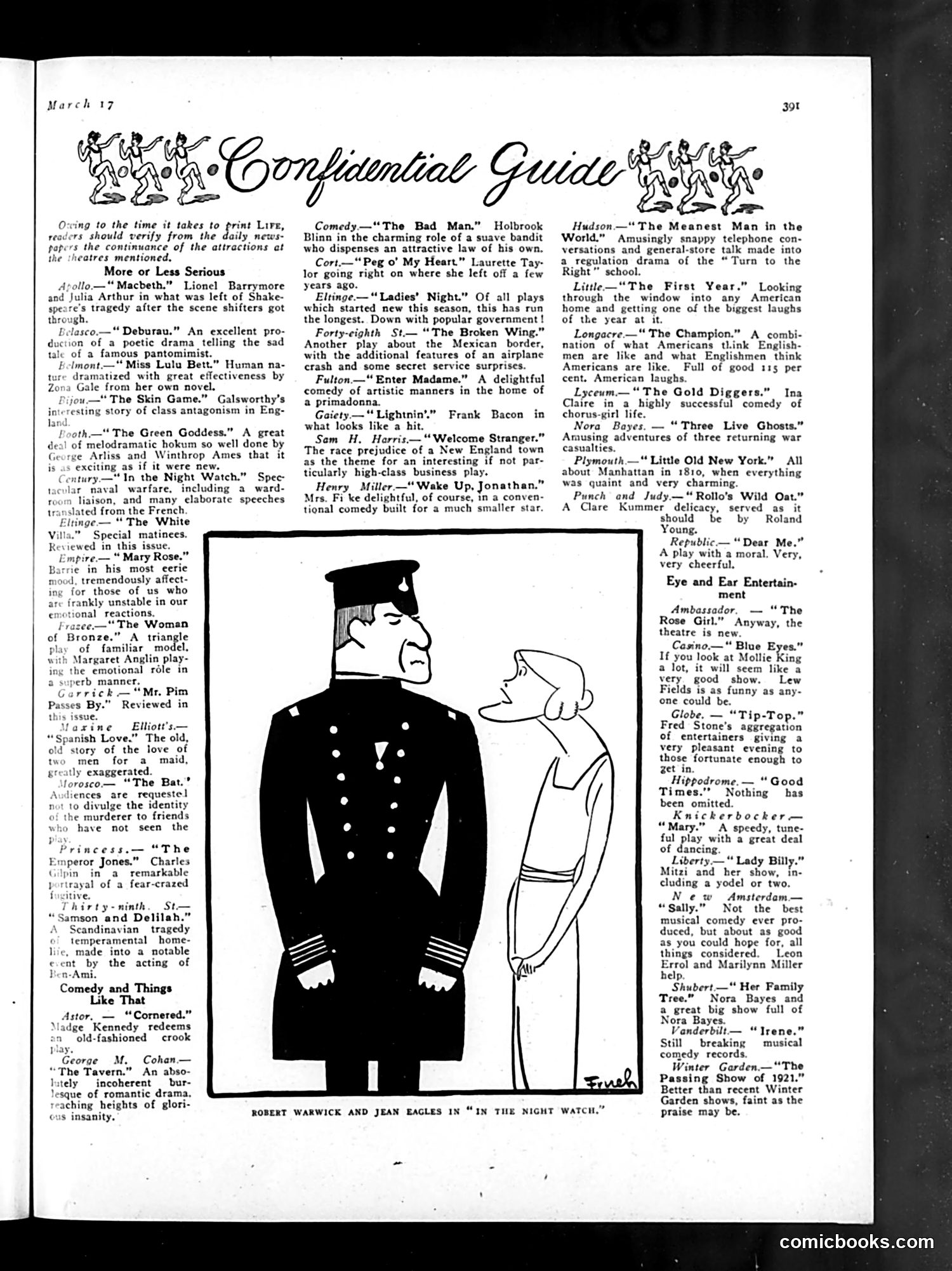
This is a theater review page from *Life* magazine listing Broadway shows running around March 1921. The central illustration shows two figures from "In the Night Watch"—a naval warfare spectacle—in a stylized art-deco drawing by what appears to be an artist's signature. The page is primarily informational: brief descriptions of current theatrical productions, ranging from serious drama (Lionel Barrymore in *Macbeth*, Charles Gilpin in *The Emperor Jones*) to popular comedies (*Peg o' My Heart*, *The Gold Diggers*). The humor is mild and embedded in the descriptions themselves—noting that *Macbeth* is "what was left...after the scene shifters got through," or joking about *Ladies' Night* running so long that it disproves democracy ("Down with popular government!"). The right column adds brief capsule reviews of lighter entertainment and musicals. This is essentially a theater listing with editorial commentary for New York's entertainment-hungry readers.
📄 Transcribed text from this page (OCR, searchable)
Machine-transcribed from the original scan — historical spelling and the odd misread are preserved.
March 17 sot BAC yontat Gace i Ovwing to the time it takes to print Lire, readers should verify from the daily news: popers the continuance of the attractions at the theatres mentioned, More or Less Serious Apollo—“ Macbeth.” Lionel Barrymore and Julia Arthur in what was left of Shake- speare’s tragedy after the scene shifters got through. Belasco.—“ Deburau.” An excellent pro- duction of a poetic drama telling the sad tale of a famous pantomimist. Imont.—“ Miss Lulu Bett.” Human na- dramatized with great effectiveness by 1 Gale from her own novel. jou—" The Skin Gam Galsworthy’s sting story of class antagonism in Eng- th—' The Green Goddess.” A great deal of melodramatic hokum so well done by George Arliss and Winthrop Ames that it is os exciting as if it were new. tury—" In the Night Watch.” Spec cular naval warfare, including a ward- room liaison, and many elaborate speeches if ‘ed from the French. Eltinge— “The White Special matinees. iewed in this issue. pire— “ Mary Rose.” ie in his most eerie sod, tremendously affect- for those of us who are frankly unstable in our emotional reactions. I .—" The Woman of Bronze.” A triangle play of familiar model, with Margaret Anglin play- ing the emotional réle in a superb manner, Carrick —“Mr. Pim Passes By.” Reviewed in this issue. Maxine Elliott’s— “Spanish Love.” The old, old story of the love of two men for a maid, greatly exaggerated. forosco— “The Bat.” Audiences are requeste! not to divulge the identity the murderer to friends who have not seen the Princess.— “The Emperor Jones.” Charles Gilpin ina remarkable yal of a fear-crazed sitive. Thirty-ninth “Samson and Delila Scandinavian ©) temperamental liie, made into a notable ¢ } the acting of Astor. — “Cornered.” Madge Kennedy redeems n old-fashioned crook play, George M. “The Tavern.” An abso- lntely incoherent — bur- lesque of romantic dram reaching heights of glori- ous insanity. Cohan. — ROBERT WARWICK AND JEAN EAGLES IN Comedy—“ The Bad Man.” Holbrook Blinn in the charming role of a suave bandit who dispenses an attractive law of his own. Cort,—“ Peg o’ My Heart.” Laurette Tay- lor going right on where she left off a few years ago. Eltinge—“ Ladies’ Night.” Of all plays which started new this season, this has run the longest. Down with popular government ! Forty-cighth St— “The Broken Wing. Another play about the Mexican border, with the additional features of an airplane crash and some secret service surprises. Fulton.—“ Enter Madame.” A delightful comedy of artistic manners in the home of a primadonna. Gaiety. —“' Lightnin’.” what looks like a hit. Sam H. Harris.— “Welcome Stranger. The race prejudice of a New England town as the theme for an interesting if not par- ticularly high-class business play. Henry Miller — Wake Up, Jonathan. Mrs. Fi ke delightful, of course, in a conven- tional comedy built for a much smaller star. Frank Bacon in IN THE NIGHT WaTCH.” Hudson—‘“ The Meanest Man in the World.” Amusingly snappy telephone con- versations and general-store talk made into a regulation drama of the “Turn to the Right” school. Littl.—“The First Year.” Looking through the window into any American home and getting one of the biggest laughs of the year at it. Longacre—“ The Champion.” A_combi- nation of what Americans tlink English- men are like and what Englishmen think Americans are like. Full of good 115 per cent. American laughs. Lyceum—“ The Gold Digger: Claire in a highly successful chorus-gitl life. Nora Bayes. — “Three Live Ghosts.” Amusing adventures of three returning war casualties. Plymouth —“ Little Old New York.” All about Manhattan in 1810, when everything was quaint and very charming. Punch and Judy.—“ Rollo's Wild Oat.” A Clare Kummer delicacy, served as it should be by Roland Young. Republic— “Dear Me.” A play with a moral. Very, very cheerful. Eye and Ear Entertain- ment Ambassador, — “The Rose Girl.” Anyway, the theatre is new. Casino.—" Blue Eyes.” If you look at Mollie King a lot, it will seem like a very” good show. Lew Fields is as funny as any- one could be. Globe. — “Tip-Top.” Fred Stone's aggregation of entertainers giving a very pleasant evening to those fortunate enough to get in. Hippodrome.— “Good Times.” Nothing has been omitted. Knickerbocker— “Mary.” A speedy, tune- ful play with a great deal of dancing. Liberty —“* Lady Billy.” Mitzi and her show, in- cluding a yodel or two. N ew Amsterdam— “Sally.” Not the best musical comedy ever pro- duced, but about as good as you could hope for, all things considered. Leon Errol and Marilynn Miller help. Shubert —“ Her Family Tree.” Nora Bayes and a great big show full of Nora Bayes. Vanderbilt — Still breaking comedy records. Winter Garden.—“The Passing Show of 1921.” Better than recent Winter Garden shows, faint as the praise may be. Ina comedy of “Trene.” musical comicbooks.com