
Life, 1921-03-17 · page 10 of 40
Life — March 17, 1921 — page 10: what you’re looking at
What you’re looking at
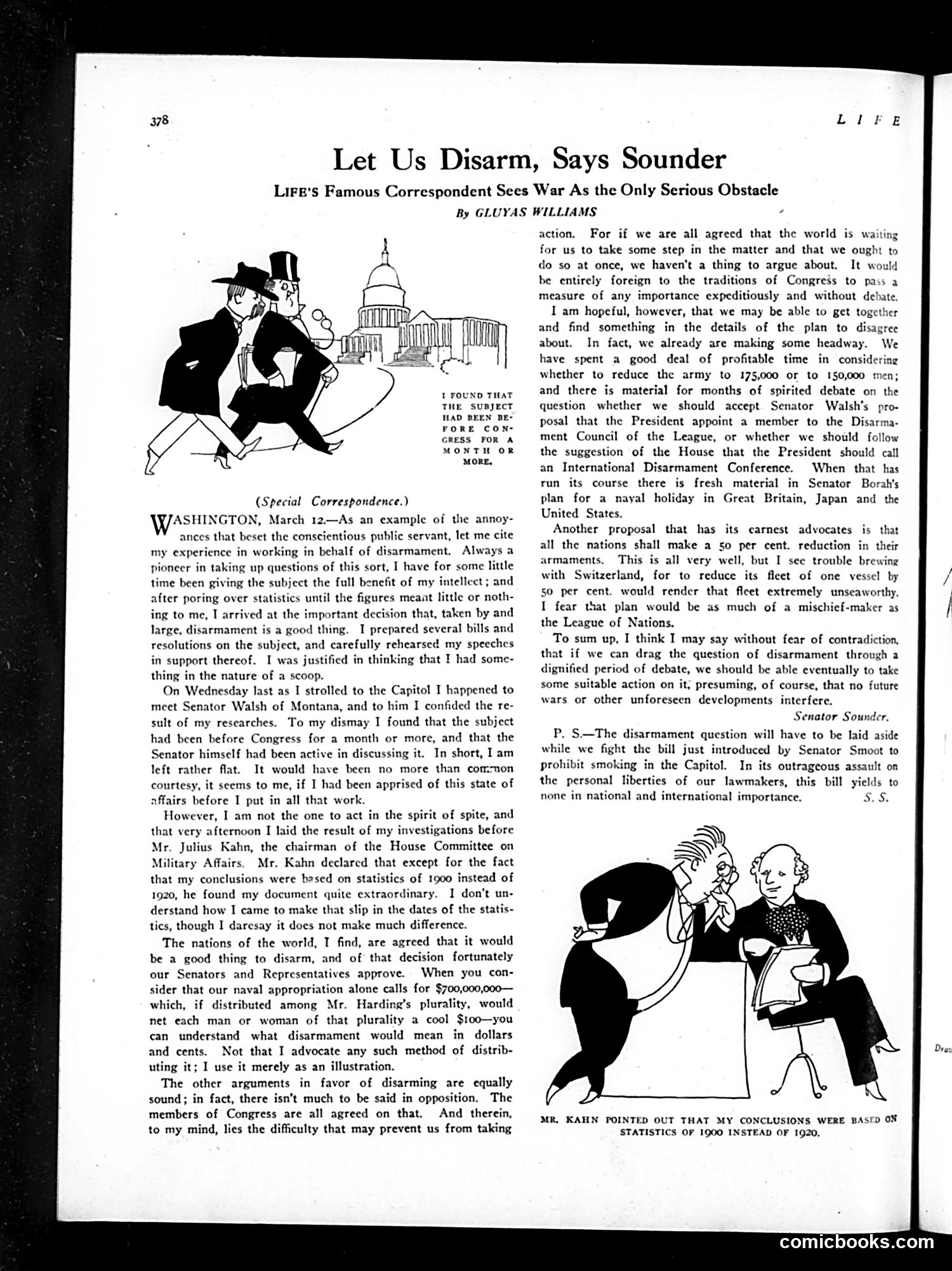
This article by Gluyas Williams discusses post-WWI disarmament proposals. The top cartoon shows a figure crouching with military equipment, satirizing reluctance to disarm despite public support. The bottom cartoon ridicules a specific debate: Mr. Kahn (chairman of the House Military Affairs Committee) challenged the author's statistical arguments about disarmament costs, claiming his conclusions were "based on statistics of 1900 instead of 1920." The cartoon mocks this pedantic objection—Kahn points out the date discrepancy while ignoring the broader disarmament argument itself, suggesting critics use minor technical errors to avoid substantive engagement with peace proposals. The piece reflects 1920s-era American debates over naval reduction and League of Nations involvement.
📄 Transcribed text from this page (OCR, searchable)
Machine-transcribed from the original scan — historical spelling and the odd misread are preserved.
Let Us Disarm, Says Sounder Lire’s Famous Correspondent Sees War As the Only Serious Obstacle By GLUYAS WILLIAMS , 1 FOUND THAT THE SUBJECT MAD BEEN BE- FORE CON- GRESS FOR A MONTH OR MORE, (Special Correspondence.) \WASHINGTON, March 12—As an example of the annoy- ances that beset the conscientious public servant, let me cite my experience in working in behalf of disarmament. Always a pioneer in taking up questions of this sort, I have for some little time been giving the subject the full benefit of my intellect; and after poring over statistics until the figures meaat little or noth- ing to me, I arrived at the important decision that, taken by and large, disarmament is a good thing. I prepared several bills and resolutions on the subject, and carefully rehearsed my speeches in support thereof. I was justified in thinking that I had some- thing in the nature of a scoop. On Wednesday last as I strolled to the Capitol I happened to meet Senator Walsh of Montana, and to him I confided the re- sult of my researches. To my dismay I found that the subject had been before Congress for a month or more, and that the Senator himself had been active in discussing it. In short, Iam left rather flat. It would have been no more than common courtesy, it seems to me, if I had been apprised of this state of affairs before I put in all that work. However, I am not the one to act in the spirit of spite, and that very afternoon I laid the result of my investigations before Mr. Julius Kahn, the chairman of the House Committee on Military Affairs. Mr. Kahn declared that except for the fact that my conclusions were based on statistics of 1900 instead of 1920, he found my document quite extraordinary. I don't un- derstand how I came to make that slip in the dates of the statis- tics, though I daresay it does not make much difference. The nations of the world, I find, are agreed that it would be a good thing to disarm, and of that decision fortunately our Senators and Representatives approve. When you con- sider that our naval appropriation alone calls for $700,000,000— which, if distributed among Mr. Harding’s plurality, would net each man or woman of that plurality a cool $100—you can understand what disarmament would mean in dollars and cents. Not that I advocate any such method of distrib- uting it; I use it merely as an illustration. The other arguments in favor of disarming are equally sound; in fact, there isn’t much to be said in opposition. The members of Congress are all agreed on that. And therein, to my mind, lies the difficulty that may prevent us from taking action. For if we are all agreed that the world is waiting for us to take some step in the matter and that we ought to do so at once, we haven't a thing to argue about. It would be entirely foreign to the traditions of Congress to pass a measure of any importance expeditiously and without debate. I am hopeful, however, that we may be able to get together and find something in the details of the plan to disagree about. In fact, we already are making some headway. We have spent a good deal of profitable time in considering whether to reduce the army to 175,000 or to 150,000 men; and there is material for months of spirited debate on the question whether we should accept. Senator Walsh's pro- posal that the President appoint a member to the Disarma- ment Council of the League, or whether we should follow the suggestion of the House that the President should call an International Disarmament Conference. When that has run its course there is fresh material in Senator Borah's plan for a nayal holiday in Great Britain, Japan and the United States. Another proposal that has its carnest advocates is that all the nations shall make a so per cent. reduction in their armaments. This is all very well, but I see trouble brewing with Switzerland, for to reduce its fleet of one vessel by 50 per cent. would render that fleet extremely unseaworthy. I fear that plan would be as much of a mischief-maker as the League of Nations. To sum up, I think I may say without fear of contradiction, that if we can drag the question of disarmament through a dignified period of debate, we should be able eventually to take some suitable action on it, presuming, of course, that no future wars or other unforeseen developments interfere. Senator Sounder, P. S—The disarmament question will have to be laid aside while we fight the bill just introduced by Senator Smoot to prohibit smoking in the Capitol. In its outrageous assault on the personal liberties of our lawmakers, this bill yields to none in national and international importance. SS. MR, KAHN POINTED OUT THAT MY CONCLUSIONS WERE BASED ON STATISTICS OF 1900 INSTEAD OF 1920, comicbooks.com