
Life, 1920-06-03 · page 28 of 52
Life — June 3, 1920 — page 28: what you’re looking at
What you’re looking at
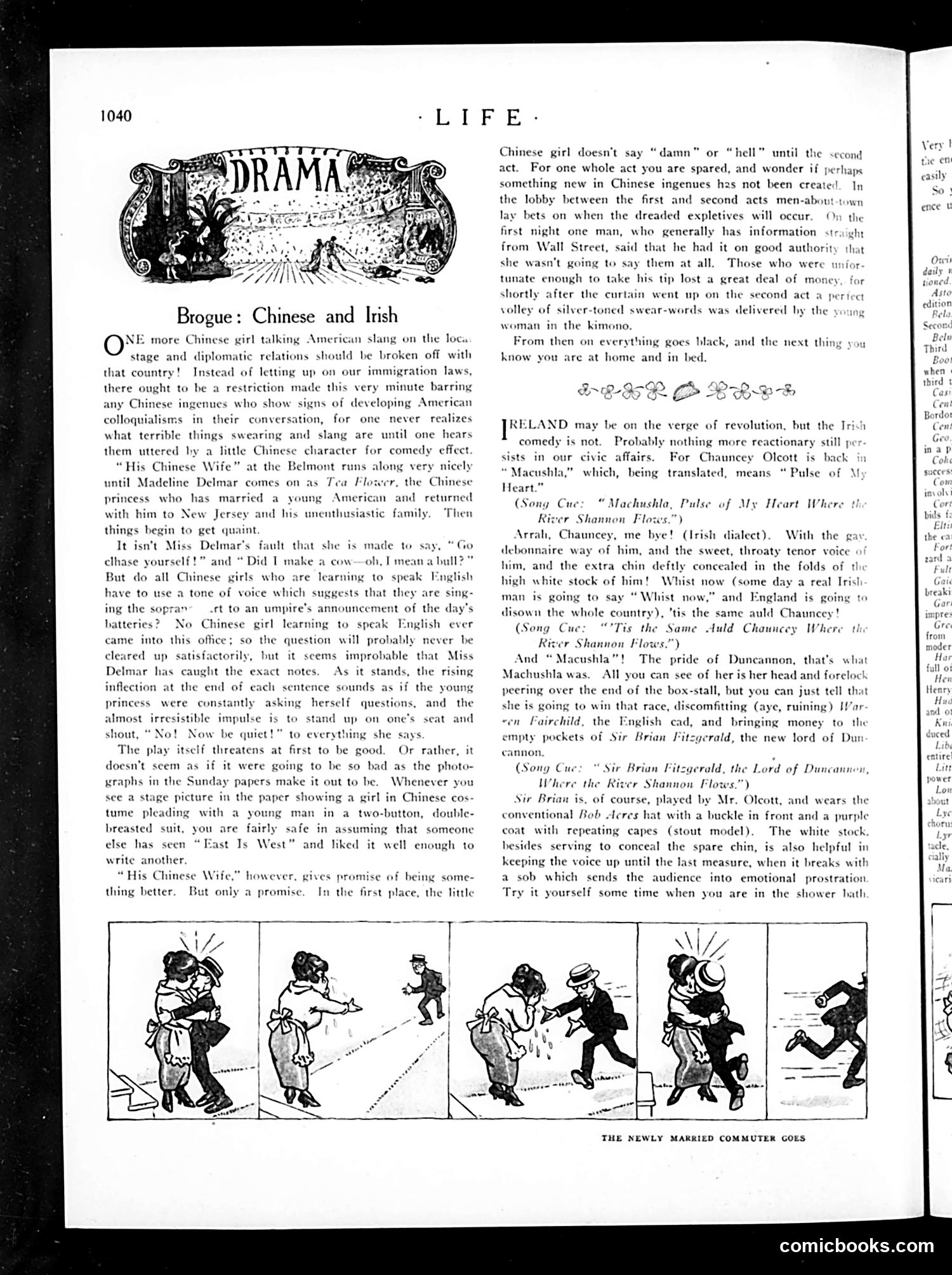
This page reviews two Broadway plays featuring ethnic stereotypes popular in early 20th-century American theater. **"His Chinese Wife"** mocks a Chinese actress (Madeline Delmar) playing a princess who adopts American slang and profanity. The critic finds her exaggerated accent—a rising inflection suggesting constant questioning—implausible and grating. The satire targets both the play's reliance on tired "East meets West" plots (following the success of "East Is West") and the absurdity of casting choices that require performers to adopt offensive vocal mannerisms for comic effect. **"Macushla"** features Irish-American actor Chauncey Olcott performing Irish-dialect comedy with exaggerated physical comedy (the strip below shows "The Newly Married Commuter"). The reviewer criticizes it as hopelessly old-fashioned and reactionary—even as Ireland faces political upheaval. Both reviews expose how mainstream entertainment relied on caricatured ethnic performances for humor, treating linguistic and cultural differences as inherently comedic.
📄 Transcribed text from this page (OCR, searchable)
Machine-transcribed from the original scan — historical spelling and the odd misread are preserved.
‘LIFE. 27MIN Brogue: Chinese and Irish > more Chinese girl talking American slang on the locas stage and diplomatic relations should be broken off with that country! Instead of letting up on our immigration laws, there ought to be a restriction made this very minute barring any Chinese ingenues who show signs of developing American colloquialisms in their conversation, for one never realizes what terrible things swearing and slang are until one hears them uttered hy a little Chinese character for comedy effec “His Chinese Wife” at the Belmont runs along very nicely until Madeline Delmar comes on as Tea Flower, the Chinese princess who has married a young American and returned with him to New Jersey and his unenthusiastic family. Then things begin to get quaint It isn’t Miss Delmar’s fault that she is made to say, “Go clhase yoursel and “ Did T make a cow—oh, I mean a bul But do all Chinese girls who are learning to speak English have to use a tone of voice which suggests that they are sing- ing the sopra hatteries ? ft to an umpire’s announcement of the da o Chinese girl learning to speak English ever came into this office; so the question will probably never be cleared up satisfactorily, but it seems improbable that Miss Delmar has caught the exact notes. As it stands, the rising inflection at the end of each sentence sounds as if the young princess were constantly asking herself questions, and the almost irresistible impulse is to stand up on one’s seat and shout, “No! Now be quiet!” to everything she says The play itself threatens at first to be good. Or rather, it doesn’t scem as if it were going to be so bad as the photo- graphs in the Sunday papers make it out to be. Whenever you see a stage picture in the paper showing a girl in Chinese cos- tume pleading with young man in a two-button, double- breasted suit, you are fairly s. in assuming that someone else has seen “East Is West” and liked it well enough to write another. “His Chinese Wife,” however, gives of being some- thing better. But only a promise. In the first place, the littl Chinese girl doesn't say “damn” or “hell” until the second act. For one whole act you are spared, and wonder if perhaps something new in Chinese ingenues has not been created. In the lobby between the first and second acts men-about-town lay bets on when the dreaded expletives will occur, On the first night one man, who generally has information straight from Wall Street, said that he had it on good authority that she wasn’t going to say them at all. Those who were unfor tunate enough to take his tip lost a great deal of money, for shortly after the curtain went up on the second act a pertect volley of silver-toned swear-words was delivered by the woman in the kimono. From then on everything goes black, and the next thing you know you are at home and in bed. &BEIR > BRES RELAND may be on the verge of revolution, but the Trisi comedy is not. Probably nothing more reactionary still 1 sists in our civic affairs. For Chauncey Olcott is back Macushla,” which, being translated, means “Pulse of M Heart.” (Song Cue: “ Machushla, Pulse of My Heart Where th River Shannon Flows.”) Arrah, Chauncey, me bye! (Irish dialect). With the ga: debonnaire way of him, and the sweet, throaty tenor voice him, and the extra chin deftly concealed in the folds of 1) high white stock of him! Whist now (some day a real Irisl man is going to say “ Whist now,” and England is going to disown the whole country), ’tis the same auld Chauncey! (Song Cue: “’Tis the Same Auld Chauncey Wh River Shannon Flows.”) And “ Macushla”! The pride of Duncannon, that’s what Machushla was. All you can see of her is her head and forelock peering over the end of the box-stall, but you can just tell that she is going to win that race, discomfitting (aye, ruining) Har ven Fairchild, the English cad, and bringing money to the empty pockets of Sir Brian Fitzgerald, the new lord of Dun cannon (Song Cue Where the River Shannon Flows.) Sir Brian is, of course, played by Mr. Olcott, and wears the conventional Bob Aeres hat with a buckle in front and a purple coat with repeating capes (stout model). The white stock. besides serving to conceal the spare chin, is also helpful in keeping the voice up until the last measure, when it breaks with a sob which sends the audience into emotional prostration Try it yourself some time when you are in the shower hath THE NEWLY MARRIED COMMUTER GOES “ Sir Brian Fitzgerald, the Lord of Duncannon, preaki impres from comicbooks.com