
Life, 1920-06-03 · page 18 of 52
Life — June 3, 1920 — page 18: what you’re looking at
What you’re looking at
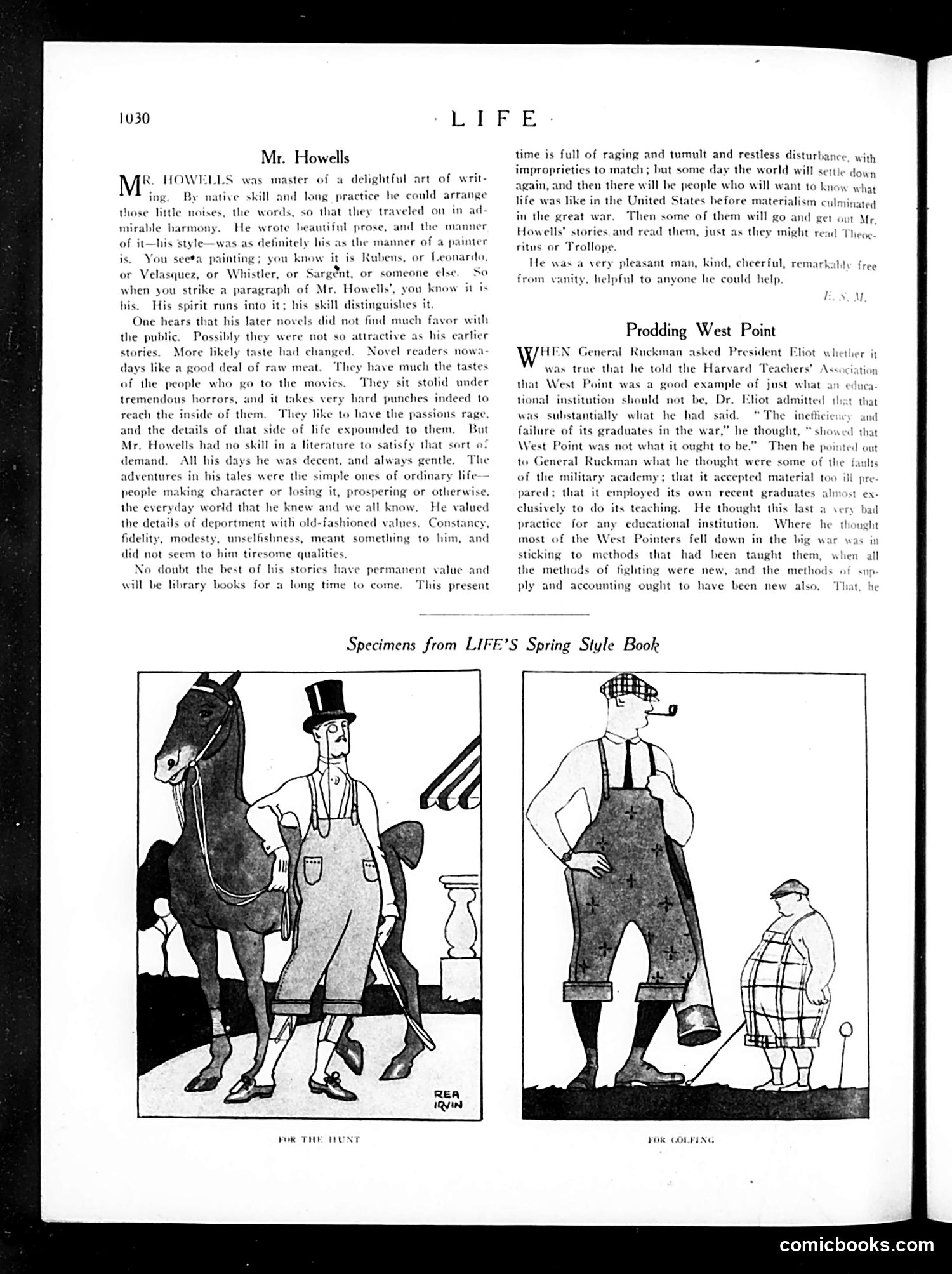
This page contains two distinct sections: **Upper Section - Mr. Howells Tribute:** An obituary/appreciation of writer William Dean Howells praising his distinctive literary style and moral values. The text criticizes modern readers' preference for sensational content over Howells' quiet, character-driven stories about ordinary life. It suggests future generations will value his work as a historical record of pre-materialist America. **Lower Section - West Point Critique:** A brief article about Harvard President Charles W. Eliot's criticism of the U.S. Military Academy. Eliot reportedly told General Ruckman that West Point exemplified what a good institution should *not* be—accepting unprepared cadets and staffing itself exclusively with recent graduates. The satire suggests West Pointers failed in WWI because they rigidly applied outdated methods rather than adapting to new warfare tactics and logistics. **Bottom - Fashion Cartoons:** Two humorous illustrations labeled "For the Hunt" and "For Golfing" showing exaggerated period clothing styles, typical of Life magazine's satirical fashion commentary.
📄 Transcribed text from this page (OCR, searchable)
Machine-transcribed from the original scan — historical spelling and the odd misread are preserved.
“LIFE: Mr. Howells R. HOWELLS was master of a delightful art of writ- ing. By native skill and long practice he could arrange those little noises, the words, so that they traveled on in ad mirable harmony He wrote beautiful prose, and the manner of it—his style—was as definitely his as the manner of a painter is. You seeta painting; you know it is Rubens, or Leonardo, or Velasquez, or Whistler, or Sargént, or someone else. So when you strike a paragraph of Mr. Howells’, you know it is his. His spirit runs into it; his skill distinguishes it One hears that his later novels did not find much favor with the public. Possibly they were not so attractive as his earlier storie: More likely taste had chang Novel readers nowa- days like a good deal of raw meat. They have much the tastes of the people who go to the movies. They sit stolid under tremendous horrors, and it takes very hard punches indeed to reach the inside of them. They like to have the passions rage, and the details of that side of life expounded to them. But Mr. Howells had no skill in a literature to satisfy that sert of demand, All his days he was decent, and always gentle. The adventures in his tales were tle simple ones of ordinary life people making character or losing it, prospering or otherwise. the everyday world that he knew and we all know, He valued the details of deportment with old-fashioned values. Constancy, fidelity, modesty, unselfishness, meant something to him, and did not seem to him tiresome qualities. doubt the best of his stories have permanent value and will be library books for a long time to come. This present time is full of raging and tumult and restless disturbance f . with improprieties to ms ch; but some day the world will settle down again, and then there will be people who will want to know what life was like in the United States before n erialism ¢ inated Then some of them will go and get out Mr in the great war. Howells’ stories and read them, just as they might read ‘Theoe. ritus or Trollope. He was a very pleasant man, kind, cheerful, remark from vanity, helpful to anyone he could help. Prodding West Point HEN General Ruckman asked President Eliot whether it was true that he told the Harvard Teachers’ Association that West Point was a good example of just what tional institution should not be, Dr. Eliot admitted. ¢! was substantially what he had said The inefficienc failure of its graduates in the war,” he thought, “showed ths West Point was not what it ought to be.” Then he pointed ou to General Ruckman what he thought were some of the of the military academy; that it accepted material too pre pared; that it employed its own recent graduates almost ex- clusively to do its teaching. He thought this last a bad practice for any educational institution. Where he thought most of the West Pointers fell down in the hig w sticking to methods that had been taught them, the methods of fighting were new, and the methods of ply and accounting ought to have been new also, That Specimens from LIFE’S Spring Style Book THE HUNT VOR GOLFING comicbooks.com