
Life, 1920-04-01 · page 34 of 60
Life — April 1, 1920 — page 34: what you’re looking at
What you’re looking at
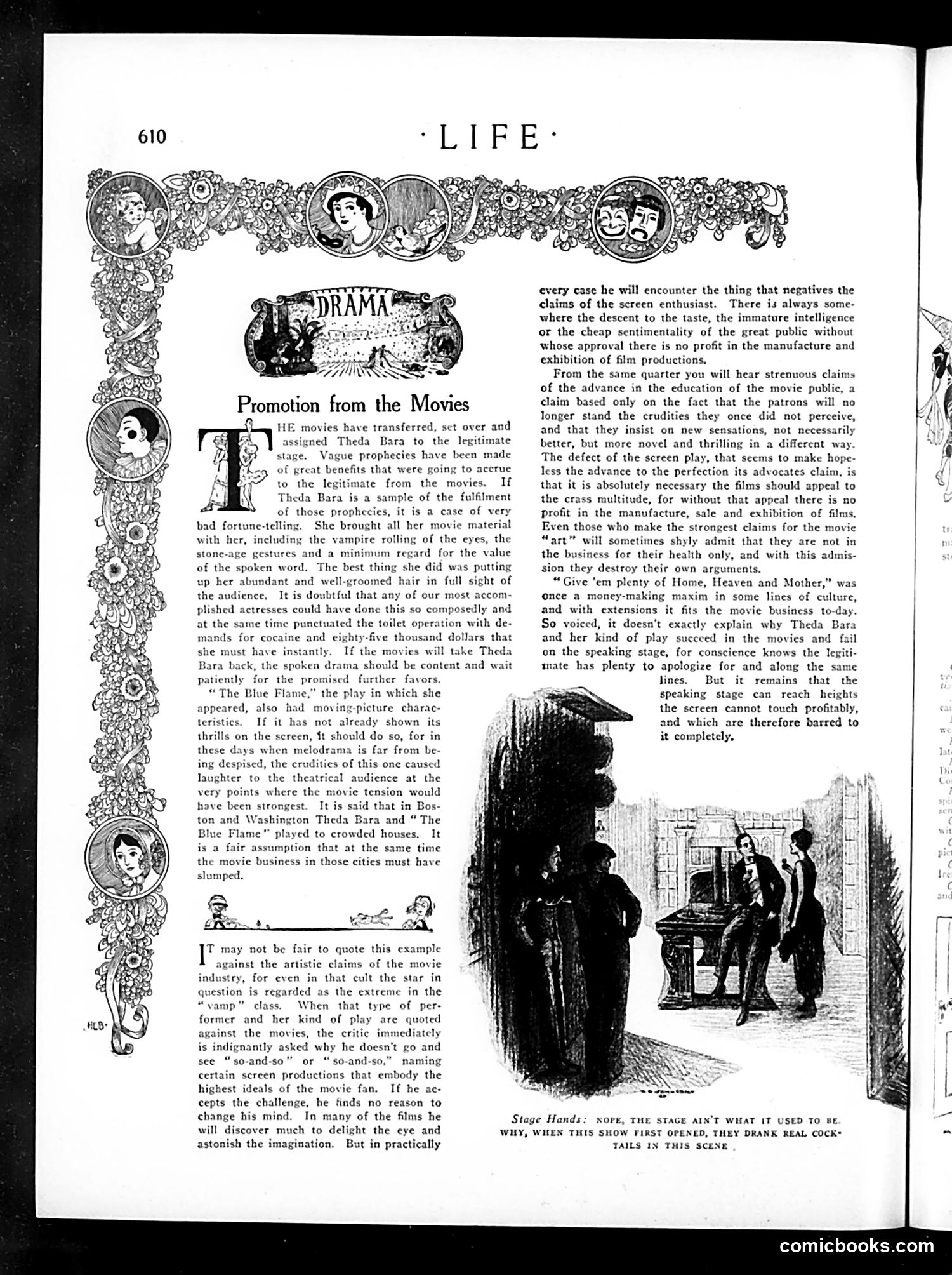
This article attacks actress **Theda Bara**, a famous silent-film "vamp" star attempting to transition to Broadway theater. The satire's core argument: movies have corrupted legitimate stage performance. The complaint is specific—Bara brought her exaggerated film mannerisms (melodramatic eye-rolling, primitive gestures, disregard for spoken dialogue) to the stage production "The Blue Flame." The author grudgingly admits she did one thing well: arranging her hair visibly during a toilette scene, which showed technical competence but hardly validates film-to-stage crossover. The broader critique attacks cinema's artistic claims. The author concedes films contain visual beauty but argues they're fundamentally compromised by their need to appeal to "the crass multitude" for profit. Even filmmakers admit this profit motive, undermining claims of artistic integrity. The famous maxim "Give 'em plenty of Home, Heaven and Mother" explains why lowbrow content succeeds commercially but fails artistically—a tension the author sees as insurmountable.
📄 Transcribed text from this page (OCR, searchable)
Machine-transcribed from the original scan — historical spelling and the odd misread are preserved.
Vague prophecies have been made of great benefits that were going to accrue to the legitimate from the movies. If Theda Bara is a sample of the fulfilment of those prophecies, it is a case of very bad fortune-telling. She brought all her movie erial with her, including the vampire rolling of the eyes, the stone-age gestures and a minimum regard for the value of the spoken word. The best thing she did was putting up her abundant and well-groomed hair in full sight of the audience, It is doubtful that any of our most accom- plished actresses could have done this so composedly and at the same time punctuated the toilet operation with de- mands for cocaine and eighty-five thousand dollars that she must have instantly. If the movies will take Theda Bara back, the spoken drama should be content and wait patiently for the promised further favors. “The Blue Flame,” the play in which she appeared, also had moving-picture charac- teristics. If it has not already shown its thrills on the screen, {t should do so, for in these days when melodrama is far from be- ing despised, the crudities of this one caused laughter to the theatrical audience at the very points where the movie tension would have been strongest. It is said that in Bos- ton and Washington Theda Bara and “ The Blue " played to crowded houses, It is a fair assumption that at the same time the movie business in those cities must have slumped. i y not be fair to quote this example against the artistic claims of the movie industry, for even in that cult the star in question is regarded as the extreme in the “vamp” class. When that type of per- former and her kind of play are quoted inst the movies, the critic immediately is indignantly asked why he doesn’t go and see “so-and-so” or “so-and-so,” naming certain screen productions that embody the highest ideals of the movie fan. If he ac- cepts the challenge, he finds no reason to change his mind. In many of the films he will discover much to delight the eye and astonish the imagination. But in practically every case he will encounter the thing that negatives the claims of the screen enthusiast. There is always some- where the descent to the taste, the immature intelligence or the cheap sentimentality of the great public without whose approval there is no profit in the manufacture and exhibition of film productions. From the same quarter you will hear strenuous claims of the advance in the education of the movie public, a claim based only on the fact that the patrons will no longer stand the crudities they once did not perceive, and that they insist on new sensations, not necessarily better, but more novel and thrilling in a different way. The defect of the screen play, that seems to make hope- less the advance to the perfection its advocates claim, is that it is absolutely necessary the films should appeal to the crass multitude, for without that appeal there is no Profit in the manufacture, sale and exhibition of films, Even those who make the strongest claims for the movie “art” will sometimes shyly admit that they are not in the business for their health only, and with this admis- sion they destroy their own arguments. “Give 'em plenty of Home, Heaven and Mother,” was once a money-making maxim in some lines of culture, and with extensions it fits the movie business to-day. So voiced, it doesn’t exactly explain why Theda Bara and her kind of play succeed in the movies and fail on the speaking stage, for conscience knows the legiti- mate has plenty to apologize for and along the same lines. But it remains that the speaking stage can reach heights the screen cannot touch profitably, and which are therefore barred to it completely, Stage Hands: Nore, TUE STAGE AIN'T WHAT IT USED TO BE. WHY, WHEN THIS SHOW FIRST OPENED, THEY DRANK REAL COCK- TAILS IN THIS SCENE comicbooks.com