
Life, 1920-04-01 · page 21 of 60
Life — April 1, 1920 — page 21: what you’re looking at
What you’re looking at
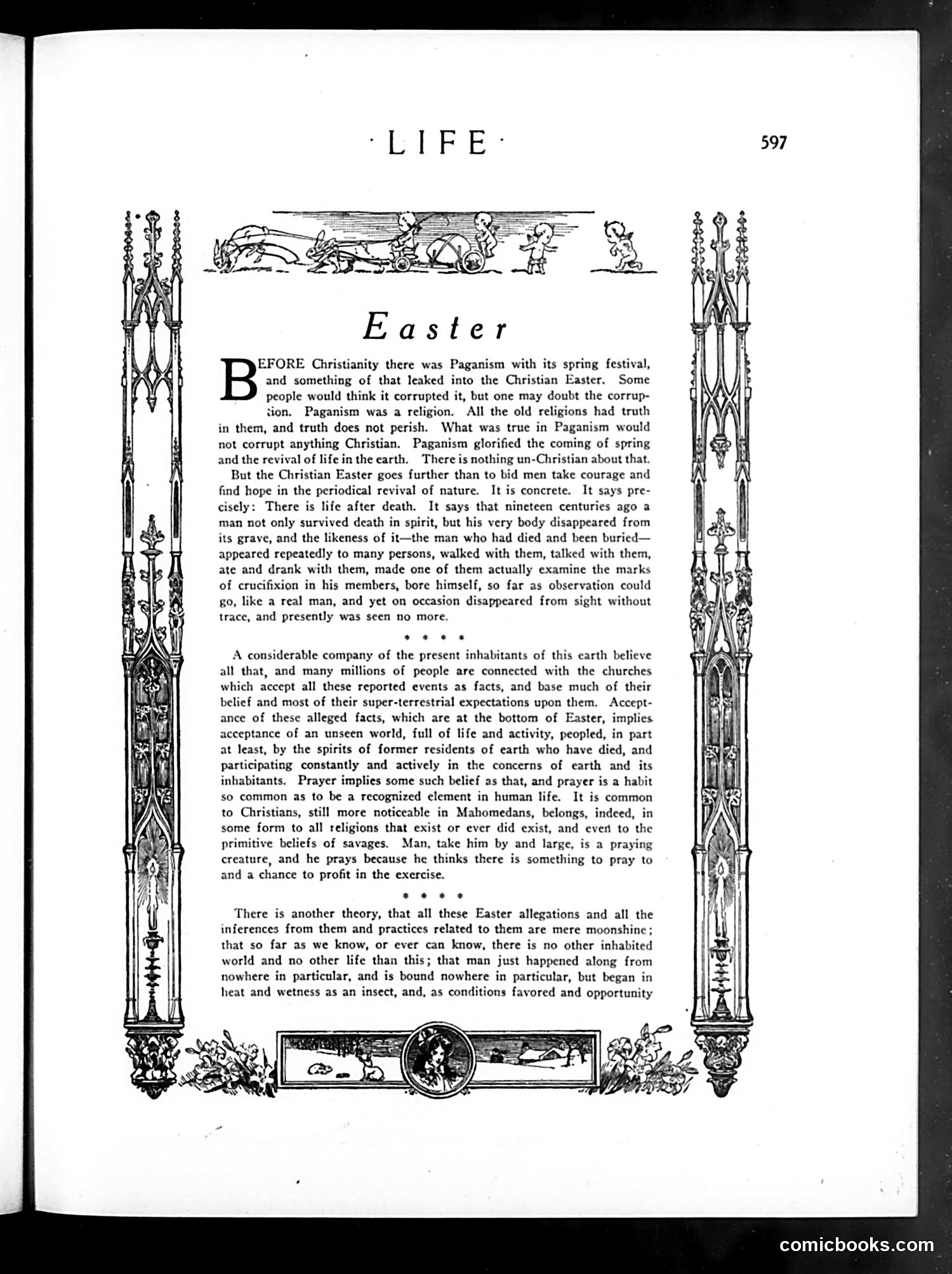
This is not a cartoon page but an editorial essay on Easter. The text presents three worldviews: 1. **Pagan origins**: Spring festivals celebrating life's renewal—presented as compatible with Christianity 2. **Christian Easter**: Claims concrete, physical resurrection—Jesus's body vanished, appeared bodily to witnesses, ate food, showed wounds. The essay notes millions accept this as fact, supporting belief in an afterlife and prayer 3. **Materialist theory**: Dismisses Easter claims as "moonshine," arguing humans arose by chance from insect-like origins with no afterlife or purpose The piece appears to be *presenting* these positions neutrally rather than satirizing them. The decorative borders and layout suggest this is serious editorial content, not satire. Life magazine is discussing genuine theological disagreement about Easter's meaning and humanity's ultimate fate—debates still relevant today.
📄 Transcribed text from this page (OCR, searchable)
Machine-transcribed from the original scan — historical spelling and the odd misread are preserved.
Easter EFORE Christianity there was Paganism with its spring festival, and something of that leaked into the Christian Easter. Some people would think it corrupted it, but one may doubt the corrup- tion. Paganism was a religion. All the old religions had truth in them, and truth does not perish. What was true in Paganism would not corrupt anything Christian. Paganism glorified the coming of spring and the revival of life in the earth. There is nothing un-Christian about that. But the Christian Easter goes further than to bid men take courage and find hope in the periodical revival of nature. It is concrete. It says pre- cisely: There is life after death. It says that nineteen centuries ago a man not only survived death in spirit, but his very body disappeared from its grave, and the likeness of it—the man who had died and been buried— appeared repeatedly to many persons, walked with them, talked with them, ate and drank with them, made one of them actually examine the marks of crucifixion in his members, bore himself, so far as observation could go, like a real man, and yet on occasion disappeared from sight without trace, and presently was seen no more. se ee A considerable company of the present inhabitants of this earth believe all that, and many millions of people are connected with the churches which accept all these reported events as facts, and base much of their belief and most of their super-terrestrial expectations upon them. Accept- ance of these alleged facts, which are at the bottom of Easter, implies acceptance of an unseen world, full of life and activity, peopled, in part at least, by the spirits of former residents of earth who have died, and participating constantly and actively in the concerns of earth and its inhabitants. Prayer implies some such belief as that, and prayer is a habit so common as to be a recognized element in human life. It is common to Christians, still more noticeable in Mahomedans, belongs, indeed, in some form to all religions that exist or ever did exist, and ever to the primitive beliefs of savages. Man, take him by and large, is a praying creature, and he prays because he thinks there is something to pray to and a chance to profit in the exercise. se ee There is another theory, that all these Easter allegations and all the inferences from them and practices related to them are mere moonshine ; that so far as we know, or ever can know, there is no other inhabited world and no other life than this; that man just happened along from nowhere in particular, and is bound nowhere in particular, but began in heat and wetness as an insect, and, as conditions favored and opportunity comicbooks.com