
Life, 1919-10-23 · page 16 of 36
Life — October 23, 1919 — page 16: what you’re looking at
What you’re looking at
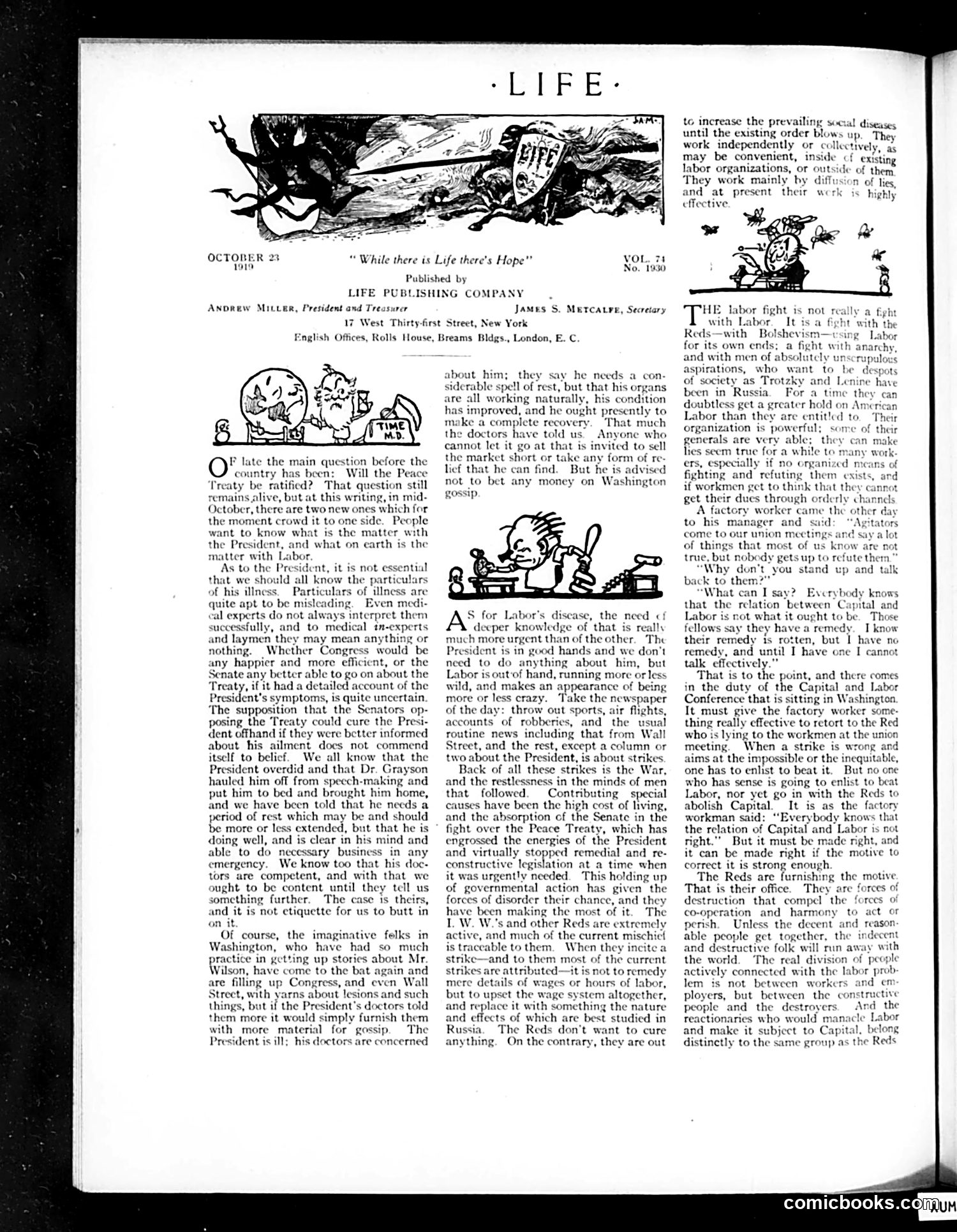
This page addresses two major crises facing America in October 1919: President Wilson's health collapse (he suffered a massive stroke while touring for the League of Nations) and nationwide labor strikes. **On Wilson:** The editor defends the President's privacy, dismissing Washington gossip about his condition. He acknowledges Wilson is ill but argues the public needs no medical details—doctors are competent, recovery is expected. **On Labor:** The article argues labor unrest stems from post-WWI instability, high living costs, and governmental neglect while Congress focused on the Peace Treaty. The cartoons (showing a distressed worker and chaotic scenes) illustrate labor "running wild" and appearing "crazy." The writer criticizes both radical "Reds" seeking to abolish capitalism and capital's failure to address workers' legitimate grievances fairly. The piece warns against dismissing either crisis, calling for serious attention to labor's real problems rather than attributing strikes to Bolshevik conspiracy alone.
📄 Transcribed text from this page (OCR, searchable)
Machine-transcribed from the original scan — historical spelling and the odd misread are preserved.
OCTOBER 23 1919 “ While there is Life there's Hope” VOL. 74 No. 1930 Published by LIFE PUBLISHING COMPANY ANDREW MILLER, President and Treasurer 17 West late the main question before the y has been: Will the Peace ratified? That question still but at this writing, in mid- October, there are two ne ‘s which for the moment crowd it to one side. People int to know what is the matter with > President, and what on earth is the matter with Labor. As to the President, it is not essential that we should all know the particulars of his illness. Particulars of illness a quite apt to be misleading. Even med cal experts do not always interpret them successfully, and to medical in-experts and laymen they may mean anything or nothing. Whether Congress would be any happier and more efficient, or the nate any better able to go on about the Treaty, if it had a detailed account of the Pre ident’s mptoms, is quite uncertain. The supposition that the Senators op- posing the Treaty could cure the Presi- dent offhand if the re better informed about his ailment docs not commend itself to be We all know that the President overdid and that Dr. Grayson hauled him off from specch-making and put him to bed and brought him home, and we have been told that he necds a period of rest which may be and should be more or less extended, but that he is doing well, and is clear in his m able to do necessary business in any emergency. We know too that his doc- tors are competent, and with that we ought to be content until they tell us something further. The case is the’ and it is not etiquette for us to butt in on it Of course, the imaginative felks in Washington, who have had so much practice in getting up stories about Mr. Wilson, have c to the bat again and are filling up Congress, and even Wall Street, with yarns about lesions and such things, but if the President's doctors told them more it would simply furnish them with more material for gossip. The President is ill; his doctors are concerned Treaty be remains ali James S. METcatre, Secretary Thirty-first Street, New York English Offices, Rolls House, Breams Bldgs. + London, E. C about him; . they say he needs a con- siderable pell of rest, but that his organs aturally, his con has improved, and he ought presently to make a complete recovery. That much the doctors have told us) Anyone who cannot let it go at that is invited to sell the market short or take any form of re lief that he can find. But he is advised not to bet any money on Washington gossip. for Labor's discase, the need cf deeper knowledge of that is really much more urgent than of the other. The President is in good hands and we don't need to do anything about him, but Labor is out‘of hand, running more orl wild, and makes an appearance of being more or less crazy. Take the newspaper of the day: throw out sports, air flights, accounts of robberies, and the usual routine news including that from Wall Street, and the rest, except a column or two about the President, is about strikes Back of all these strikes is the War, and the restle in the minds of men that followed. Contributing _ special causes have been the high t of living, and the absorption of the Senate in the fight over the Peace Treaty, which has engrossed the energies of the President and virtually stopped remedial and re- constructive legislation at a time when it was urgently needed. This holding up of governmental action has given the forces of disorder their chance, and they have t making the most of it. The I. W. W.'s and other Reds are extremely ind much of the current mischict ble to them. When the and to them f the current it to remedy mere details of wages or hours of labor, but to upset the wage system altogether, replace it with something the nature and effects of which are best studied in Russia. The Reds don’t want to cure anything. On the contrary, they are out to increase the prevailing socal diseases until the existing order blows up. They work independently or collectively, may be convenient, inside isting labor organizations, ‘or outs: then They work mainly’ by diffusion of and’ at present their” werk HE labor fight is not with Labor. It is a f shevism— Reds—with Bi for its own ends; and with men of at aspirations, who w of society as Trotzky been in Russia. Fi doubtless get a gr Labor than they organization is powerful generals are very able hes seem true for a wh ers, especially if no organized means of fighting and refuting them exi if workmen get to think that th get their dues through ¢ A factory worker came the o to his manager and come to our union mee of things that most of true, but nobody gets up to refute them.” “Why don't you stand t back to them?” What can Isay? E that the relation between Cay Labor is not what it ought to be. . fellows say they have a remedy. I know their remedy is rotten, but 1 have no remedy, and until I have one I cannot talk effectively That is to the point, and there comes in the duty of the Capital and Labor Conference that is sitting in Washington. It must give the factory worker some- thing really effective to retort to the Red who is lying to the workmen at t meeting. When a strike is wror aims at the impossible or the inequitable, one has to enlist to beat it, But no one who has sense is going to enlist to beat Labor, nor yct go in with the Reds to abolish Capital. It is as the factory workman said: “Everybody knows t the relation of Capital and Labor is not right." But it must be de right, and it can be made right if the motive to correct it is strong enough. The Reds are furnishing the mo That is their office. They are fore destruction that compel the forces 0! co-operation and harmony to act or perish. Unless the decent and_ reas able people get together, the and destructive folk will run a the world. The real divisic actively connected with the labor prob: lem is not between workers and en ployers, but between the co struct people and the destroyers reactionaries who would and make it su comicbooks.conit