
Life, 1912-08-15 · page 24 of 40
Life — August 15, 1912 — page 24: what you’re looking at
What you’re looking at
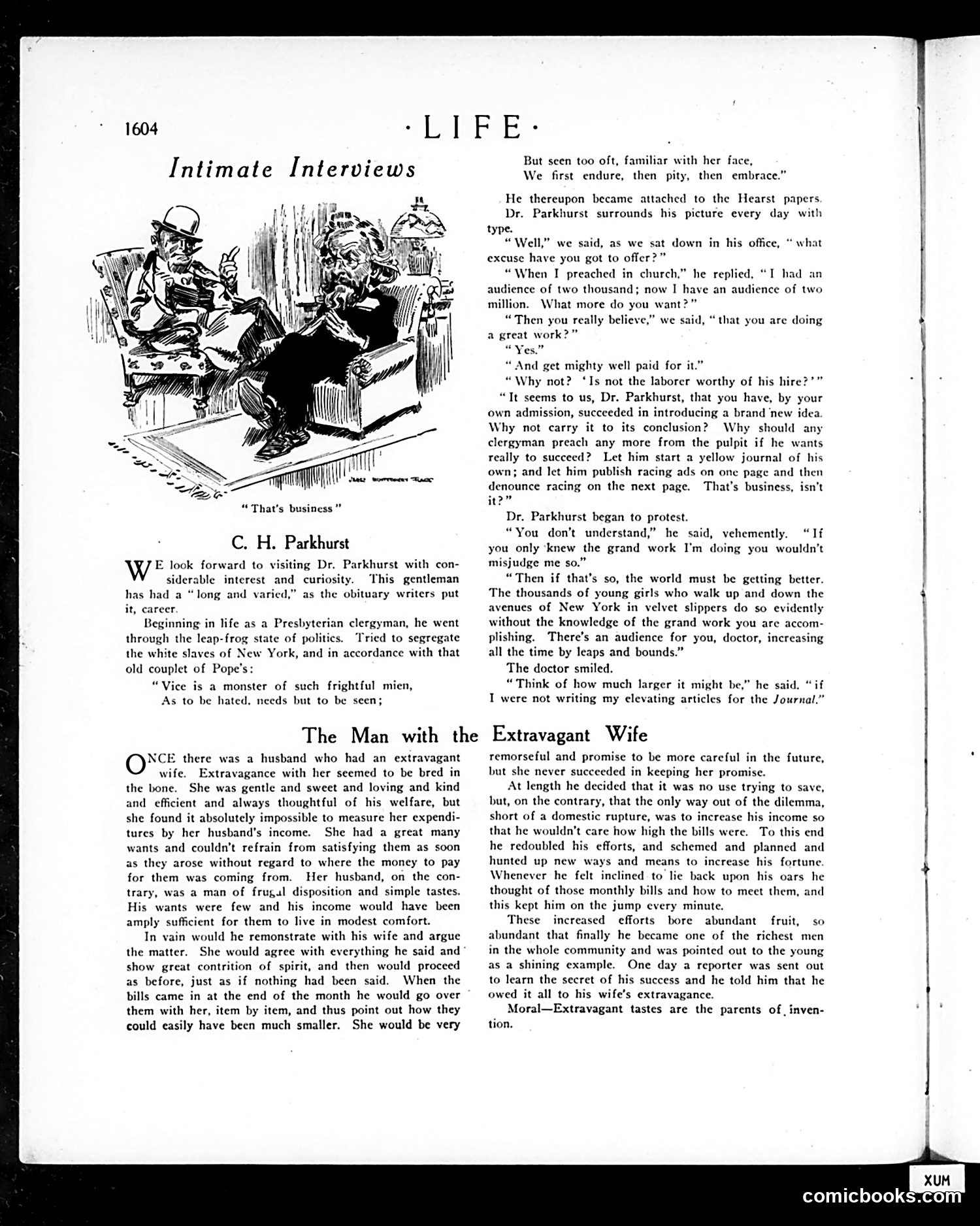
## The Cartoon: "That's Business" The sketch depicts an interview between Life's editor and **Dr. C. H. Parkhurst**, a real Presbyterian minister who became famous in 1890s New York for crusading against vice and corruption. The satire mocks Parkhurst's apparent hypocrisy: he abandoned pulpit preaching (audience: 2,000) for writing sensationalist articles in Hearst's yellow journalism (audience: 2 million), claiming this represents greater moral work. The interviewer sardonically suggests Parkhurst exemplifies modern "business"—that clergymen should start their own scandal sheets, running "racing ads" while denouncing racing. The joke: Parkhurst profits from exactly the vice he claims to oppose, using reform rhetoric to build a media empire. ## "The Man with the Extravagant Wife" A separate morality tale about a husband who abandons financial restraint, instead working to increase income so he can afford his wife's spending. The satire's moral: **extravagant tastes drive ambition**—mirroring Parkhurst's apparent motivation.
📄 Transcribed text from this page (OCR, searchable)
Machine-transcribed from the original scan — historical spelling and the odd misread are preserved.
1604 -LIFE-: Intimate Interviews “That's business” C. H. Parkhurst E look forward to visiting Dr. Parkhurst with con- siderable interest and curiosit: This gentleman has had a “long and varied,” as the obituary writers put it, career. Beginning in life as a Presbyterian clergyman, he went through the leap-frog state of politics. Tried to segregate the white slaves of New York, and in accordance with that old couplet of Pope's: “Vice is a monster of such frightful mien, As to be hated, needs but to be seen; The Man with the O*XC = there was a husband who had an extravagant wife. Extravagance with her seemed to be bred in the bone. She was gentle and sweet and loving and kind and efficient and always thoughtful of his welfare, but she found it absolutely impossible to measure her expendi- tures by her husband's income. She had a great many wants and couldn’t refrain from satisfying them as soon as they arose without regard to where the money to pay for them was coming from. Her husband, on the con- trary, was a man of frugal disposition and simple tastes. His wants were few and his income would have been amply sufficient for them to live in modest comfort. In vain would he remonstrate with his wife and argue the matter. She would agree with everything he said and show great contrition of spirit, and then would proceed as before, just as if nothing had been said. When the bills came in at the end of the month he would go over them with her, item by item, and thus point out how they could easily have been much smaller. She would be very But seen too oft, familiar with her face, We first endure, then pity, then embrace.” He thereupon became attached to the Hearst papers. Dr. Parkhurst surrounds his picture every day with type. “Well,” we said, as we sat down in his office, “ what excuse have you got to offer?” “When I preached in church,” he replied, “I had an audience of two thousand; now I have an audience of two million. What more do you want?” “Then you really believe,” we said, “ that you are doing a great work?” “Yes,” “And get mighty well paid for it.” “Why not? ‘Is not the laborer worthy of his hire?’” “Tt seems to us, Dr. Parkhurst, that you have, by your own admission, succeeded in introducing a brand ‘new idea Why not carry it to its conclusion? Why should any clergyman preach any more from the pulpit if he wants really to succeed? Let him start a yellow journal of his own; and let him publish racing ads on one page and then denounce racing on the next page. That's business, isn’t it?” Dr. Parkhurst began to protest. “You don’t understand,” he said, vehemently. “If you only ‘knew the grand work I'm doing you wouldn't misjudge me so.” “Then if that’s so, the world must be getting better. The thousands of young girls who walk up and down the avenues of New York in velvet slippers do so evidently without the knowledge of the grand work you are accom- plishing. There’s an audience for you, doctor, increasing all the time by leaps and bounds.” The doctor smiled. “Think of how much larger it might be,” he said. “if I were not writing my elevating articles for the Journal.” Extravagant Wife remorseful and promise to be more careful in the future, but she never succeeded in keeping her promise. At length he decided that it was no use trying to save, but, on the contrary, that the only way out of the dilemma, short of a domestic rupture, was to increase his income so that he wouldn't care how high the bills were. To this end he redoubled his efforts, and schemed and planned and hunted up new ways and means to increase his fortune. Whenever he felt inclined to lie back upon his oars he thought of those monthly bills and how to meet them, and this kept him on the jump every minute. These increased efforts bore abundant fruit, so abundant that finally he became one of the richest men in the whole community and was pointed out to the young as a shining example. One day a reporter was sent out to learn the secret of his success and he told him that he owed it all to his wife’s extravagance. Moral—Extravagant tastes are the parents of, inven- tion. comicbook | 1 a s.com