
Life, 1912-08-15 · page 22 of 40
Life — August 15, 1912 — page 22: what you’re looking at
What you’re looking at
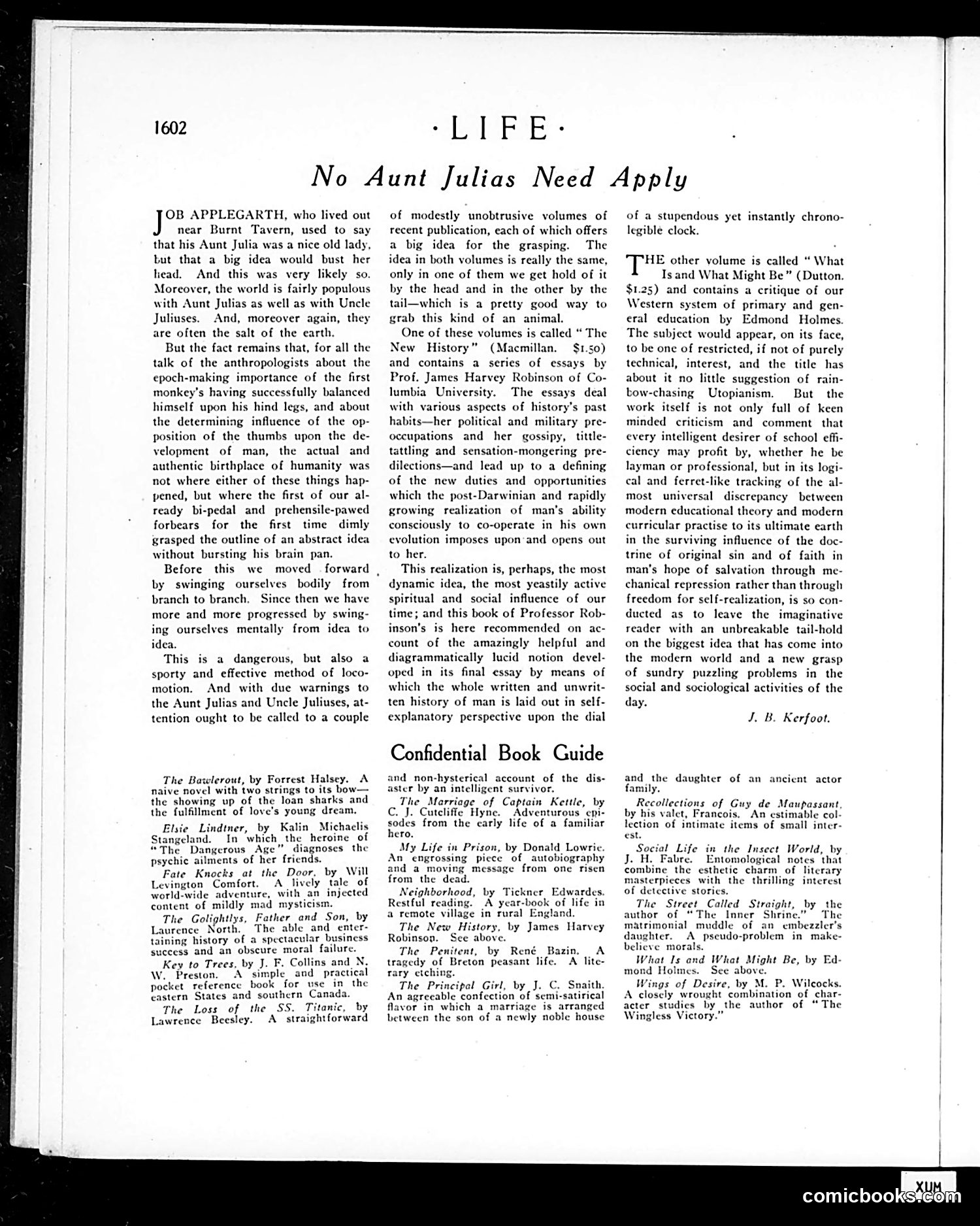
This essay satirizes people resistant to new ideas—the "Aunt Julias" and "Uncle Juliuses" who represent intellectual stagnation despite their virtues ("salt of the earth"). The author argues that humanity's true achievement wasn't biological evolution (upright posture, opposable thumbs) but rather the capacity for abstract thinking—"swinging ourselves mentally from idea to idea." This is presented as risky but necessary progress. The piece then reviews two books presenting "big ideas": James Harvey Robinson's *The New History* is praised for reframing history beyond politics and gossip toward understanding human cooperation and conscious evolution. The essay celebrates this as the era's most vital spiritual influence. The satire targets closed-minded traditionalists who would reject such progressive reinterpretation of history and human potential—they "need not apply" to this modern intellectual movement.
📄 Transcribed text from this page (OCR, searchable)
Machine-transcribed from the original scan — historical spelling and the odd misread are preserved.
sal GRE No Aunt Julias Need Apply OB APPLEGARTH, who lived out near Burnt Tavern, used to say that his Aunt Julia was a nice old lady, but that a big idea would bust her head. And this was very likely so. Moreover, the world is fairly populous with Aunt Julias as well as with Uncle Juliuses. And, moreover again, they are often the salt of the earth. But the fact remains that, for all the talk of the anthropologists about the epoch-making importance of the first monkey’s having successfully balanced himself upon his hind legs, and about the determining influence of the op- position of the thumbs upon the de- velopment of man, the actual and authentic birthplace of humanity was not where either of these things hap- pened, but where the first of our al- ready bi-pedal and prehensile-pawed forbears for the first time dimly grasped the outline of an abstract idea without bursting his brain pan. Before this we moved by swinging ourselves bodily from branch to branch, Since then we have more and more progressed by swing- ing ourselves mentally from idea to idea. This is a dangerous, but also a sporty and effective method of loco- motion. And with due warnings to the Aunt Julias and Uncle Juliuses, at- tention ought to be called to a couple The Bawlerout, by Forrest Halsey. A naive novel with two strings to its bow— the showing up of the loan sharks and the fulfillment of love's young dream, Elsie Lindner, by Kalin Michaelis Stangeland. In ‘which the heroine of “The Dangerous Age” psychic ailments of her friends. Fate Knocks at the Door, by Will Levington Comfort. A lively tale of world-wide adventure, with an injected content of mildly mad mysticism. The Golightlys, Father and Son, by Laurence North.” The able and enter- taining history of a spectacular business success and an obscure moral failur Key to Trees, by J. F. Collins and N. W. Preston. A simple. and_ practical pocket reference book for use in the castern States and southern Canada. The Loss of the SS. Titanic, by Lawrence Beesley. A straightforward forward , of modestly unobtrusive volumes of recent publication, each of which offers a big idea for the grasping. The idea in both volumes is really the same, only in one of them we get hold of it by the head and in the other by the tail—which is a pretty good way to grab this kind of an animal. One of these volumes is called “ The New History” (Macmillan. $1.50) and contains a series of essays by Prof. James Harvey Robinson of Co- lumbia University. The essays deal with various aspects of history's past habits—her political and military pre- occupations and her gossipy, tittle- tattling and sensation-mongering pre- dilections—and lead up to a defining of the new duties and opportunities which the post-Darwinian and rapidly growing realization of man’s ability consciously to co-operate in his own evolution imposes upon:and opens out to her. This realization is, perhaps, the most dynamic idea, the most yeastily active spiritual and social influence of our time; and this book of Professor Rob- inson’s is here recommended on ac- count of the amazingly helpful and diagrammatically lucid notion devel- oped in its final essay by means of which the whole written and unwrit- ten history of man is laid out in self- explanatory perspective upon the dial Confidential Book Guide and non-hysterical account of the dis- aster by an intelligent survivor. The Marriage of Captain Kettle, by C. J. Cutcliffe Hyne. Adventurous ‘epi- sodes from the carly life of a familiar hero. My Life in Prison, by Donald Lowrie. An ‘engrossing piece of autobiography and a moving message from one risen from the dead. Neighborhood, by Tickner Edwardes. Restful reading.” A year-book of life in a remote village in rural England. The New History, by James Harvey Robinson. See above. The Penitent, by René Bazin. A tragedy of Breton peasant life. A lite- rary ciching. The Principal Girl, by J. C. Snaith An agreeable confection of semi-satirical flavor in which a marriage is arranged between the son of a newly noble house of a stupendous yet instantly chrono- legible clock. 'HE other volume is called “ What Is and What Might Be” (Dutton. $1.25) and contains a critique of our Western system of primary and gen- eral education by Edmond Holmes. The subject would appear, on its face, to be one of restricted, if not of purely technical, interest, and the title has about it no little suggestion of rain- bow-chasing Utopianism. But the work itself is not only full of keen minded criticism and comment that every intelligent desirer of school effi- ciency may profit by, whether he be layman or professional, but in its logi- cal and ferret-like tracking of the al- most universal discrepancy between modern educational theory and modern curricular practise to its ultimate earth in the surviving influence of the doc- trine of original sin and of faith in man's hope of salvation through me- chanical repression rather than through freedom for self-realization, is so con- ducted as to leave the imaginative reader with an unbreakable tail-hold on the biggest idea that has come into the modern world and a new grasp of sundry puzzling problems in the social and sociological activities of the day. J. B. Kerfoot. and the daughter of an ancient actor family. Recollections of Guy de Maupassant by his valet, Francois. An estimable col- lection of intimate items of small inter- est. Social Life in the Insect World, by J.H. Fabre. Entomological notes tha combine the esthetic charm of literary masterpieces with the thrilling interest of detective stories. The Street Called author of “The Inner Shrine.” matrimonial muddle of an embezzler’ daughter. A pseudo-problem in make- believe morals. What Is and What Might Be, by Ed- mond Holmes. See above. Wings of Desire, by M. P. Wilcocks. A closely wrought combination of char- acter studies by the author of “The Wingless Victory.” raight, by the comicboolit cu 2