
Life, 1912-08-15 · page 18 of 40
Life — August 15, 1912 — page 18: what you’re looking at
What you’re looking at
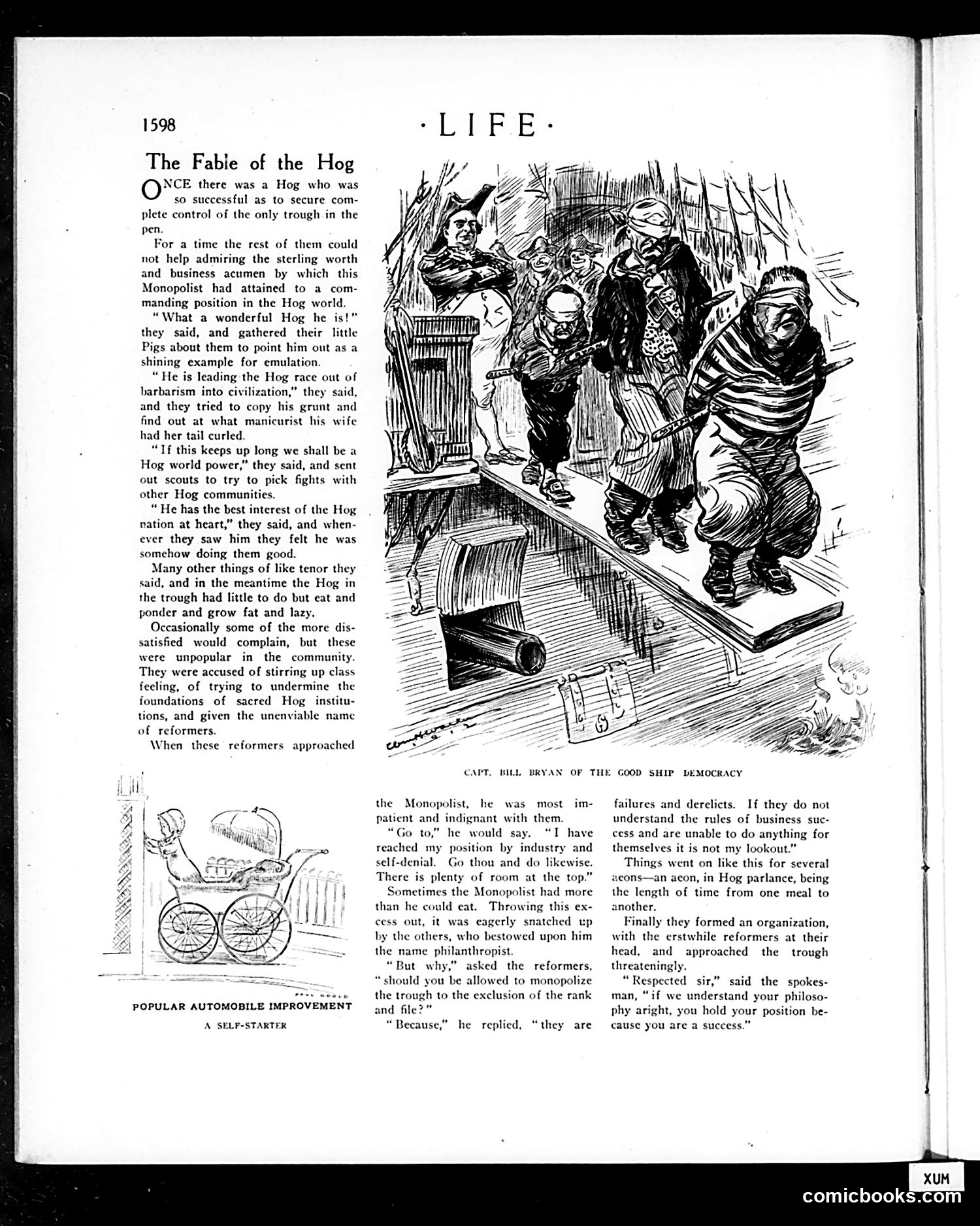
This is a Gilded Age political allegory attacking unchecked monopolies and wealth concentration. The "Hog" represents a wealthy industrialist (likely a robber baron) who controls the "trough"—the economy's resources. The satire mocks: - **Public admiration** of the monopolist as a civilization-builder, despite his self-serving control - **His justifications**: claiming success proves merit, dismissing the poor as "failures and derelicts" - **Co-opted philanthropy**: his table scraps rebranded as generosity - **Suppression of dissent**: reformers labeled troublemakers for questioning the system The cartoon at bottom references "Capt. Bill Bryan of the Good Ship Democracy"—likely William Jennings Bryan, who championed anti-monopoly positions. The reformers finally organize to confront the monopolist, threatening his unchallenged power. The fable advocates for collective action against concentrated economic control.
📄 Transcribed text from this page (OCR, searchable)
Machine-transcribed from the original scan — historical spelling and the odd misread are preserved.
1598 The Fable of the Hog NCE there was a Hog who was so successful as to secure com- plete control of the only trough in the pen. For a time the rest of them could not help admiring the sterling worth and business acumen by which this Monopolist had attained to a com- manding position in the Hog world. “What a wonderful Hog he is!” they said, and gathered their little Pigs about them to point him out as a shining example for emulation. “He is leading the Hog race out of barbarism into civilization,” they said, and they tried to copy his grunt and find out at what manicurist his wife had her tail curled. “Tf this keeps up long we shall be a Hog world power,” they said, and sent out scouts to try to pick fights with other Hog communities. “He has the best interest of the Hog nation at heart,” they said, and when- ever they saw him they felt he was somehow doing them good. Many other things of like tenor they said, and in the meantime the Hog in the trough had little to do but eat and ponder and grow fat and lazy. Occasionally some of the more dis- satisfied would complain, but these were unpopular in the community. They were accused of stirring up class feeling, of trying to undermine the foundations of sacred Hog institu- tions, and given the unenviable name of reformers, When these reformers approached — ‘e a POPULAR AUTOMOBILE IMPROVEMENT A SELF-STARTER CAPT, the Monopolist, he was most im- patient and indignant with them. “Go to,” he would say. “I have reached my position by industry and self-denial. Go thou and do likewii There is plenty of room at the to Sometimes the Monopolist had more than he could eat. Throwing this ex- cess out, it was eagerly snatched up by the others, who bestowed upon him the name philanthropist. “But why,” asked the reformers, “ should you be allowed to monopolize the trough to the exclusion of the rank and file?” “ Because,” * he replied, “they are WILL BRYAN OF THE GOOD SHIP DEMOCRACY failures and derelicts. If they do not understand the rules of business suc- cess and are unable to do anything for themselves it is not my lookout.” Things went on like this for several aeons—an acon, in Hog parlance, being the length of time from one meal to another. Finally they formed an organization, with the erstwhile reformers at their head, and approached the trough threateningly. “Respected sir,” said the spokes- man, “if we understand your philoso- phy aright, you hold your position be- cause you are a success.” comicbooks.com