
Life, 1908-10-22 · page 9 of 24
Life — October 22, 1908 — page 9: what you’re looking at
What you’re looking at
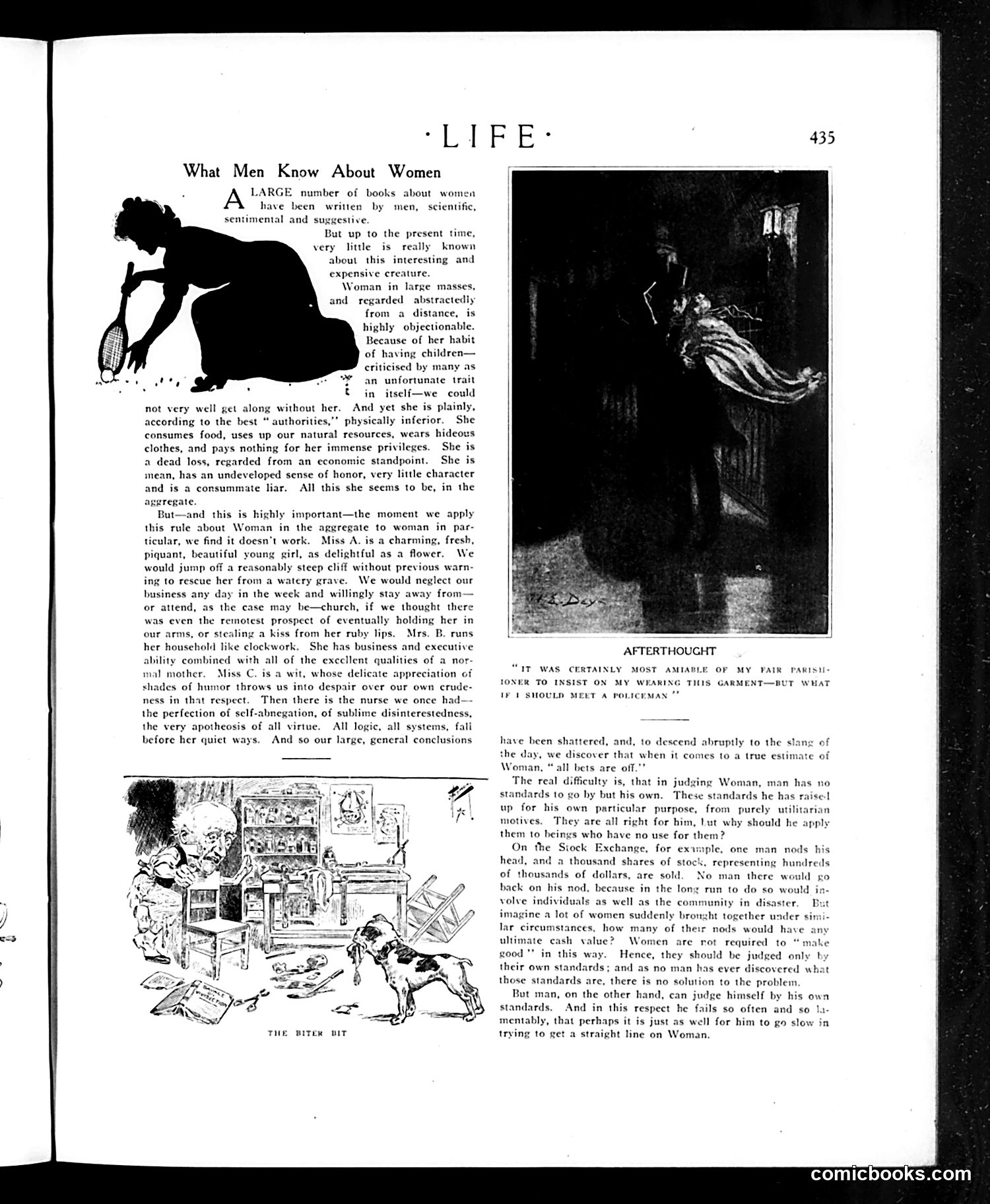
This satirical article mocks men's presumed expertise about women while actually exposing male ignorance and hypocrisy. The opening illustration shows a silhouetted woman in an athletic pose (tennis racket visible), challenging the article's claim that women are physically inferior and economically unproductive. The text ironically catalogs male complaints: women consume resources, wear expensive clothes, have children, lack honor and character—yet contradicts itself by praising individual women (Miss A, Mrs. B) as charming, capable managers and devoted nurses. "The Biter Bit" cartoon depicts domestic chaos—a messy home with a dog—illustrating the gap between male theory and reality. The "Afterthought" section concludes that men lack consistent standards for judging women, suggesting male judgment itself is unreliable. The satire's point: men confidently generalize about women while revealing their own confused and contradictory thinking.
📄 Transcribed text from this page (OCR, searchable)
Machine-transcribed from the original scan — historical spelling and the odd misread are preserved.
“LIFE: What Men Know About Women LARGE number of books about wome have been written by men, scientific, sentimental and suggestive. But up to the present time, very little is really known about this interesting and expensive creature. Woman in large masses, and regarded abstractedly from a distance, is highly objectionable. Because of her habit of having children— criticised by man; ¥ an unfortunate trait t in itseli—we could not very well get along without her. And yet she is plainly, according to the best “authorities,” physically inferior. She consumes food, uses up our natural resources, wears hideous clothes, and pays nothing for her immense privileges. She is a dead loss, regarded from an economic standpoint. She is mean, has an undeveloped sense of honor, very little character and is a consummate liar. All this she seems to be, in the aggregate. But—and this is highly important—the moment we apply this rule about Woman in the aggregate to woman in par- ticular, we find it doesn’t work. Miss A. is a charming, fresh, piquant, beautiful young girl, as delightful as a flower. We would jump off a reasonably steep cliff without previous warn- ing to rescue her from a watery grave. We would neglect our business any day in the week and willingly stay away from— or attend, as the case may be—church, if we thought there was even the remotest prospect of eventually holding her in our arms, or stealing a kiss from her ruby lips. Mrs. B. runs her household like clockwork. She has business and executive apreeruoucer ability combined with all of the excellent qualities of a nor- mal mother. Miss C. is a wit, whose delicate appreciation of shades of humor throws us into despair over our own crude- ness in that respect. Then there is the nurse we once had “IT WAS CERTAINLY MOST AMIADLE OF MY PAIR: PARIS 1ONER TO INSIST ON MY WEARING THIS GARMENT—BUT WHAT IP 1 SMOULD MEET A POLICEMAN the perfection of sclf-abnegation, of sublime disinterestedness, the very apotheosis of all virtue. All logic, all systems, fall _ before her quiet ways. And so our large, general conclusions have been shattered, and, to descend abruptly to the slanz of the day, we discover that when it comes to a true estimate of Woman, “all bets are off." The real difficulty is, that in judging Woman, man has no standards to go by but his own. These standards he has raise! up for his own particular purpose, from purely utilitarian motives. They are all right for him, Lut why should he apply them to beings who have no use for them? On the Siock Exchange, for example, one man nods his head, and a thousand shares of stock, representing hundreds of thousands of dollars, are sold. No man there would go back on his nod, because in the long run to do so would volve individuals as well as the community in disaster. But imagine a lot of women suddenly brought together under sir lar circumstances, how many of their nods would have any ultimate cash value? Women are rot required to “make good" in this way. Hence, they should be judged only by their own standards; and as no man ever discovered what those standards are, there is no solution to the problem. But man, on the other hand, can judge himself by his own standards. And in this respect he fails so often and so nentably, that perhaps it is just as well for him to go slow in TNE RITER DIT trying 10 get a straight line on Woman. comicbooks.com