
Life, 1908-10-22 · page 6 of 24
Life — October 22, 1908 — page 6: what you’re looking at
What you’re looking at
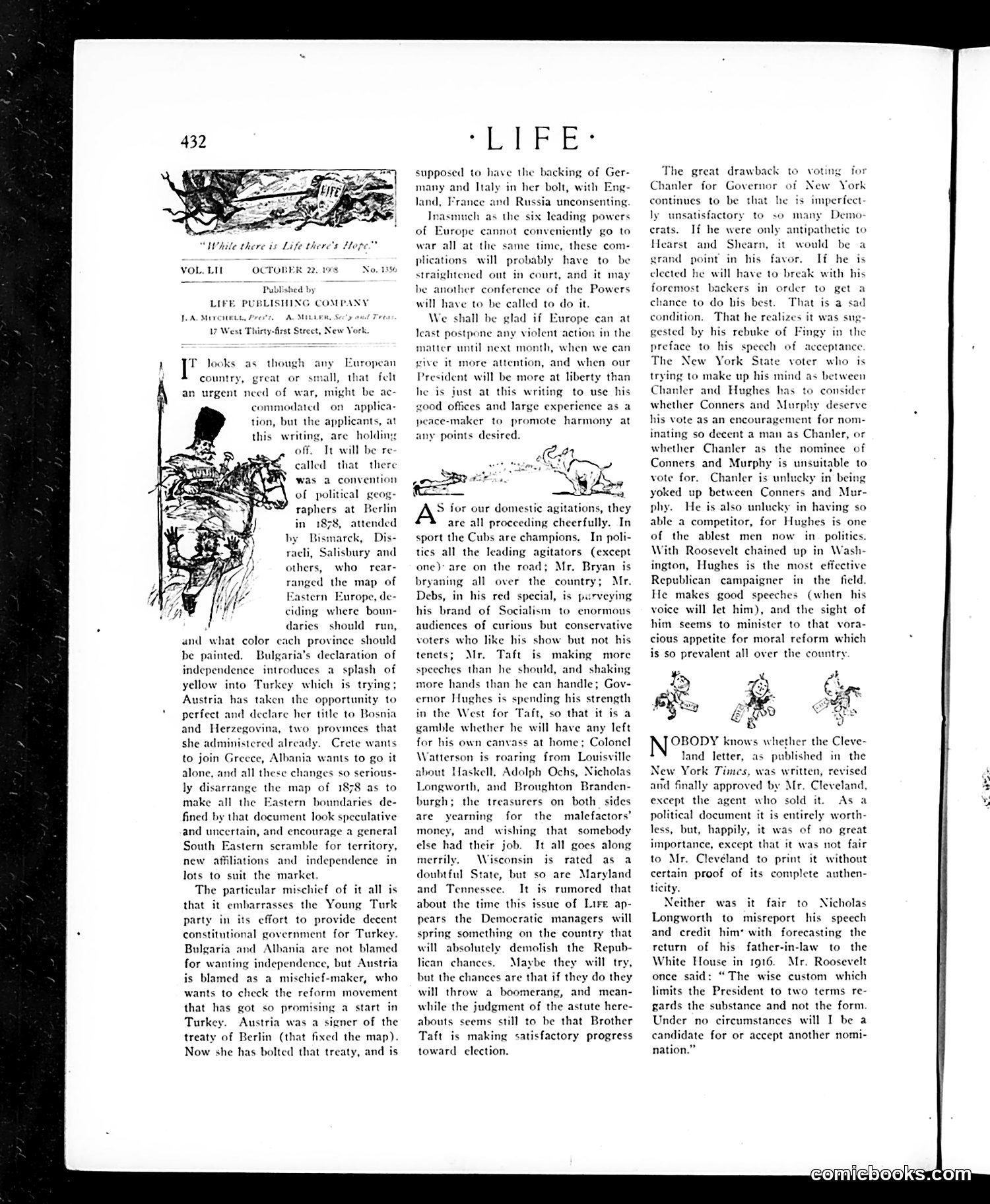
The page contains editorial commentary on European politics and American domestic affairs during the 1928 election season. The illustrated figure on the left appears to be a caricatured European political leader, likely commenting on the complex diplomatic situation following World War I. The text references conferences among European powers and discusses territorial disputes, particularly involving Turkey, Bulgaria, Austria, and the Balkans. The domestic section criticizes various political figures including William Jennings Bryan, Eugene Debs, William Howard Taft, and Governor Hughes, mocking their campaign activities. It also discusses the presidential candidacy of someone named Chandler, questioning his viability as a candidate. The tone is satirical and dismissive toward both European complications and American political leadership of the period.
📄 Transcribed text from this page (OCR, searchable)
Machine-transcribed from the original scan — historical spelling and the odd misread are preserved.
“While there i OCTOBER 22, 178 Life there's H VOL. LIL Published by LIFE PUBLISHING COMPANY JA MITCHELL Prete, 17 West Thirty-first Street, New York. AL Mine, See'y [* looks as though any European country, great or small, that felt an urgent need of war, might be a comm applica- tion, but the applicants, this writing, are holdiy off. It will be re called that there was a convention of political geog- raphers at Berlin in 1878, attended hy Bismarck, Dis- racli, Salisbury and others, who rear- ranged the map of Eastern Europe, de- ciding where boun- daries should run, what color cach province should be painted. Bulgaria’s declaration of independence introduces a splash of yellow into Turkey which is trying; Austria has taken the opportunity to perfect and declare her title to Bosnia and Herzegovina, two provinces that she administered alr . Crete wants to join Greece, Albania wants to go it alone, and all these changes so serious- ly disarrange the map of 1878 as to make all the Eastern boundaries de- fined by that document look speculative and uncertain, and encourage a general South Eastern scramble for territory, new affiliations and independence in lots to suit the market. The particular mischief of it all is that it embarrasses the Young Turk party in its effort to provide decent constitutional government for Turkey. Bulgaria and Albania are not blamed for wanting independence, but Austria is blamed as a mischief-maker, who wants to check the reform movement that has got so promising a start in Turkey. Austria was a signer of the treaty of Berlin (that fixed the map). Now she has bolted that treaty, and is nied on and “Lil+'e * supposed to have the backing of Ger- many and Italy in her bolt, with Eng- land, France and Russia unconsenting. Inasmuch as the six leading powers of Europe cannot conveniently go to war all at the same time, these com- plications will probably have to be straightened out in court, and it may be another conference of the Powers will have to be called to do it. We shall be glad Zurope can at least postpone any violent action in the matter until next month, when we can give it more attention, and when our President will be more at liberty than he is just at this writing to use his ood offices and large experience as a peace-maker to promote harmony at any points desired. (a SU AU ad N32 ad <4. S for our domestic agitations, they are all proceeding cheerfully. In sport the Cubs are champions. In poli- tics all the leading agitators (except one) are on the road; Mr. Bryan is bryaning all over the country; Mr. Debs, in his red special, is purveying his brand of Socialism to enormous audiences of curious but conservative voters who like his show but not his tenets; Mr. Taft is making more speeches than he should, and shaking more hands than he can dle; Gov- crnor Hughes is spending his strength in the West for Taft, so that it is a gamble whether he will have any left for his own canvass at home; Colonel Watterson is roaring from Louisville about Haskell, Adolph Ochs, Nicholas Longworth, and Broughton Branden- burgh; the treasurers on both sides are yearning for the malefactors’ money, and wishing that somebody else had their job. It all goes along merrily. Wisconsin is rated as a doubtful State, but so are Maryland and Tennessee. It is rumored that about the time this issue of Lire ap- pears the Democratic managers will spring something on the country that will absolutely demolish the Repub- lican chances. Maybe they will try, but the chances are that if they do they will throw a boomerang, and mean- while the judgment of the astute here- abouts seems still to be that Brother Taft is making satisfactory progress toward election. Phe great drawback to voting for Chanler for Governor of New York continues to be that he is imperfect ly uns. Demo: crats, Hearst sfactory many If he were only antipathetic to and Shearn, it would be a grand point in his favor. If he is elected he will have to break with his foremost backers in chance to do his best condition. to x order to get a That is a sad That he realizes it was s gested by his rebuke of Fingy in the preface to his specch of acceptance The New York State voter trying to make up his mind as between Chanter and Hughes has to consider whether Conners and Murphy deserve who is his vote as an encouragement for nom- inating so decent a man as Chanler, or whether Chanler as the nominee of Conners and Murphy is unsuitable to vote for. Chanler is unlucky in being yoked up between Conners and Mur- phy. He is also unlucky in having so able a competitor, for Hughes is one of the ablest men in. polities. With Roosevelt chained up in Wash- ington, Hughes is the most effective Republican campaigner in the field. He makes good speeches (when his voice will let him), and the sight of him seems to minister to that vora- cious appetite for moral reform which is so prevalent all over the country. % now t i at OBODY knows whether the Cleve- land letter, as published in the New York Times, was written, revised ard finally approved by Mr. Cleveland, except the agent who sold it. As a political document it is entirely worth- less, but, happily, it was of no great importance, except that it was not fair to Mr. Clevéland to print it without certain proof of its complete authen- ticity. Neither was it fair to Nicholas Longworth to misreport his speech and credit him‘ with forecasting the return of his father-in-law to the White House in 1916. Mr. Roosevelt once said: “The wise custom which limits the President to two terms re- gards the substance and not the form Under no circumstances will I be a candidate for or accept another nomi- nation.”