
Life, 1905-09-21 · page 6 of 26
Life — September 21, 1905 — page 6: what you’re looking at
What you’re looking at
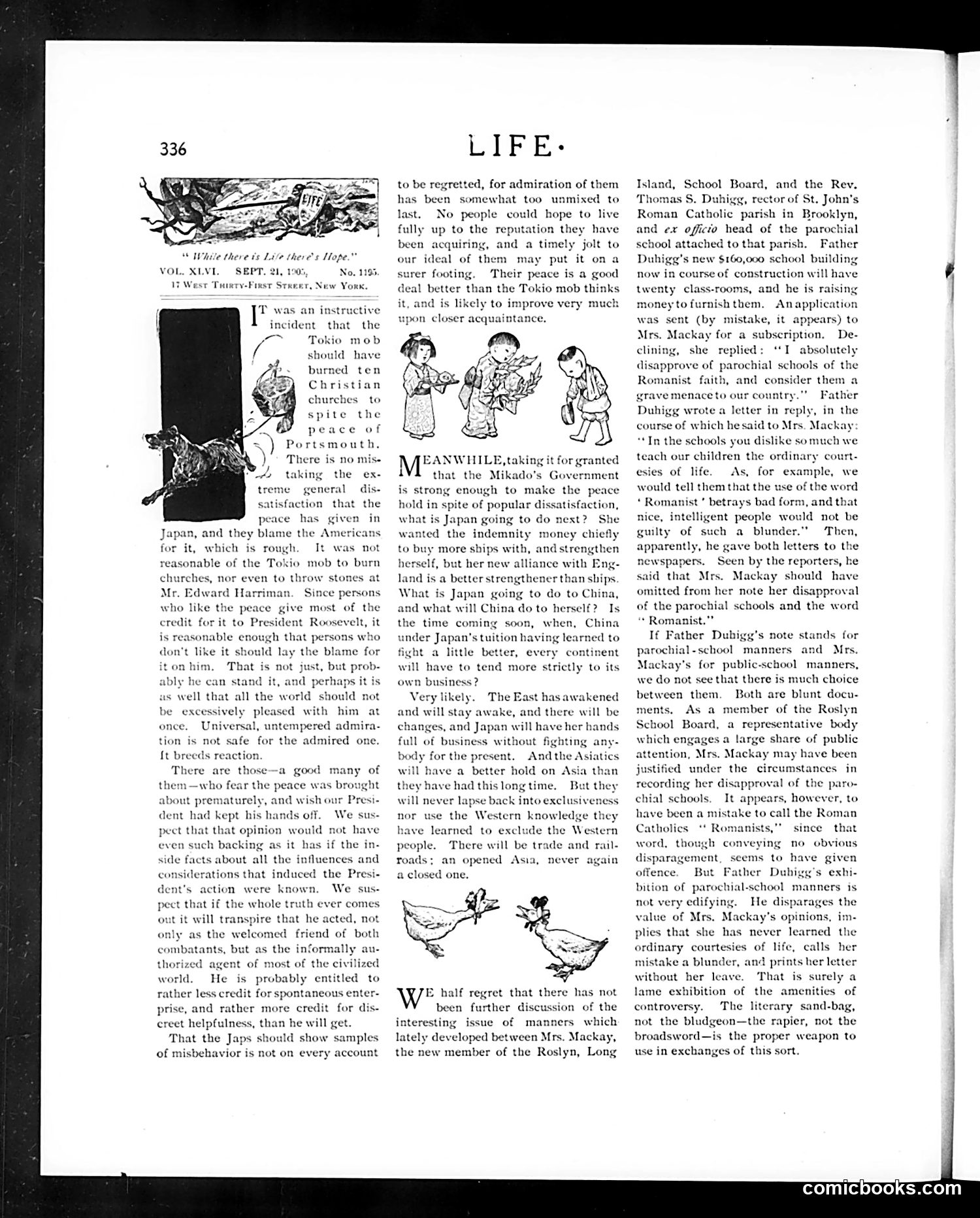
This page critiques Japan's post-war conduct and American foreign policy naïveté. The text discusses the Tokio (Tokyo) mob burning churches and whether Americans should blame Japan's government or hold President Roosevelt responsible for trusting Japanese peace intentions. The small cartoon illustrations (children and birds) appear decorative rather than substantive commentary. The main argument satirizes American optimism about Japan's reliability as a peaceful ally. The author suggests Roosevelt was too credulous in accepting Japanese assurances, and that Japan will inevitably pursue expansionist policies in Asia regardless of treaties. The piece implies Japan's current peaceful posturing masks deeper imperial ambitions—a prescient concern given Japan's later militarism in the 1930s-40s.
📄 Transcribed text from this page (OCR, searchable)
Machine-transcribed from the original scan — historical spelling and the odd misread are preserved.
“While there ts Lilet 17 West Tatery-Fiest Steeer, New Yore. Christian spite the Portsmouth, There is no mis- Japan, and they blame the Ame for it, which is rough sonable of the Tokio mob to burn churches, nor even to throw stones at Since persons most of the who like the peace give credit for it to President sonable enough tha don’t like it should lay th That is not ji st, but prob- us well that all the world should r ely pleased w tion is not safe for the a It breeds reaction. n—who fear the peace was br about prematurely, and wish our Presi- dent had kept his hands off. pect that that opinion would not have even such backing as it has if the in- ‘acts about all the influences and considerations that induced the Presi- were known, uth ever comes dent's action pect that if the whole it will transpire that he acted, not as the welcomed friend of both the informally ost of the civ He is probably entitled to pontaneous en! combatants, but rather less credit for prise, and rather more credit for dis- creet helpfulness, than he will get. That the Japs should show samples of misbehavior is not on ew ery account LIF Es to be regretted, for admiration of them has been mewhat too unmixed to last. No people could hope to live fully up to the reputation they have been acquiring, and a timely jolt to lof them may put it on a surer footing. ‘Their peace is a good deal better than the Tokio mob thinks it, and is likely to improve very muck our ide ANWHILE, taking it for granted that the Mikado's Government is strong enough to make the + hold in spite of popular dissatisfaction, what is Japan going to do anted the indemni: to buy more ships with, and strengthen herself, but her new alliance with Eng- land is a better strengthener than ships. at is Japan going to do to China, and what will China do to herself? Is the time coming soon, when, China der Japan's tuition having learned to continent will have to tend more strictly to its own busines: The East has awakened y awake, and there will be ands and will sta changes, and Japan will have her full of business without fighting body for the present. And the A will have a better hold on Asia than they have had this longtime. But they will never lapse back into exclusiveness nor use the Western knowle y nave learned to exclude the Western people. There will be trade and rail- roads; an opened Asia, never again a closed one, half regret that there has not been further discussion of the interesting issue of manners which lately developed between Mrs. Mackay, the new member of the Roslyn, Long Island, School Board, and the Rev. Thomas §. Duhigg, rector of St. John's Roman Catholic ish in Brook’ and ex officio head of the parochial school attached to that parish, Father Duhigg’s new $160,000 school building eof construction will have now in cours money to furnish them. ation ‘as sent (by mistake, it ATS) to Mrs, Mackay for a subscription, De- clining, she replied: “I absolutely disapprove of parochial schools of the Romanist faith, and consider them a grave menace to our country." Father Duhigg wrote a letter in reply, in the course of which he said to Mrs. Mac “In the schools you dislike somuch we t e Anappli ch our children the ordinary cou of life. would tell themt * Romanist ’ betra: s, for e the use of the word bad form, and that nice, intelligent people would not be guilty of such a blunder." Then, apparently, he gave both letters to newspape! Seen by the reporter: said that Mrs. Mackay should have omitted from her note her disappro of the parochial schools and the word * Romanist. If Father Dubigg’s note stands for parochial-school manners and Mrs. ckay’s for public-school m we do not see that there is much choic between them. Both are blunt docu- ments, As a member of the Roslyn School Board, a representative body which engagt ge share of public attention, Mrs. Mackay may have been ied under the circumstances in recording her disapproval of the paro- chial schools. It appears, however, to have been a mistake to call the Roman Catholics ‘t Romanists,"" since that thot obvious disparagement, s offence. But F: bition of parochis 'y edifying. lue of Mrs. Mackay’s opinions, plies that she never learned the ordinary courtesies of life, calls her mistake a blunder, and prints her lette without her le That is surely a lame exhibition of the amenities of controversy. The literary sand-bag, not the bludgeon—the rapier, not the broadsword—is the proper weapon to use in excha mple, we justi word, eying no ms to have given her Dubigg’s exhi- nners is L-school ms He disparages the im- not ve v nges of this sort. comicbooks.com