
Life, 1905-09-21 · page 14 of 26
Life — September 21, 1905 — page 14: what you’re looking at
What you’re looking at
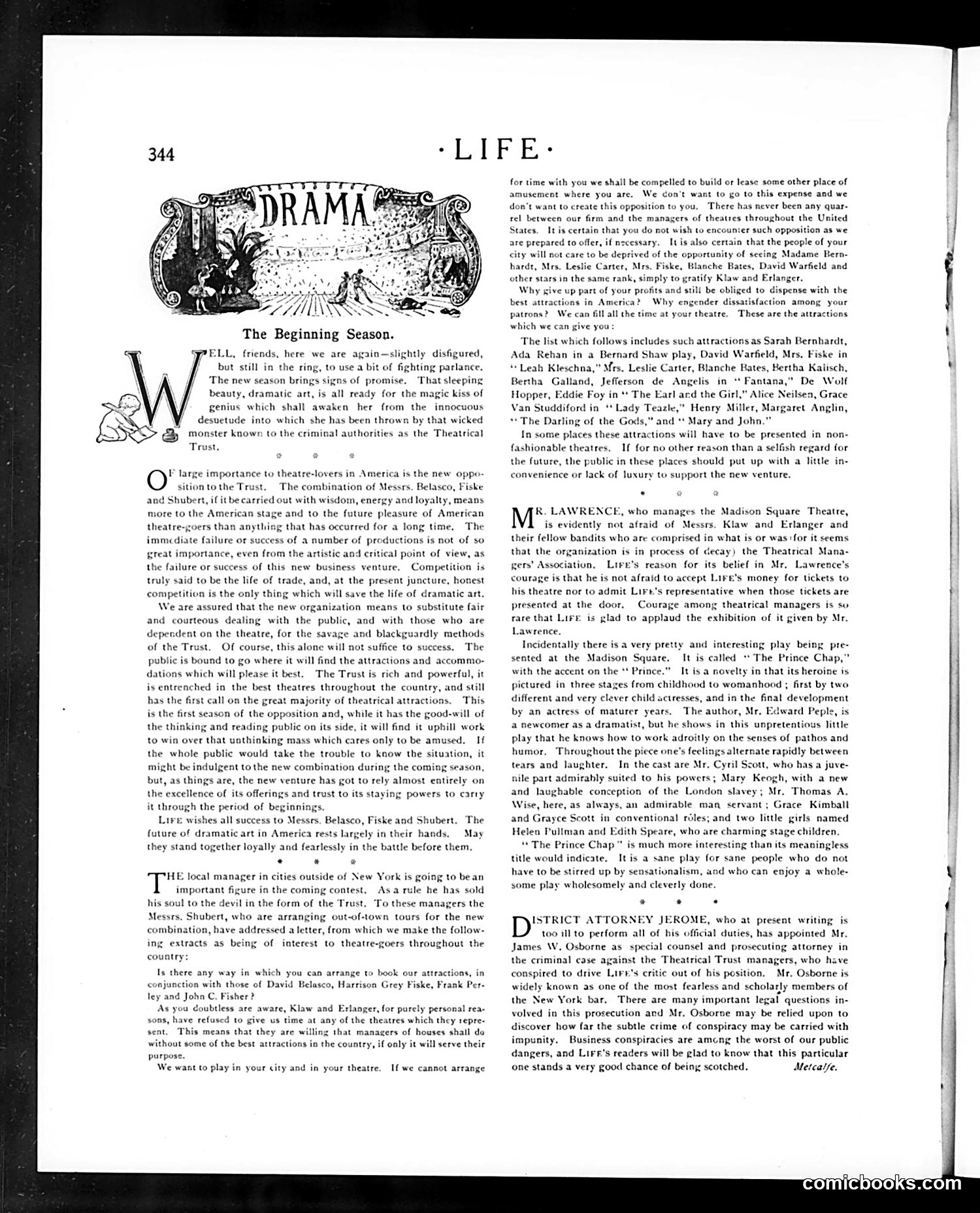
This 1900s *Life* editorial addresses the **Theatrical Trust**, a monopoly controlling American theater distribution. The "wicked monster" referenced is the Trust's stranglehold on venues and productions. **The Opposition**: Belasco, Fiske, and Shubert (prominent theater producers) are forming a competing organization to break the Trust's power. *Life* frames this as a crucial moment for American theater's future. **The Satire**: The editorial mocks the Trust's ruthless tactics—particularly their refusal to give stage time to rival producers' shows, forcing competitors to build their own theaters. The letter excerpt shows how the new combination pressures local managers: support us or we'll construct competing venues in your city. **Key Point**: This represents an early **antitrust battle**. *Life* champions competition as essential to dramatic art's health, opposing the monopoly's "savage and blackguardly methods" that prioritize profit over public access to quality entertainment. The piece advocates for artistic merit over corporate control—a Progressive Era concern about big business consolidation.
📄 Transcribed text from this page (OCR, searchable)
Machine-transcribed from the original scan — historical spelling and the odd misread are preserved.
The Beginning Season. ELL, friends, here we are again—slightly disfigured, but still in the ring, to use a bit of fighting parlance, ‘The new season brings signs of promise, That sleeping beauty, dramatic art, is all ready for the magic kiss of genius which shall awaken her from the innocuous desuetude into which she has been thrown by that wicked the Theatrical monster known to the criminal authorities Trust. O' large importance to theatre-lovers in America is the new oppo- sition tothe Trust. The combination of Messrs. Belasco, Fiske and Shubert, if it be carried out with wisdom, energy and loyalty, means nore to the American stage and to the future pleasure of American theatre. that has occurred for a long time, The immcdiate failure of success of a number of productions is not of so rs than anyth great importance, even from the artistic and critical point of view, as the failure or success of this new business venture. Competition is truly said to be the life of trade, and, at the present juncture, honest competition is the only thing which will save the life of dramatic art. We are assured that the new organization means to substitute fair and courteous dealing with the public, and with those who are ependent on the theatre, for the savage and blackguardly methods of the T public is bound to go where it will find the attractions and accommo- dations which will please it best. The Trust is rich and powerful, it is entrenched in the best theatres throughout the country, and still ns. This t. Of course, this alone will not suffice to success, The has the first call on the great majority of theatrical attracti is the first season of the opposition and, while it has the good-will of the thinking and reading public on its side, it will find it uphill work to win over that unthinking mass which cares only to be amused. If the whole public would take the trouble to know the situation, it might be indulgent to the new combination durin but, as things are, the new venture has got to rely almost entirely on the excellence of its offerings and trust to its staying powers to carry it through the period of beginnings. Lire wishes all success to Messrs, Belasco, Fiske and Shubert, The future of dramatic art in America rests largely in their hands, May they stand together loyally and fearlessly in the battle before them. the coming season, . * * HE local manager in cities outside of New York is going to bean important figure in the coming contest. Asa rule he has sold his soul to the devil in the form of the Trust, ‘To these managers the Messrs. Shubert, who are arranging out-of-town tours for the new combination, have addressed a letter, from which we make the follow- ff of interest to theatre-goers throughout the ing extracts as be country: in which you can arrange to book our attractions, in ison Grey Fiske, Frank Per- Is there any wa conjunction with those of David Belasco, Ha ley and John C. Fisher? As you doubtless are aware, Klaw and Erlanger, for purely personal rea- sons, have refused to give us time at any of the theatres which they repre- sent. This means that they are willing that managers of houses shall d without some of the best attractions in the country, if only it will serve their We want to play in your city and in your theatre. If we cannot arrange LIP E- for time with you we shall be compelled to build or lease some other place of amusement where you are, We con't want to go to this expense and we don’t want to create this opposition to you. ‘There has never been any quar- rel between our firm and the managers of theatres throughout the United States, It is certain that you do not wish to encounter such opposition as we are prepared to offer, if necessary. It is also certain that the people of your city will not care to be deprived of the opportunity of seeing Madame Bern- hardt, Mrs. Leslie Carter, Mrs. Fiske, Blanche Bates, David Warfield and ts in the same rank, simply to gratify Klaw and Erlanger. Why give up part of your profits and stil! be obliged to dispense with the best attractions in America? Why engender dissatisfaction among your > We can fill all the time at your theatre. These are the attractions patrons which we can give you: The list which follows includes such attractions as Sarah Bernhardt, Ada Rehan in a Bernard Shaw play, David Warfield, Mrs, Fiske in ‘Leah Kleschna,” Mrs, Leslie Carter, Blanche Bates, Bertha Kalisch, Bertha Galland, Jefferson de Angelis in * Fantana,” De Wolf Hopper, Eddie Foy in ** The Earl ard the Girl,” Alice Neilsen, Grace Van Studdiford in ‘ Lady Teazle,” Henry Miller, Margaret Anglin, * The Darling of the Gods,” and * Mary and John.” In some places these attractions will have to be presented in non- fashionable theatres, If for no other reason than a selfish regard for the future, the convenience or lack of luxury to support the new venture. bblic in these places should put up with a little in- M LAWRENCE, who manages the Madison Square Theatre, is evidently not afraid of Messrs. Klaw and Erlanger and their fellow bandits who are comprised in what is or was for it seems that the organization is in process of decay) the Theatrical Mana- gers’ Association, Lire’s reason for its belief in Mr, Lawrence's courage is that he is not afraid to accept Lire’s money for tickets to his theatre nor to admit Lire’s representative when those tickets are presented at the door, Courage among theatrical managers is su rare that Lie is glad to applaud the exhibition of it given by Mr. Lawrence. Incidentally there is a very pretty and interesting play being pre- sented at the Madison Square, It is called * The Prince Chap,” with the accent on the ** Prince.” It is a novelty in that its heroine is pictured in three stazes from childhood to womanhood ; first by two different and very clever child actresses, and in the final development by an actress of maturer years, The author, Mr. Edward Peple, is ‘a newcomer asa dramatist, but he shows in this unpretentious little play that he knows how to work adroitly on the senses of pathos and humor. Throughout the piece one’s feelings alternate rapidly between tears and laughter, In the cast are Mr. Cyril Scott, who has a juve- nile part admirably suited to his powers; Mary Keogh, with a new and laughable conception of the London slavey; Mr, Thomas A. Wise, here, as always, an admirable man servant ; Grace Kimball and Grayce Scott in conventional riles; and two little girls named Helen Pullman and Edith Speare, who are charming stage children, “The Prince Chap” is much more interesting than its meaningless title would indicate, It is a sane play for sane people who do not have to be stirred up by sensationalism, and who can enjoy a whole- some play wholesomely and cleverly done. ISTRICT ATTORNEY JEROME, who at present writing is too ill to perform all of his official duties, has appointed Mr. James W, Osborne as special counsel and prosecuting attorney in the criminal case against the Theatrical Trust managers, who have ired to drive Lure’s critic out of his position, Mr, Osborne is widely known as one of the most fearless and scholarly members of the New York bar. There are many important legal questions in- volved in this prosecution and Mr. Osborne may be relied upon to discover how far the subtle crime of conspiracy may be carried with impunity. Business conspiracies are among the worst of our public dangers, and Lirr’s readers will be glad to know that this particular one stands a very good chance of being scotched. Metcalfe. cons