
Life, 1902-08-07 · page 4 of 22
Life — August 7, 1902 — page 4: what you’re looking at
What you’re looking at
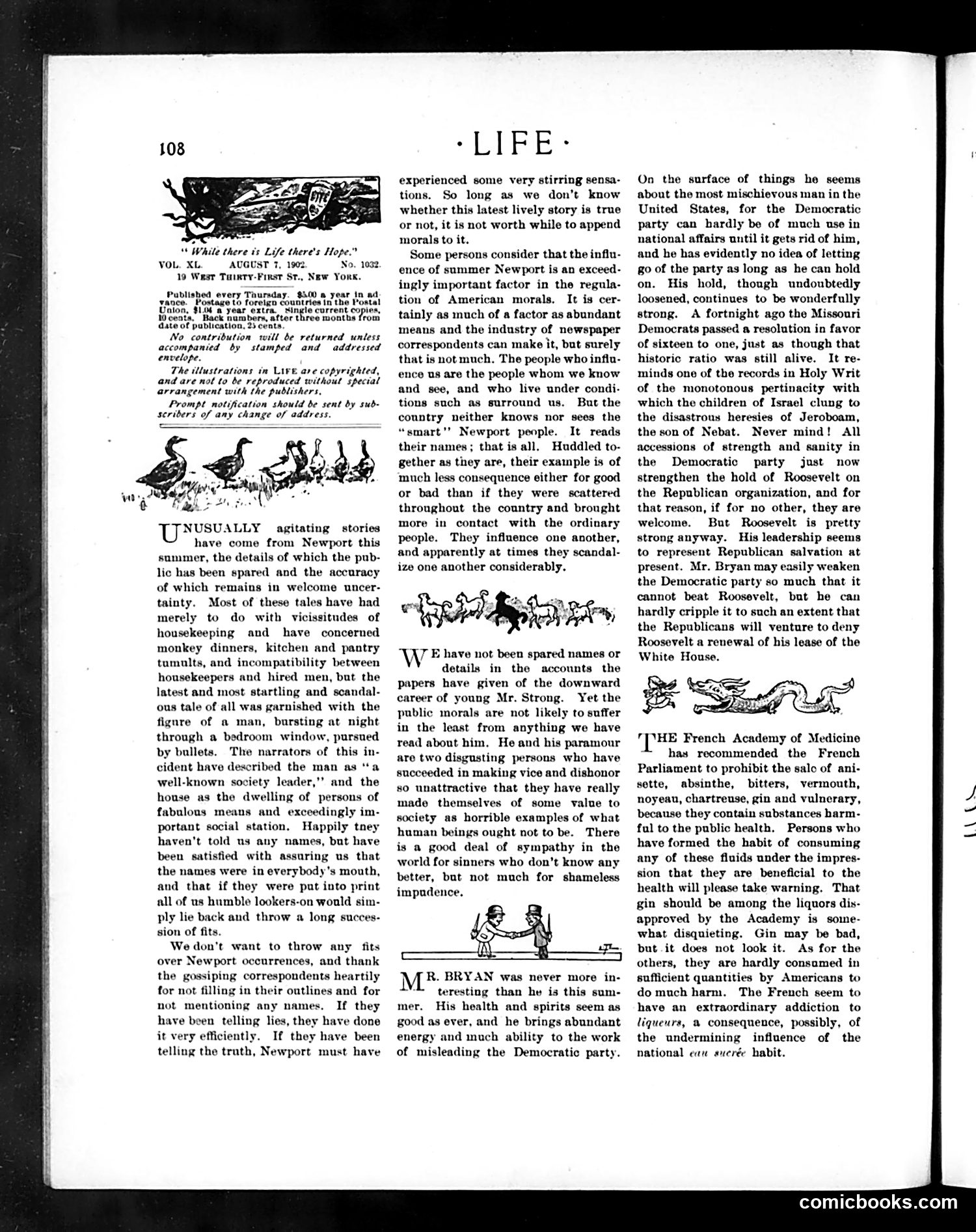
This page contains political commentary about Newport society and Democratic Party leadership, circa early 1900s. The text criticizes "Mr. Strong," a young man from a prominent Newport family whose scandalous behavior has damaged Democratic Party interests. The article suggests his moral failings reflect poorly on the party's reputation. The page also discusses President Roosevelt's political strength, suggesting Democrats cannot easily defeat him. A separate section critiques the French Academy of Medicine's recommendations regarding absinthe and other liqueurs, warning Americans against adopting such habits. The decorative illustrations (ducks, figures) are typical period ornaments rather than satirical cartoons. The satire operates primarily through the written commentary rather than visual caricature on this particular page.
📄 Transcribed text from this page (OCR, searchable)
Machine-transcribed from the original scan — historical spelling and the odd misread are preserved.
“\ While there is Life there's Hope.” VOL. XL. AUGUST 7, 19 Was Tairty-First Published every Thursday. $300 a year in ad vance. Postage to foreign countries in the Postal Valon, $14 a year extra. single current copies. Weents. Back numbers, after three months from date of publication, 25 cents, No contribution will be returned unless accompanied by stamped and addressed envelope. The illustrations in Live. are copyrighted, and are not to be reproduced without special arrangement with the publishers, Prompt notification should be sent by sub- scribers of any change of address. NUSUALLY agitating stories have come from Newport this summer, the details of which the pub- lic has been spared and the accuracy of which remains in welcome uncer- tainty. Most of these tales have had merely to do with vicissitudes of housekeeping and have concerned monkey dinners, kitchen and pantry tumults, and incompatibility between housekeepers and hired men, but the latest and most startling and scandal- ous tale of all was garnished with the fignre of a man, bursting at night through a bedroom window, pursued by bullets. The narrators of this in- cident have described the man as “a well-known society leader,’’ and the house as the dwelling of persons of fabulous means and exceedingly im- portant social station. Happily tney haven't told us any names, but have been satisfied with assuring us that the names were in everybody's mouth, and that if they were put into print all of us humble lookers-on would sim- ply lie back and throw a long succes- sion of fits. We don't want to throw any fits over Newport occurrences, and thank the gossiping correspondents heartily for not filling in their outlines and for not mentioning any names. If they ve been telling lies, they have done it very efficiently. If they have been telling the trath, Newport must have : LIFE « experienced some very stirring sensa- tions. So long as we don’t know whether this latest lively story is true or not, it is not worth while to append morals to it. Some persons consider that the influ- ence of summer Newport is an exceed- ingly important factor in the regula- tion of American morals. It is cer- tainly as much of a factor as abundant means and the industry of newspaper correspondents can make it, but surely that is not much. The people who influ- ence us are the people whom we know and see, and who live under condi- tions such as surround us, But the country neither knows nor sees the “smart'? Newport people. It reads their names ; that is all, Huddled to- gether as they are, their example is of much less consequence either for good or bad than if they were scattered throughout the country and brought more in contact with the ordinary people. They influence one another, and apparently at times they scandal- ize one another considerably. W E have not been spared names or details in the accounts the papers have given of the downward career of young Mr. Strong. Yet the public morals are not likely to suffer in the least from anything we have read about him. He and his paramour are two disgusting persons who have succeeded in making vice and dishonor so unattractive that they have really made themselves of some value to society as horrible examples of what human beings ought not to be. There is a good deal of sympathy in the world for sinners who don’t know any better, but not much for shameless impudence. A R. BRYAN was never more in- teresting than he is this sum- mer. His health and spirits seem as good as ever, and he brings abundant energy and much ability to the work of misleading the Democratic party. On the surface of things he seems about the most mischievous man in the United States, for the Democratic party can hardly be of much use in national affairs until it gets rid of him, and he has evidently no idea of letting go of the party as long as he can hold on. His hold, though undoubtedly loosened, continues to be wonderfully strong. A fortnight ago the Missouri Democrats passed a resolution in favor of sixteen to one, just as though that historic ratio was still alive. It re- minds one of the records in Holy Writ of the monotonous pertinacity with which the children of Israel clung to the disastrous heresies of Jeroboam, the son of Nebat. Never mind! All accessions of strength and sanity in the Democratic party just now strengthen the hold of Roosevelt on the Republican organization, and for that reason, if for no other, they are welcome. But Roosevelt is pretty strong anyway. His leadership seems to represent Republican salvation at present. Mr. Bryan may easily weaken the Democratic party so much that it cannot beat Roosevelt, but he can hardly cripple it to such an extent that the Republicans will venture to deny Roosevelt a renewal of his lease of the White House. "THE French Academy of Medicine has recommended the French Parliament to prohibit the salo of ani- sette, absinthe, bitters, vermouth, noyean, chartreuse, gin and vulnerary, because they contain substances harm- ful to the public health. Persons who have formed the habit of consuming any of these fluids under the impres- sion that they are beneficial to the health will please take warning. That gin should be among the liquors dis- approved by the Academy is some- what disquieting. Gin may be bad, but it does not look it. As for the others, they are hardly consamed in sufficient quantities by Americans to do much harm. The French seem to have an extraordinary addiction to liqueurs, & consequence, possibly, of the undermining influence of the national eau sucrée habit. comicbooks.com Tt A.