
Life, 1901-12-02 · page 27 of 44
Life — December 2, 1901 — page 27: what you’re looking at
What you’re looking at
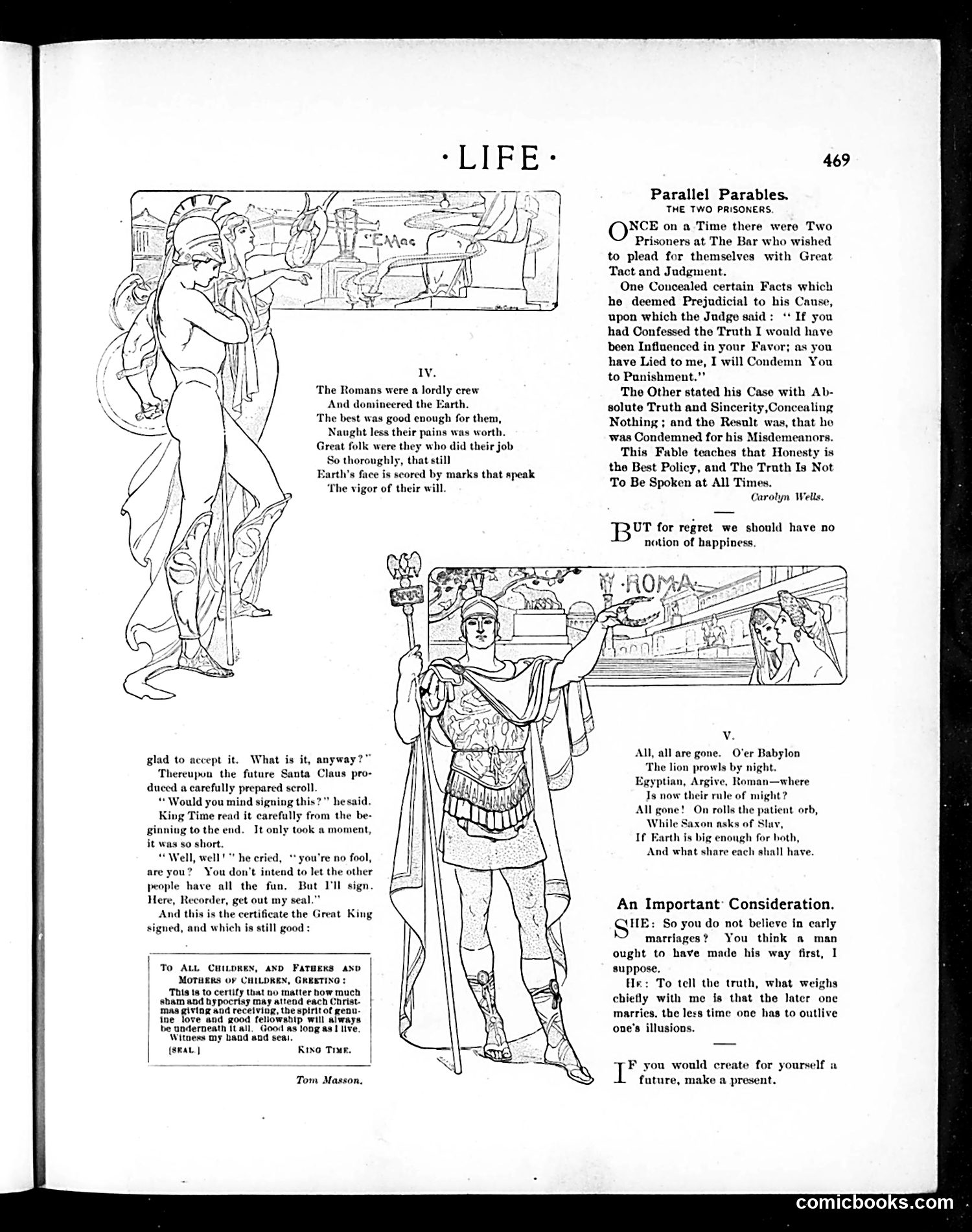
This page contains a moral fable about honesty and legal proceedings. Two prisoners appear before a judge: one conceals facts and lies, receiving condemnation; the other states his case with complete truth but is also condemned for his misdemeanors. The satire's point—stated explicitly—is ironic: "Honesty is the Best Policy, and The Truth Is Not To Be Spoken at All Times." This critiques the legal system's contradictions, where truthfulness offers no advantage and may even harm one's case. The Roman poem (section IV) celebrates Rome's imperial dominance through forceful action. The page also includes unrelated social commentary pieces on regret, early marriage, and creating one's future. The illustrations are decorative classical figures rather than specific caricatures, suggesting the piece targets systemic hypocrisy rather than individuals.
📄 Transcribed text from this page (OCR, searchable)
Machine-transcribed from the original scan — historical spelling and the odd misread are preserved.
Parallel Parables. THE TWO PRISONERS. NCE on a Time there were Two Prisoners at The Bar who wished to plead for themselves with Great Tact and Judgment. One Concealed certain Facts which he deemed Prejudicial to his Cause, upon which the Judge said: ‘* If you had Confessed the Truth I would have been Influenced in your Favor; as you have Lied to me, I will Condemn You Iv. to Panishment.”” ‘The Romans were a lordly crew The Other stated his Case with Ab- And domineered the Earth. solute Truth and Sincerity ,Concealing The best was good enough for them, Nothing ; and the Result was, that ho Naught less their pains was worth. was Condemned for his Misdemeanors. Great folk were they who did their job This Fable teaches that Honesty is Po theroughly tbat sult | tho Best Policy, and The Truth Is Not Earth's face is scored by marks that speak : ‘The vigor of their will. To Be Spoken at All Times, ; Carolyn Wells. Br for regret we should have no nation of happiness. glad to accept it. What is it, anyway?” r All, ote aan Qe Babee Thereupou the future Santa Claus pro- we, nee "i ae hire y oman—whe dnsed 5 carefally prepared scrON 1. Is now their rule of might? “ Would you mind signing this?” hesaid. \ Peon ska King Time read it carefully from the be- ecco ginning to the end. It only took a moment, : ie Bask is Gitecciah far Gaal i waa eo chor. | : arth is big enough for both, “Well, well! he eried, “you're no fool, | ; And what share each shall have. are you? You don't intend to let the other people have all the fun, But I'll sign. corder, getont mysesl An Important: Consideration. And this is the certificate the Great King ‘ signed, and which is still good : j ‘ SUE: Ss you do Le verre in carly marriages ? ou thin! a& man | ought to have made his way first, I To ALL CHILDREN, AND FATHERS AND suppose. mene bate inorcient GRERTING 2 7 He: To tell the truth, what weighs sbatn uod bypocriay may attend each Christ : chiefly with me is that the later one mas giving snd receiving, the spirit of genu- ‘ <8 ti ri ine fove nad good felowabip’ will always marries. the less time one has to outlive be underneath 1 all. Good as long as | live one’s illusions. Witness my hand and seal. (seat} Kixo Tr. x Z TF you wonld create for yourself a Tom Masson, future, make a present. comicbooks.com