
Life, 1901-12-02 · page 12 of 44
Life — December 2, 1901 — page 12: what you’re looking at
What you’re looking at
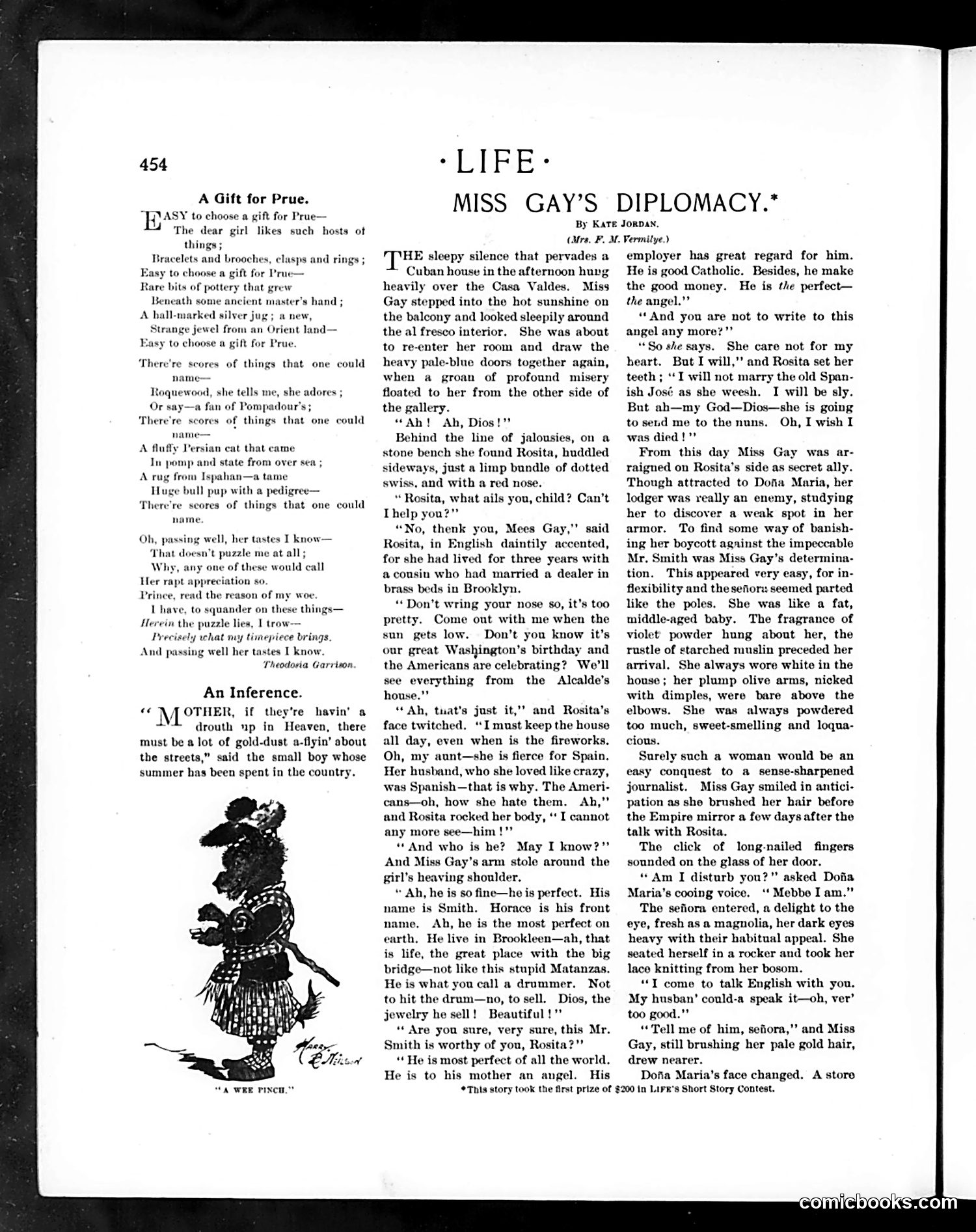
This page contains two distinct pieces: a poem titled "A Gift for True" (left) and a short story titled "Miss Gay's Diplomacy" by Kate Jordan (right), with an illustration of "A Wee Pinch" (a woman in elaborate dress). **The cartoon/illustration** labeled "A Wee Pinch" appears to be a decorative figure illustrating feminine fashion or character types of the period—likely early 20th century based on the styling. **The content** is not political satire but rather literary material typical of Life magazine's mixed format: light verse and fiction aimed at middle-class readers. The story concerns Miss Gay navigating social dynamics with her employer's son in Brooklyn, involving themes of propriety and romantic tension. The satirical elements are social rather than political—gentle mockery of romantic conventions and class-consciousness rather than commentary on current events.
📄 Transcribed text from this page (OCR, searchable)
Machine-transcribed from the original scan — historical spelling and the odd misread are preserved.
A Gift for Prue. E to choose a gift for Prue— The dear girl likes such hosts of things; Bracelets and brooc Easy to choose a gift for Prac— Rare bits of pottery that grew Beneath some ancient master’s hand ; A hall-marked silver jug; a new, Strange jewel from an Orient land— Easy to choose a gift for Prue. and rings ; ‘There're scores of things that one could name— Roquewood, she tells me, she adores ; a fan of Pompadour’ ‘ores of things that name— . A fluffy Persian cat that came In pomp and state from over sea ; m Ispahan—a tame : bull pup with a pedigree— There're scores of things that one could name could Oh, passing well, her tastes I know— T doesn't puzzle me at all; any one of these would call Her rapt apprec Prince, read the reason of my woe. I have, to squander on these things— Herein the puzzle lies, 1 trow Precisely what my timepiece brings. tion so. And passing well her tastes I know. Theodora Garrison An Inference. «© \ A OTHER, if they're havin’ o M drouth up in Heaven, there must be a lot of gold-dust a-flyin’ about the streets,” said the small boy whose summer has been spent in the country. “A WRE PINCH.” *LIRE = MISS GAY’S DIPLOMACY." By Kate Jonpan. (Mra, P.M. Vermilye.) HE sleepy silence that pervades a Cuban house in the afternoon huyg heavily over the Casa Valdes. Miss Gay stepped into the hot sunshine on the balcony and looked sleepily around the al fresco interior, She was about to re-enter her room and draw the heavy pale-blue doors together again, when a groan of profound misery floated to her from the other side of the gallery. “Ah! Ah, Dios!"” Behind the line of jalousies, on a stone bench she found Rosita, huddled sideways, just a limp bundle of dotted swiss, and with a red nose. “ Rosita, what ails you, Thelp you?” “No, thenk you, Mees Gay,” said Rosita, in English daintily accented, for she had lived for three years with acousiu who had married a dealer in brass beds in Brooklyn. “Don’t wring your nose so, it's too pretty. Come out with me when the sun gets low. Don’t you know it’s our great Washington's birthday and the Americans are celebrating? We'll see everything from the Alcalde’s house.”” “Ah, tuat’s just it,’’ and Rosita’s face twitched. “I must keep the house all day, even when is the fireworks, Oh, my aunt—she is fierce for Spain. Her husband, who she loved like crazy, was Spanish—that is why. The Ameri- cans—oh, how she hate them. Ah,” and Rosita rocked her body, “ I cannot any more see—him !"” “And who is he? May I know?” And Miss Gay’s arm stole around the girl’s heaving shoulder. *« Ah, he is so fine—he is perfect. His name is Smith. Horace is his front name, Ah, he is the most perfect on earth. He live in Brookleen—ah, that is life, the great place with the big bridge—not like this stupid Matanzas. He is what you call a drummer. Not to hit the dram—no, to sell. Dios, the jewelry he sell! Beautiful!” ‘Are you sure, very sure, this Mr. Smith is worthy of you, Rosita?”’ “He is most perfect of all the world, He is to his mother an angel. His iid? Can’t employer has great regard for him. He is good Catholic. Besides, he make the good money. He is the perfect— the angel.” “*And you are not to write to this angel any more?’’ “So she says. She care not for my heart. But I will,” and Rosita set her teeth ; “I will not marry the old Span- ish José as she weesh. I will be sly. But ah—my God—Dios—she is going to send me to the nuns. Oh, I wish I was died!" From this day Miss Gay was ar- raigned on Rosita’s side as secret ally. Though attracted to Dofa Maria, her lodger was really an enemy, studying her to discover a weak spot in her armor. To find some way of banish- ing her boycott against the impeccable Mr. Smith was Miss Gay’s determina- tion. This appeared very easy, for in- flexibility and the sefor: seemed parted like the poles. She was like a fat, middle-aged baby. The fragrance of violet powder hung about her, the rustle of starched muslin preceded her arrival. She always wore white in the house; her plump olive arms, nicked with dimples, were bare above the elbows. She was always powdered too much, sweet-smelling and loqua- cious. Surely such a woman would be an easy conquest to a sense-sharpened journalist. Miss Gay smiled in antici- pation as she brushed her hair before the Empire mirror a few days after the talk with Rosita. The click of long-nailed fingers sounded on the glass of her door. «Am I disturb you?” asked Doia Maria’s cooing voice. ‘ Mebbo I am.” The sefiora entered, a delight to the eye, fresh as a magnolia, her dark eyes heavy with their habitual appeal. She seated herself in a rocker and took her lace knitting from her bosom. “I come to talk English with you. My husban’ could-a speak it—oh, ver’ too good.”’ “Tell me of him, sefora,” and Miss Gay, still brushing her pale gold hair, drew nearer. Dofia Maria’s face changed. A store This story took the first prize of $200 in LirK’s Short Story Contest.