
Life, 1901-12-02 · page 10 of 44
Life — December 2, 1901 — page 10: what you’re looking at
What you’re looking at
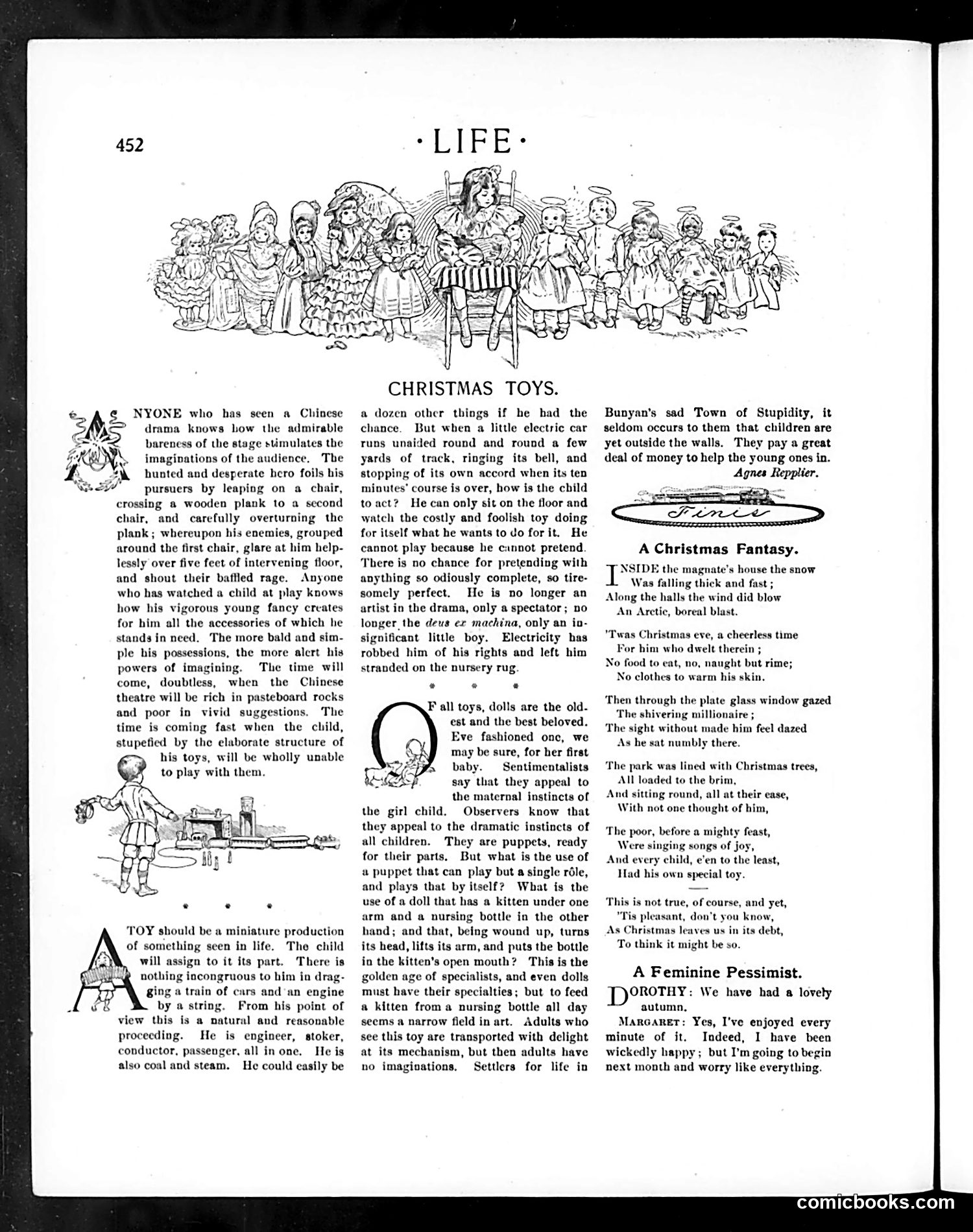
This page discusses the educational and dramatic value of toys, particularly dolls and mechanical trains. The text critiques how realistic toys—like dolls with nursing bottles or wind-up trains—paradoxically limit children's imagination by being too functionally complete. The author argues that children need toys that require their creativity to animate and complete imaginatively. The illustrations show a child playing with a toy train and another examining a doll, demonstrating these mechanical toys in action. The page also includes poetry titled "A Christmas Fantasy" about a poor child viewing Christmas trees through a window, and a brief dialogue between "Dorothy" and "Margaret" about autumn worries—typical Life magazine features mixing social commentary with sentimental verse.
📄 Transcribed text from this page (OCR, searchable)
Machine-transcribed from the original scan — historical spelling and the odd misread are preserved.
§ NYONE who has seen a Chinese Se drama knows how the admirable YA2 — darences of the stage stimulates the NV, imaginations of the audience. The ‘L hunted and desperate hero foils bis pursuers by leaping on a chair, crossing a wooden plank to a second chair, and carefully overturning the plank ; whereupon his enemies, grouped around the first chair, glare at him help- lessly over five feet of intervening floor, and shout their baffled rage. Anyone who has watched a child at play knows how his vigorous young fancy creates for him all the accessories of which he stands in need. The more bald and sim- ple his possessions, the more alert his powers of imagining. The time will come, doubtless, when the Chinese theatre will be rich in pasteboard rocks and poor in vivid suggestions. The time is coming fast when the child, stupetied by the elaborate structure of his toys, will be wholly unable to play with them. TOY should be a miniature production of something seen in life. The child will assign to it its part. There is nothing incongruous to him in drag- ging a train of cars and’an engine by a string. From his point of view this is a natural and reasonable proceeding. He is engineer, stoker, conductor, passenger, all in one. He is also coal and steam. He could easily be CHRISTMAS TOYS. a dozen other things if he had the chance. But when a little electric car runs unaided round and round a few yards of track, ringing its bell, and stopping of its own accord when its ten minutes’ course is over, how is the child toact? He can only sit on the floor and watch the costly and foolish toy doing for itself what he wants to do for it. He cannot play because he cannot pretend. ‘There is no chance for pretending with anything so odiously complete, so tire- somely perfect. He is no longer an artist in the drama, only a spectator; no longer the deus ex machina, only an in- significant little boy. Electricity has robbed him of his rights and left him stranded on the nursery rug. ° e . F all toys, dolls are the old- est and the best beloved. Eve fashioned onc, we may be sure, for her first baby. Sentimentalists say that they appeal to the maternal instincts of the girl child. Observers know that they appeal to the dramatic instincts of all children. They are puppets, ready for their parts, But what is the use of a puppet that can play but a single réle, and plays that by itself? What is the use of a doll that has a kitten under one arm and a nursing bottle in the other hand; and that, being wound up, turns its head, lifts its arm, and puts the bottle in the kitten’s open mouth? This is the golden age of specialists, and even dolls must have their specialties; but to feed a kitten froma nursing bottle all day seems a narrow field in art. Adults who see this toy are transported with delight at its mechanism, but then adults have no imagivations. Settlers for life in aye Bunyan’s sad Town of Stupidity, it seldom occurs to them that children are yet outside the walls. They pay a great deal of money to help the young ones in. Agnes Repplier. A Christmas Fantasy. ‘SIDE the magnate's house the snow Was falling thick and fast ; Along the halls the wind did blow An Arctic, boreal blast. 'Twas Christmas eve, a cheerless time or him who dwelt therein ; No food to eat, no, naught but rime; No clothes to warm his skin. Then through the plate glass window gazed The shivering millionaire ; The sight without made him feel dazed As he sat numbly there. The park was lined with Christmas trees, All loaded to the brim, And sitting round, all at their ease, With not one thought of him, The poor, before a mighty feast, Were singing songs of joy, And every child, e'en to the least, Had his own special toy. This is not true, of course, and yet, “Tis pleasant, don't you know, As Christmas leaves us in its debt, To think it might be so. A Feminine Pessimist. DPoeroray: We have had a lovely autumn, Marcaret: Yes, I’ve enjoyed every minute of it. Indeed, I have been wickedly happy; but I'm going to begin next month and worry like everything. comicbooks.com