
Life, 1896-01-16 · page 8 of 20
Life — January 16, 1896 — page 8: what you’re looking at
What you’re looking at
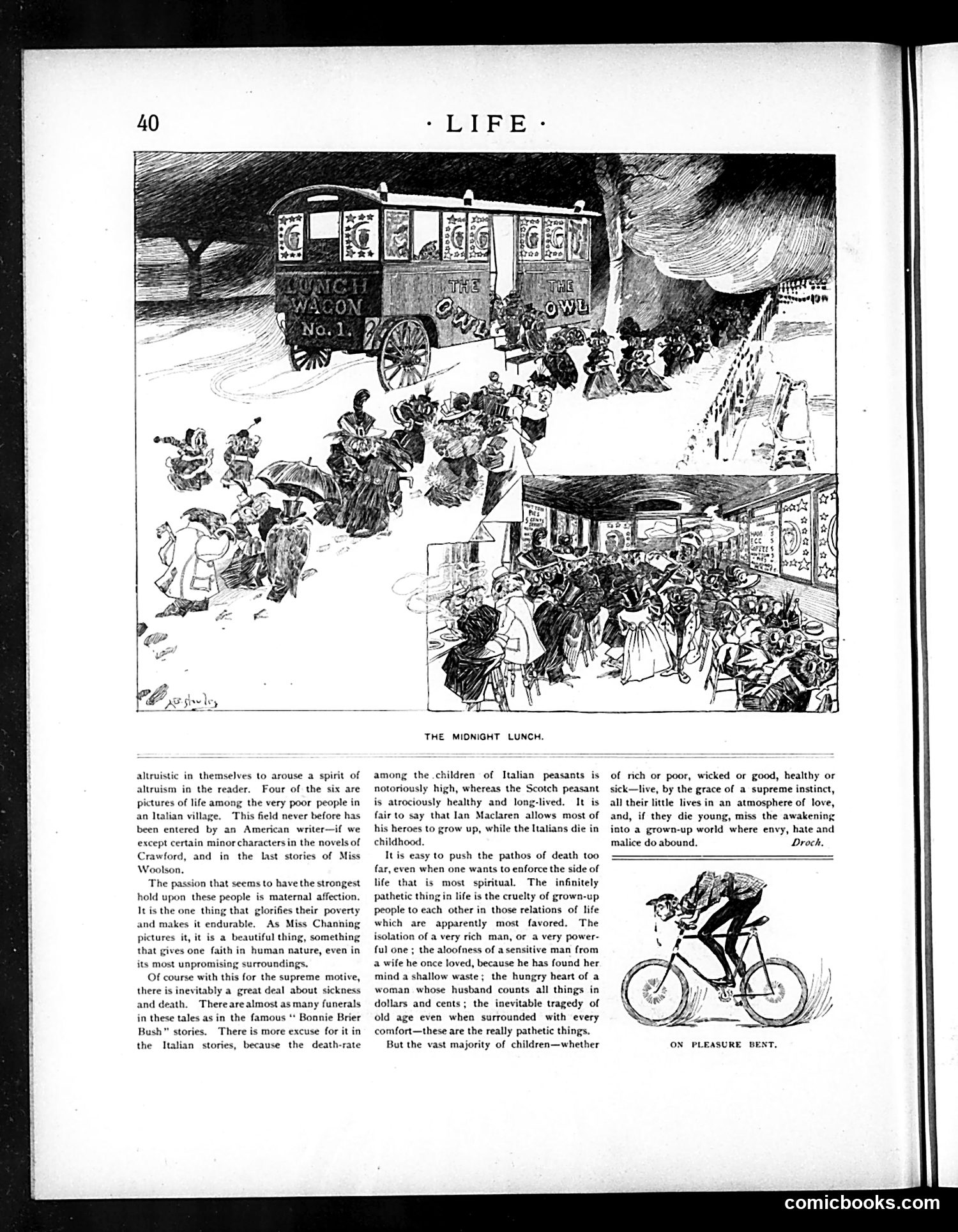
This page satirizes the romanticization of peasant poverty in literature. The top illustration shows "The Lunch Wagon" and "The Owl" - mobile food vendors attracting crowds, likely referencing how writers (particularly those writing about Italian peasant life) exploit sympathy for the poor. The accompanying text criticizes how literature falsely glamorizes hardship and death among peasants and poor children. It specifically mentions author Ian Maclaren and references the sentimental "Bonnie Brier Bush" stories, arguing that real poverty involves cruel neglect and isolation—not the picturesque, emotionally manipulative versions found in popular fiction. The bottom illustration "On Pleasure Bent" shows leisure contrast to this critique. The satire targets literary sentimentalism about poverty as dishonest and exploitative.
📄 Transcribed text from this page (OCR, searchable)
Machine-transcribed from the original scan — historical spelling and the odd misread are preserved.
\ as ao SY NO.1. Wife o Y E Ui oN s <y Ps Siw ley altruistic in themselves to arouse a spirit of altruism in the reader. Four of the six are pictures of life among the very poor people in an Italian village, ‘This field never before has been entered by an American writer—if we except certain minor charactersin the novels of crawford, and in the last stories of Miss Woolson, The passion that seems to have the strongest hold upon these people is maternal affection, It is the one thing that glorifies their poverty and makes it endurable. As Miss Channing pictures it, it is a beautiful thing, something that gives one faith in human nature, even in its most unpromising surroundings. Of course with this for the supreme motive, there is inevitably a great deal about sickness and death. Thereare almost as many funerals in these tales as in the famous ‘ Bonnie Brier Bush" stories. There is more excuse for it in the Italian stories, because the death-rate THE MIONIGHT LUNCH. among the .children of Italian peasants is notoriously high, whereas the Scotch peasant is atrociously healthy and long-lived. It is fair to say that lan Maclaren allows most of his heroes to grow up, while the Italians die in childhood. It is easy to push the pathos of death too far, even when one wants to enforce the side of life that is most spiritual. The infinitely pathetic thing in life is the cruelty of grown-up people to each other in those relations of life which are apparently most favored. The isolation of a very rich man, or a very power- ful one ; the aloofness of a sensitive man from a wife he once loved, because he has found her mind a shallow waste; the hungry heart of a woman whose husband counts all things in dollars and cents; the inevitable tragedy of old age even when surrounded with every comfort—these are the really pathetic things. But the vast majority of children—whether of rich or poor, wicked or good, healthy or sick—live, by the grace of a supreme instinct, all their little lives in an atmosphere of love, and, if they die young, miss the awakening into a grown-up world where envy, hate and malice do abound, Droch. ON PLEASURE BENT. comicbooks.com