
Life, 1896-01-16 · page 4 of 20
Life — January 16, 1896 — page 4: what you’re looking at
What you’re looking at
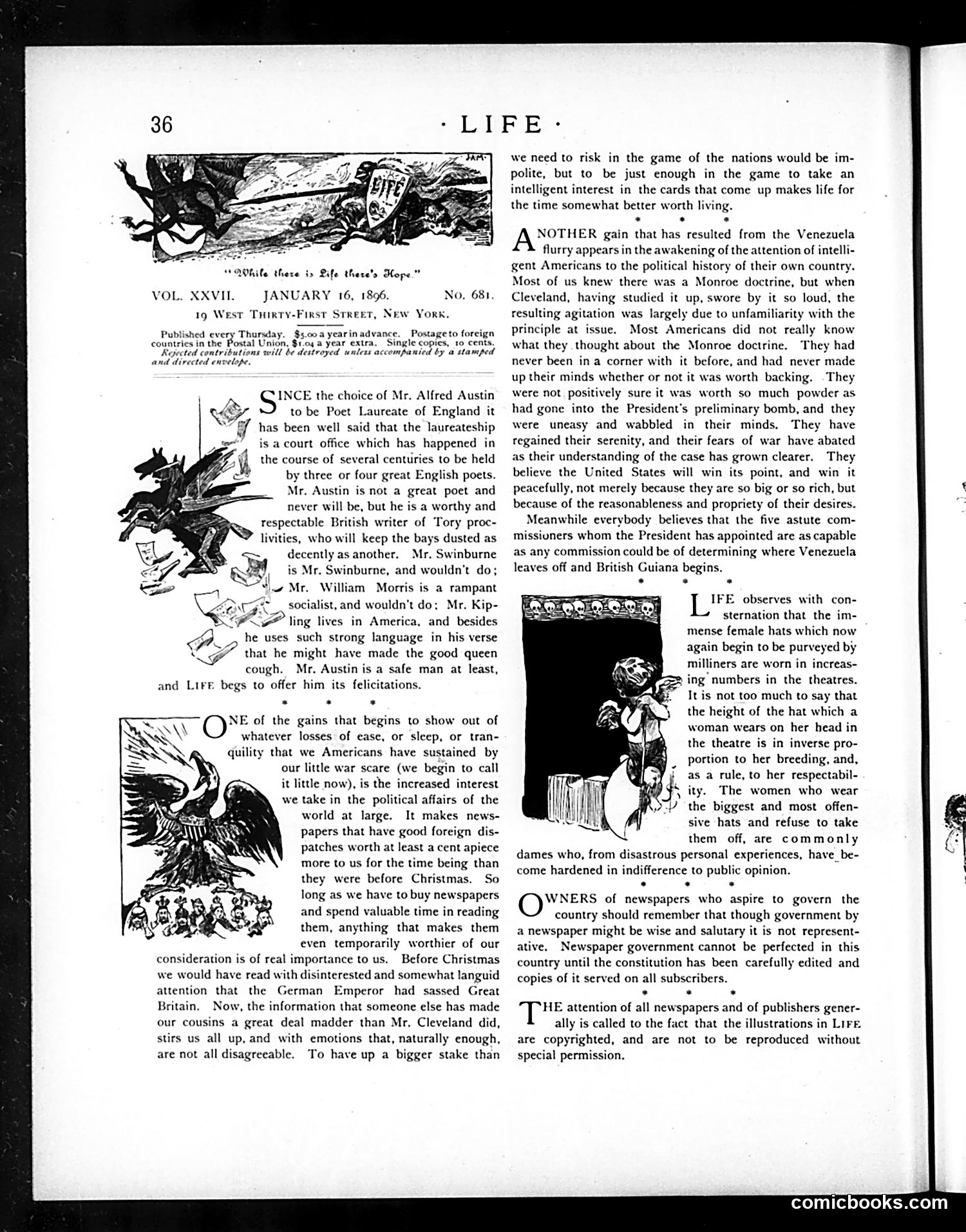
The page discusses the **Venezuela crisis** and its impact on American political attention. The text praises President Cleveland's handling of the situation, noting that Americans previously unfamiliar with the Monroe Doctrine have now become engaged with it. **The cartoon at top left** (captioned "While there is Life there's Hope") appears to show a figure in distress, likely representing Venezuela or a nation threatened by foreign powers—a visual commentary on the Monroe Doctrine's protective role. **The lower cartoon** depicts an eagle with spread wings surrounded by papers or documents, symbolizing American power and authority over Western Hemisphere affairs. The page celebrates increased American interest in foreign policy and the reasonableness of the nation's strategic interests, framing intervention as justified and proper.
📄 Transcribed text from this page (OCR, searchable)
Machine-transcribed from the original scan — historical spelling and the odd misread are preserved.
> LEFE:* VOL. XXVIL. JANUARY 16, 1896. No, 681. 19 West THirty-First Street, New York. Pubtished every Thursday. $5.00 a yearinadvance. Postage to foreign tries in the Postal Union, $1.04 a year extra. Single copies, 10 cents. jected contributions will be destroyed unless accompanied by a stamped IN he choice of Mr. Alfred Austin oy, to be Poet Laureate of England it ff has been well said that the laureateship “ is acourt office which has happened in the course of several centuries to be held by three or four great English poets. Mr. Austin is not a great poet and never will be, but he is a worthy and respectable British writer of Tory proc- livities, who will keep the bays dusted as decently as another. Mr, Swinburne eH, is Mr. Swinburne, and wouldn't do; | Mr. William Mortis is a rampant Se FL, sotialist, and wouldn't doz Mr. Kip- s PLZ ling lives in America, and besides A 4 he uses such strong language in his verse fg that he might have made the good queen cough. Mr. Austin is a safe man at least, and Lirr begs to offer him its felicitations. NE of the gains that begins to show out of whatever losses of ease, or sleep, or tran- quility that we Americans have sustained by our little war scare (we begin to call it little now), is the increased interest we take in the political affairs of the world at large. It makes new papers that have good foreign dis- patches worth at least a cent apiece more to us for the time being than they were before Christmas. So long as we have to buy newspapers and spend valuable time in reading them, anything that makes them even temporarily worthier of our consideration is of real importance to us. Before Christmas we would have read with disinterested and somewhat languid attention that the German Emperor had sassed Great Britain, Now, the information that someone else has made our cousins a great deal madder than Mr. Cleveland did, stirs us all up, and with emotions that, naturally enough, are not all disagreeable. To have up a bigger stake than we need to risk in the game of the nations would be im- polite, but to be just enough in the game to take an intelligent interest in the cards that come up makes life for the time somewhat better worth living. . . . NOTHER gain that has resulted from the Venezuela flurry appears in the awakening of the attention of intelli- gent Americans to the political history of their own country. Most of us knew there was a Monroe doctrine, but when Cleveland, having studied it up, swore by it so loud, the resulting agitation was largely due to unfamiliarity with the principle at issue. Most Americans did not really know what they thought about the Monroe doctrine. ‘They had never been ina corner with it before, and had never made up their minds whether or not it was worth backing. They were not positively sure it was worth so much powder as had gone into the President's preliminary bomb, and they were uneasy and wabbled in their minds. They have regained their serenity, and their fears of war have abated as their understanding of the case has grown clearer. They believe the United States will win its point, and win it peacefully, not merely because they are so big or so rich, but because of the reasonableness and propriety of their desires. Meanwhile everybody believes that the five astute com- missioners whom the President has appointed are as capable as any commission could be of determining where Venezuela leaves off and British Guiana begins. . . . IFE observes with con- sternation that the im- mense female hats which now again begin to be purveyed by milliners are worn in increas- ing numbers in the theatres. It is not too much to say that the height of the hat which a woman wears on her head in the theatre is in inverse pro- portion to her breeding, and, s a rule, to her respectabil- ity. The women who wear the biggest and most offen- sive hats and refuse to take them off, are commonly dames who, from disastrous personal experiences, have_be- come hardened in indifference to public opinion. . . . WNERS of newspapers who aspire to govern the country should remember that though government by a newspaper might be wise and salutary it is not represent- ative. Newspaper government cannot be perfected in this country until the constitution has been carefully edited and copies of it served on all subscribers. . . . HE attention of all newspapers and of publishers gener- ally is called to the fact that the illustrations in Lirz are copyrighted, and are not to be reproduced without special perm comicbooks.com