
Life, 1896-01-16 · page 12 of 20
Life — January 16, 1896 — page 12: what you’re looking at
What you’re looking at
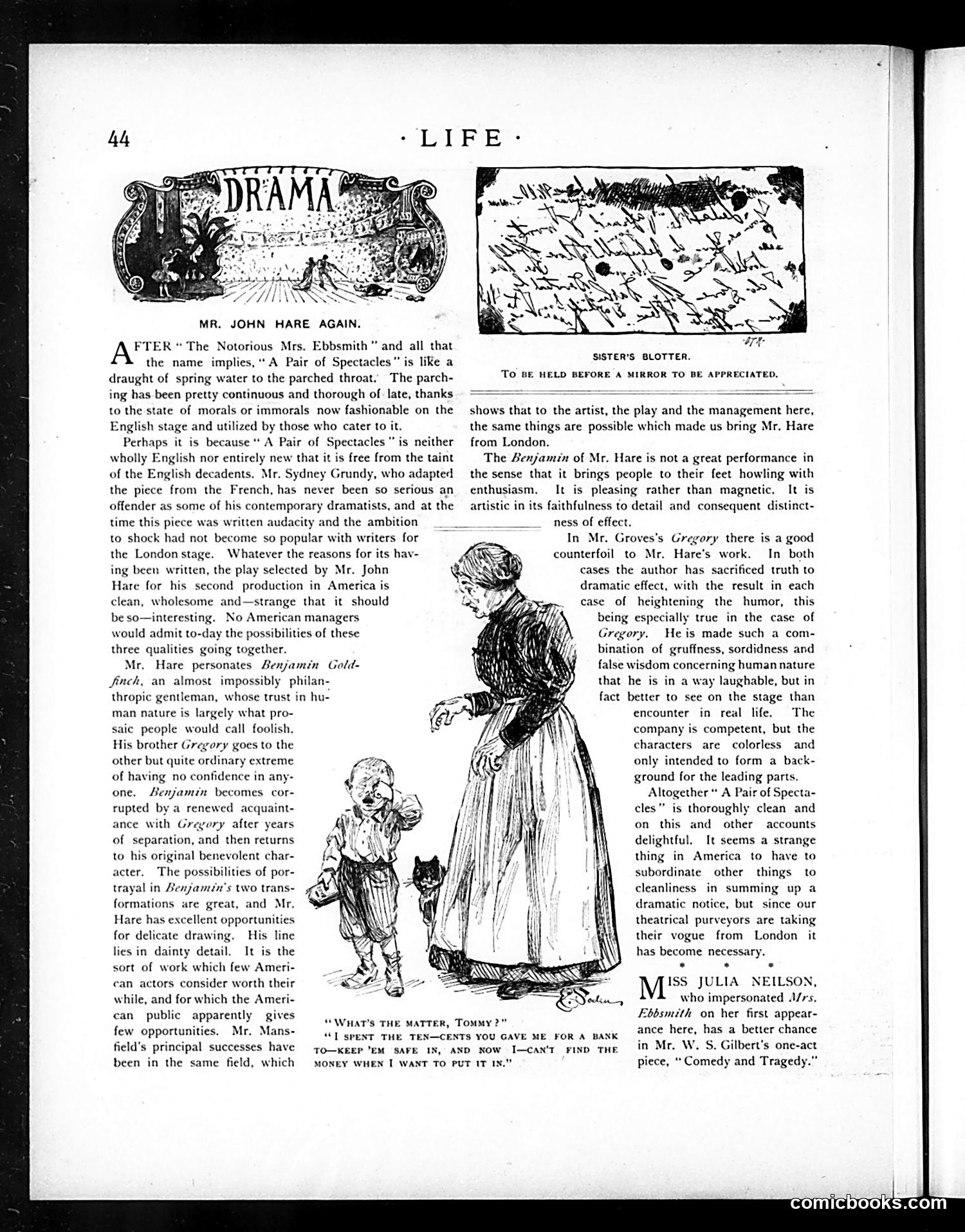
This *Life* magazine drama section reviews John Hare's American production of "A Pair of Spectacles," a French-adapted play by Sydney Grundy. The critic praises it as refreshingly "clean, wholesome and interesting"—a stark contrast to contemporary English theatre, which the piece criticizes as morally decadent (referencing "The Notorious Mrs. Ebbsmith" as an example of risqué material). The review focuses on Hare's performance as Benjamin Goldfinch, a naïve philanthropist corrupted then redeemed. The critic admires the delicate character work but notes American audiences and managers undervalue such subtle performances. The small cartoon shows a child who spent his ten cents on a savings bank rather than candy—satirizing American parental values around thrift. "Sister's Blotter" is a mirror-image cartoon (read by reflecting it), a playful visual puzzle typical of *Life*'s humor.
📄 Transcribed text from this page (OCR, searchable)
Machine-transcribed from the original scan — historical spelling and the odd misread are preserved.
MR. JOHN HARE AGAIN. Ane “The Notorious Mrs. Ebbsmith” and all that the name implies, ‘A Pair of Spectacles” is like a draught of spring water to the parched throat. The parch- ing has been pretty continuous and thorough of late, thanks to the state of morals or immorals now fashionable on the English stage and utilized by those who cater to Perhaps it is because “ A Pair of Spectacles" is neither wholly English nor entirely new that it is free from the taint of the English decadents. Mr. Sydney Grundy, who adapted the piece from the French, has never been so serious an offender as some of his contemporary dramatists, and at the time this piece was written audacity and the ambition to shock had not become so popular with writers for the London stage. Whatever the reasons for its hav- ing been written, the play selected by Mr. John Hare for his second production in America is clean, wholesome and—strange that it should be so—interesting. No American managers would admit to-day the possibilities of these three qualities going together. Mr. Hare personates Benjamin Gold- finch, an almost impossibly philan- thropic gentleman, whose trust in hu- man nature is largely what pro- saic people would call foolish. His brother Gregory goes to the other but quite ordinary extreme of having no confidence in any- one. Benjamin becomes cor- rupted by a renewed acquaint- ance with Gregory after years of separation, and then returns to his original benevolent char- The possibilities of por- trayal in Benjamin’ acter. two trans- formations are great, and Mr. Hare has excellent opportunities for delicate drawing. His line lies in dainty detail. It is the sort of work which few Ameri- can actors consider worth their while, and for which the Ameri- can public apparently gives few opportunities. Mr. Mans- field's principal successes have been in the same field, which M SAFE IN, af “WHAT'S THE MATTER, Tommy?” “*] SPENT THE TEN—CENTS YOU GAVE ME FOR A BANK AND NOW I WaNT To PUT IT IN.” ro SISTER'S BLOTTER. ‘TO BE HELD BEFORE A MIRROR TO BE APPRECIATED. the play and the management here, ible which made us bring Mr. Hare shows that to the artis the same things are poss from London. The Benjamin of Mr. Hare is not a great performance in the sense that it brings people to their feet howling with enthusiasm. It is pleasing rather than magnetic. It is artistic in its faithfulness to detail and consequent distinct- ness of effect. In Mr. Groves’s Gregory there is a good counterfoil to Mr. Hare's work. In both cases the author has sacrificed truth to dramatic effect, with the result in each case of heightening the humor, this being especially true in the case of Gregory. He is made such a com- bination of gruffness, sordidness and false wisdom concerning human nature that he is in a way laughable, but in fact better to see on the stage than encounter in real life. The company is competent, but the characters are colorless and only intended to form a bac! ground for the leading parts. Altogether “ A Pair of Specta- cles” is thoroughly clean and on this and other delightful. It seems a strange thing in America to have to subordinate other things to cleanliness in summing up a dramatic notice, but since our theatrical purveyors are taking their vogue from London it has become necessary. . . . ISS JULIA NEILSON, who impersonated J/rs, Ebbsmith on her first appear- ance here, has a better chance in Mr, W. S. Gilbert’s one-act piece, * Comedy and Tragedy.” accounts I—CAN'T FIND THE