
Life, 1895-09-05 · page 4 of 16
Life — September 5, 1895 — page 4: what you’re looking at
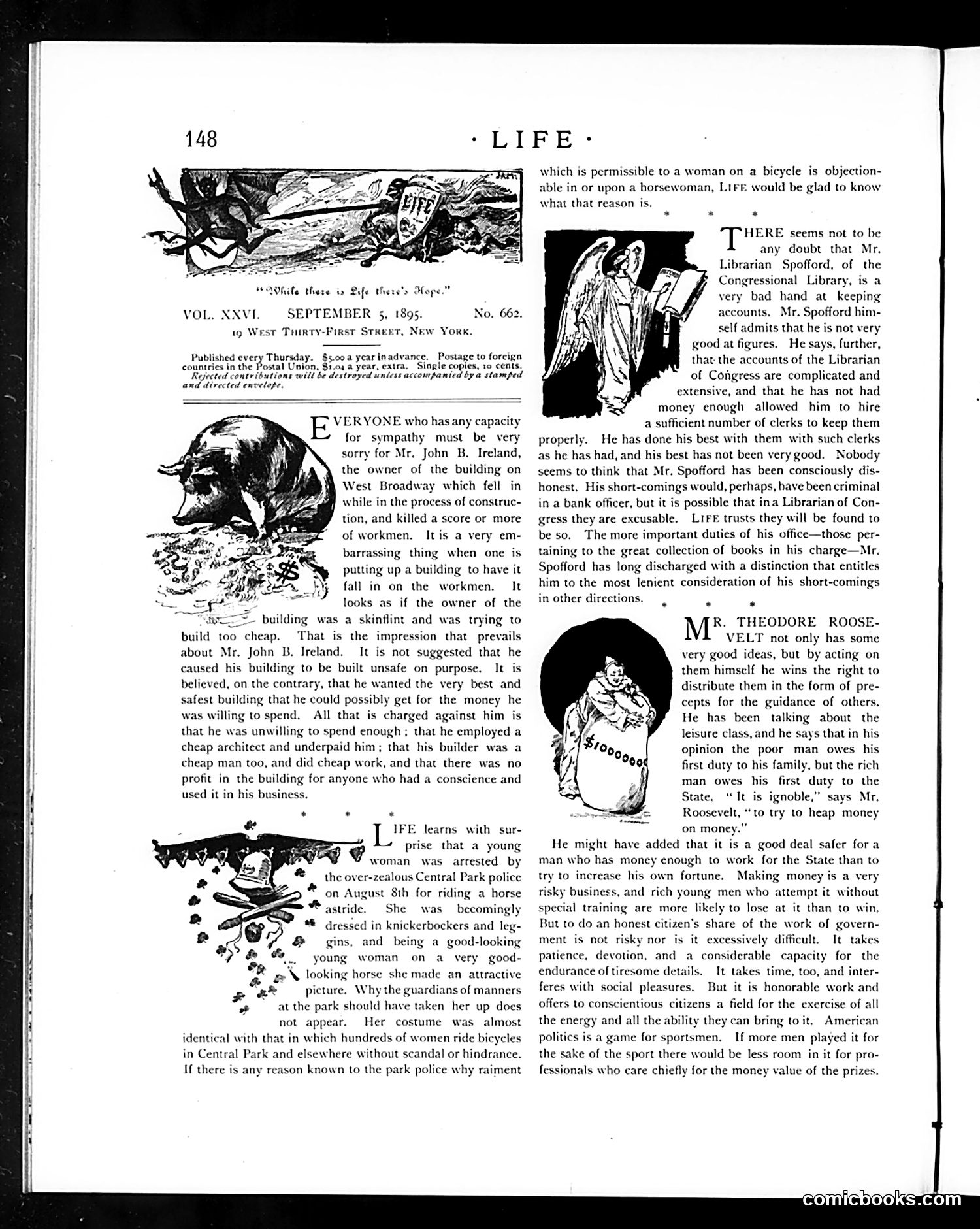
What you’re looking at
This page contains three separate satirical items: 1. **Building Collapse Commentary**: The text criticizes John B. Ireland, owner of a West Broadway building that collapsed during construction, killing workers. The satire suggests Ireland prioritized cheap construction costs over worker safety—a common industrial-era critique. 2. **Woman Arrested for Horseback Riding**: The cartoon depicts a young woman arrested by Central Park police for riding a horse in a "good-looking" outfit. The satire mocks overly strict park regulations and suggests gender-based policing of women's leisure activities and clothing. 3. **Theodore Roosevelt Commentary**: Text praises Roosevelt's views on wealthy citizens' obligations to public service rather than merely accumulating money—reflecting Progressive Era debates about wealth and civic duty. All three items critique contemporary social/industrial problems through humor.
📄 Transcribed text from this page (OCR, searchable)
Machine-transcribed from the original scan — historical spelling and the odd misread are preserved.
* LIFE: hile these is Life there's Ilo; PTEMBER 5, 1895. inst Street, New York. VOL. XXVI. SI No. 662. 1g West Tut $s.00.a yearinadvance, Postage to foreign jon, $1.04 a year, extra. Single copies, 10 cents, ill be destroyed unless accompanied by a stamped Published every Thursd countries in the Postal Ui Rejected contributions and directed envelope. VERYONE who hasany capacity for sympathy must be very sorry for Mr. John B. Ireland, the owner of the building on Ww Broadway which fell in while in the process of construc- tion, and killed a score or more of workmen. It is a very em- barrassing thing when one is putting up a building to have it fall in on the workmen. It ~ looks as if the owner of the - building was a skinflint and was trying to build too cheap. That is the impression that prevails about Mr. John B. Ireland. It is not suggested that he caused his building to be built unsafe on purpose. It is believed, on the contrary, that he wanted the very best and safest building that he could possibly get for the money he was willing to spend, All that is charged against him is that he was unwilling to spend enough ; that he employed a cheap architect and underpaid him; that his builder was a cheap man too, and did cheap work, and that there was no profit in the building for anyone who had a conscience and used it in his business. ¥ yy IFE learns with sur- ~ prise that a young woman was arrested by zealous Central Park police on August 8th for riding a horse astride. She was becomingly *€ dressed in knickerbockers and gins, and being a good-looking young very good- g \ looking horse she made an attractive e® picture, Why the guardians of manners ; aken her up does was almost woman on a at the park should hav not appear. Her costume identical with that in which hundreds of women ride bic in Central Park and elsewhere without scandal or hindrance. If there is any reason known to the park police why raiment which is permissible to a woman on a bicycle is objection- able in or upon a horsewoman, LIFE would be glad to know what that reason is. . * * HERE seems not to be any doubt that Mr, Librarian Spofford, of the Congressional Librar very bad hand at_ keeping accounts, Mr. Spofford him- self admits that he is not very good at figures. He says, further, that the accounts of the Librarian of Congress are complicated and extensive, and that he has not had money enough allowed him to hire a sufficient number of clerks to keep them properly. He has done his best with them with such clerks as he has had, and his best has not been very good. Nobody seems to think that Mr. Spofford has been consciously dis- honest. His short-comings would, perhaps, have been criminal in a bank officer, but it is possible that ina Librarian of Con- gress they are excusable. LIFE trusts they will be found to be so. The more important duties of his office—those per- taining to the great collection of books in his charge—Mr. Spofford has long discharged with a distinction that entitles him to the most lenient consideration of his short-comings in other directions. isa R. THEODORE ROOSE- VELT not only has some very good ideas, but by acting on them himself he wins the right to distribute them in the form of pre- cepts for the guidance of others. He has been talking about the leisure class, and he says that in his. opinion the poor man owes his first duty to his family, but the rich man owes his first duty to the State. “It is ignoble,” says Mr. Roosevelt, “to try to heap money on money.” He might have added that it is a good deal safer fora man who has money enough to work for the State than to try to increase his own fortune. Making money is a very risky business, and rich young men who attempt it without special training are more likely to lose at it than to win, But to do an honest citizen's share of the work of govern- ment is not risky nor is it excessively difficult. It takes patience, devotion, and a considerable capacity for the It takes time, too, and inter- But it is honorable work and endurance of tiresome details. feres with social pleasures. offers to conscientious citizens a field for the exercise of all the energy and all the ability they can bring to it. American If more men played it for the sake of the sport there would be less room in it for pro- fessionals who care chiefly for the money value of the prizes. politics is a game for sportsmen.