
Life, 1894-12-13 · page 6 of 16
Life — December 13, 1894 — page 6: what you’re looking at
What you’re looking at
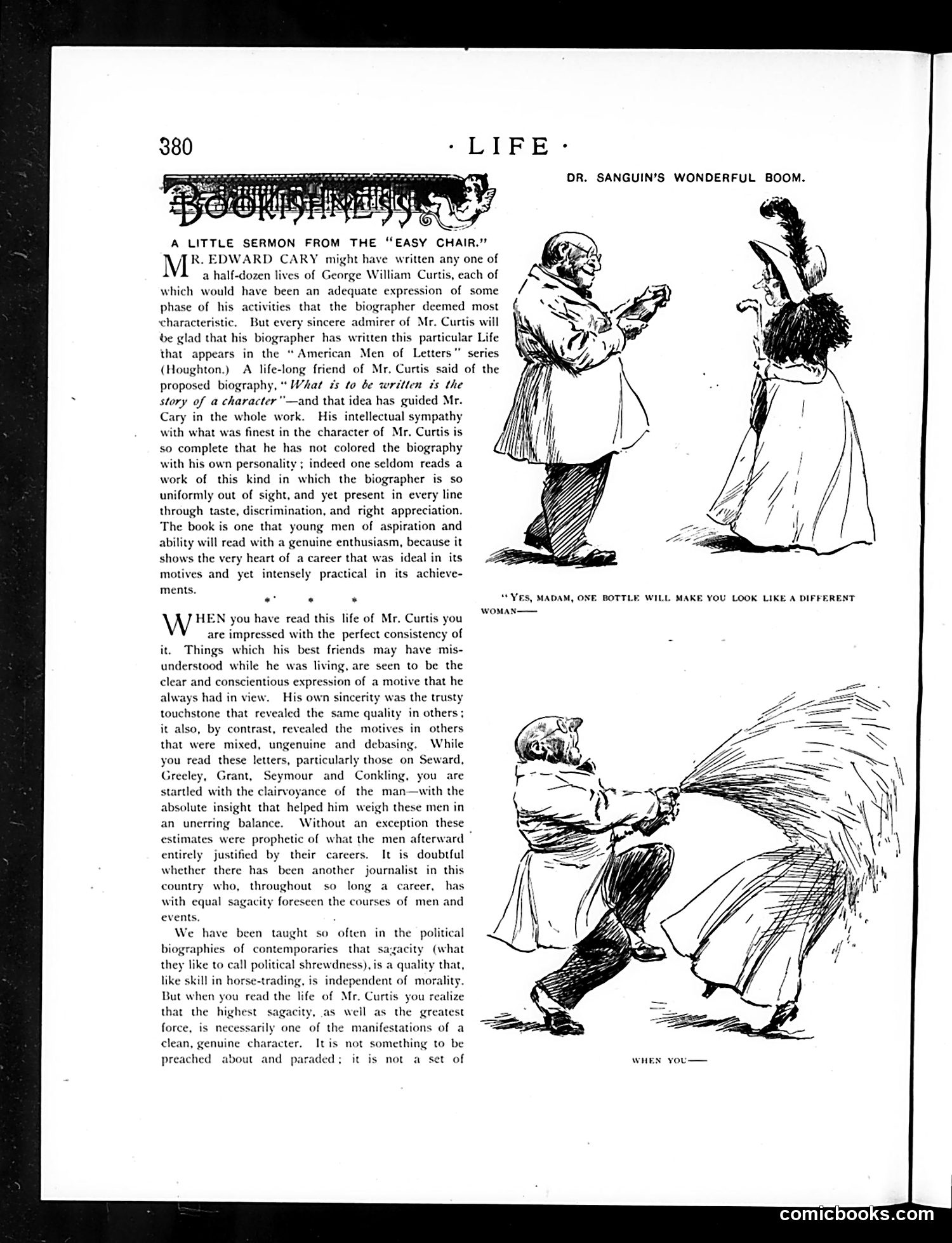
This page contains a biographical essay about George William Curtis, not a political cartoon. The text discusses Curtis's character and career, praising his consistency and moral integrity as a journalist and writer. The two illustrations appear to be satirical sketches titled "Dr. Sanguín's Wonderful Boom" (top) and "When You—" (bottom), though the cartoons themselves are incomplete or their captions cut off. They depict what appear to be social commentary scenes—possibly about medicine, quackery, or dubious schemes—rendered in the period's typical satirical style with exaggerated figures and expressions. Without full context or complete captions, the specific targets of these sketches remain unclear, though they likely referenced contemporary scandals or popular follies of the era.
📄 Transcribed text from this page (OCR, searchable)
Machine-transcribed from the original scan — historical spelling and the odd misread are preserved.
A LITTLE SERMON FROM THE “EASY CHAIR.” q* EDWARD CARY might have written any one of i a half-dozen lives of George William Curtis, each of which would have been an adequate ex ion of some phase of his activities that the biographer deemed most characteristic. But every sincere admirer of Mr. Curtis will be glad that his biographer has written this particular Life that appears in the “American Men of Letters” series (Houghton.) A life-long friend of Mr. Curtis said of the proposed biography, * What #s to be written is the story of a character"’—and that idea has guided Mr. Cary in the whole work. His intellectual sympathy with what was finest in the character of Mr. Curtis is so complete that he has not colored the biography with his own personality ; indeed one seldom reads a work of this kind in which the biographer is so uniformly out of sight, and yet present in every line through taste, discrimination, and right appreciation. The book is one that young men of aspiration and ability will read with a genuine enthusiasm, because it shows the very heart of a career that was ideal in its motives and yet intensely practical in its achieve- ments. WwW N you have read this life of Mr. Curtis you are impressed with the perfect consistency of it. Things which his best friends may have mis- understood while he was living, are seen to be the clear and conscientious expression of a motive that he always had in view. His own sincerity was the trusty touchstone that revealed the same quality in others; it also, by contrast, revealed the motives in others that were mixed, ungenuine and debasing. While you read these letters, particularly those on Seward, Greeley, Grant, Seymour and Conkling, you are startled with the clairvoyance of the man—with the absolute insight that helped him weigh these men in an unerring balance. Without an exception these estimates were prophetic of what the men afterward” entirely justified by their careers, It is doubtful whether there has been another journalist in this country who, throughout so long a career, has with equal sagacity foreseen the courses of men and events. : We have been taught so often in the political biographies of contemporaries that sayacity (what they like to call political shrewdness), is a quality that, like skill in horse-trading, is independent of morality. But when you read the life of Mr. Curtis you realiz that the highest ci as well as the greatest force, is necessarily one of the manifestations of a clean, genuine character. It is not something to be preached about a ded; it is not a set of OR. SANGUIN’S WONDERFUL BOOM. “YES, MADAM, ONE. BOTTLE WILL MAKE YOU LOOK LIKE A DIFFERENT womMaN—— WHEN You— comicbooks.com