
Life, 1894-12-13 · page 12 of 16
Life — December 13, 1894 — page 12: what you’re looking at
What you’re looking at
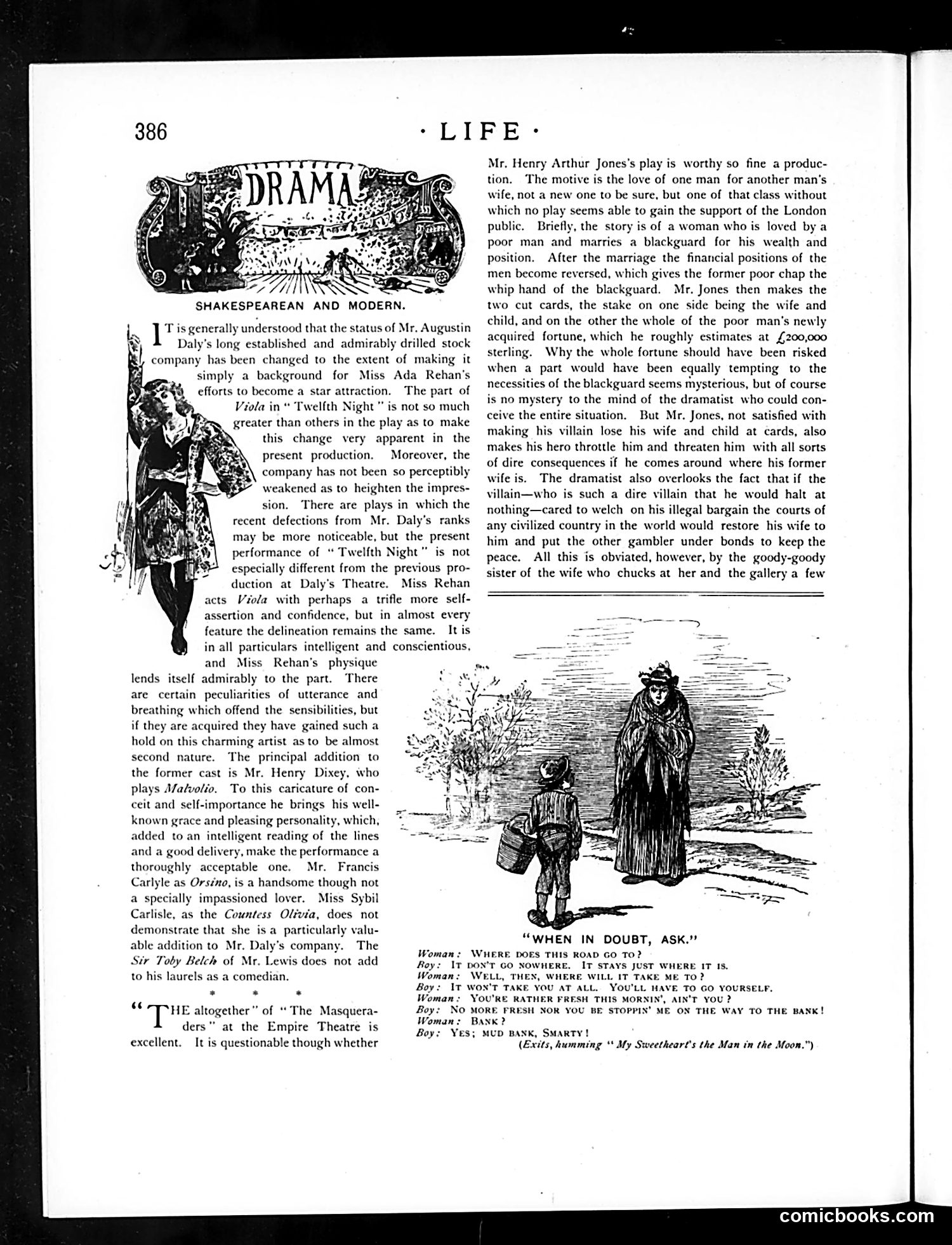
This *Life* magazine page reviews theatrical productions, primarily Augustin Daly's "Twelfth Night" starring Ada Rehan as Viola. The critic notes that while Rehan's performance is competent and intelligent, the production hasn't fundamentally changed despite Daly restructuring his company to showcase her as a star. The review praises Henry Dixey's comedic performance as Malvolio. The cartoon below shows a boy and woman discussing directions on a muddy road—a simple domestic comedic exchange typical of *Life*'s satirical humor. The boy's cheeky responses ("mud bank, smarty") mock the woman's attempts at polite conversation. The page also reviews Henry Arthur Jones's play, critiquing its plot mechanics—particularly the protagonist's decision to gamble away his entire fortune rather than a portion, and the dramatic implausibility of threatening violence against someone who could legally reclaim his former wife.
📄 Transcribed text from this page (OCR, searchable)
Machine-transcribed from the original scan — historical spelling and the odd misread are preserved.
*~ LIFE: SHAKESPEAREAN AND MODERN. T is generally understood that the status of Mr. Augustin Daly's long established and admirably drilled stock company has been changed to the extent of making it simply a background for Miss Ada Rehan's efforts to become a star attraction. The part of Viola in “ Twelfth Night" is not so much greater than others in the play as to make this change very apparent in the present production. Moreover, the company has not been so perceptibly weakened as to heighten the impres- sion. There are plays in which the recent defections from Mr. Daly's ranks may be more noticeable, but the present performance of “ Twelfth Night” is not especially different from the previous pro- duction at Daly's Theatre. Miss Rehan acts Vyola with perhaps a trifle more self- assertion and confidence, but in almost every feature the delineation remains the same. It is in all particulars intelligent and conscientious, and Miss Rehan’s physique lends itself admirably to the part. There are certain peculiarities of utterance and breathing which offend the sensibilities, but if they are acquired they have gained such a hold on this charming artist as to be almost second nature. The principal addition to the former cast is Mr. Henry Dixey, who plays Malvolio. To this caricature of con- ceit and self-importance he brings his well- known grace and pleasing personality, which, added to an intelligent reading of the lines and a good delivery, make the performance a thoroughly acceptable one. Mr. Francis Carlyle as Orséno, is a handsome though not a specially impassioned lover. Miss Sybil Carlisle, as the Countess Olivia, does not demonstrate that she is a particularly valu- able addition to Mr. Daly's company. The Str Toby Belch of Mr. Lewis does not add to his laurels as a comedia * * . §© HE altogether” of “The Masquera- ders" at the Empire Theatre is It is questionable though whether Woman: Woman: Woman: Boy: } Woman: Boy: excellent. Boy: It we You'RE RATHER FRESH THIS MORNIN’, AIN'T YOU ? MORE FRESH NOR YOU BE STOPPIN Bank ? Yes; MUD BANK, SMARTY! Mr. Henry Arthur Jones's play is worthy so fine a produc- tion. The motive is the love of one man for another man’s wife, not a new one to be sure, but one of that class without which no play seems able to gain the support of the London public. Briefly, the story is of a woman who is loved by a poor man and marries a blackguard for his wealth and position. After the marriage the financial positions of the men become reversed, which gives the former poor chap the whip hand of the blackguard. Mr. Jones then makes the two cut cards, the stake on one side being the wife and child, and on the other the whole of the poor man’s newly acquired fortune, which he roughly estimates at £200,000 sterling. Why the whole fortune should have been risked when a part would have been equally tempting to the necessities of the blackguard seems mysterious, but of course is no mystery to the mind of the dramatist who could con- ceive the entire situation. But Mr. Jones, not satisfied with making his villain lose his wife and child at cards, also makes his hero throttle him and threaten him with all sorts of dire consequences if he comes around where his former wife is. The dramatist also overlooks the fact that if the villain—who is such a dire villain that he would halt at nothing—cared to welch on his illegal bargain the courts of any civilized country in the world would restore his wife to him and put the other gambler under bonds to keep the peace, All this is obviated, however, by the goody-goody sister of the wife who chucks at her and the gallery a few “WHEN IN DOUBT, ASK.” WHERE DOES THIS ROAD GO TO? Boy: It DON'T GO NOWHERE. v IT STAYS JUST WHERE IT 18. L, THEN, WHERE WILL IT TAKE ME TO? "T TAKE YOU AT ALL, YOU'LL HAVE TO GO YOURSELF. ME ON THE WAY TO THE BANK! (Exits, humming “ My Sweetheart’s the Man in the Moon.”) comicbooks.com