
Life, 1894-08-16 · page 6 of 16
Life — August 16, 1894 — page 6: what you’re looking at
What you’re looking at
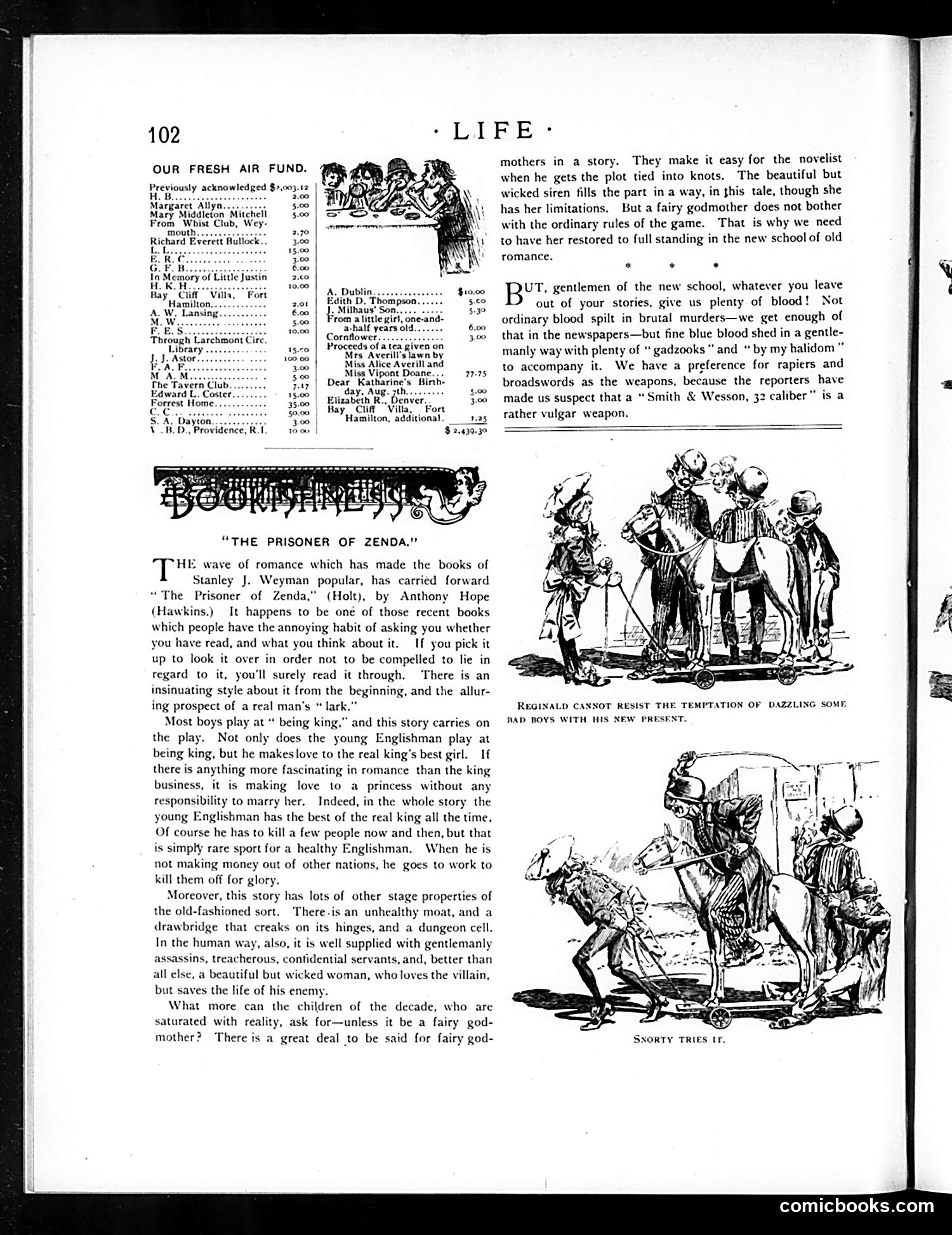
This page reviews "The Prisoner of Zenda," a popular romantic adventure novel by Anthony Hope Hawkins. The text argues that modern fiction overly emphasizes brutal realism and crime reporting, contrasting this with the appeal of romantic fantasy literature. The two illustrations accompanying the review depict scenes from the story: the first shows characters in period costume, likely representing the romantic intrigue central to the plot; the second, captioned "SORTY TRIES IT," appears to show comedic action. The review's broader point critiques the "new school" of realistic fiction favored by contemporary writers, arguing that audiences—particularly children—still need the escapism and moral clarity that fairy tales and romantic adventure stories provide, rather than constant exposure to sensational crime narratives.
📄 Transcribed text from this page (OCR, searchable)
Machine-transcribed from the original scan — historical spelling and the odd misread are preserved.
102 OUR FRESH AIR FUND. Previously acknowledged $>,003.12 4. 2.00 i Mary Middleton Mitchell From "Whist Club, Wey- a-half years old. Cornflower. Proceeds of atea given on Mrs Averill’s lawn by Miss Alice Averill and Miss Vipont Doane. Dear Katharine's Bin- day, Aug. ‘ wuasbtin Re Denver, Bay Clift “Villa, Hamilton, additional Edward L. Coster. Eorrest Home, 3.00 Cis A. Da 1.3$ $2.439-50 “THE PRISONER OF ZENDA.” HE wave of romance which has made the books of Stanley J. Weyman popular, has carriéd forward “The Prisoner of Zenda,” (Holt), by Anthony Hope (Hawkins.) It happens to be oné of those recent books which people have the annoying habit of asking you whether you have read, and what you think about it. If you pick it up to look it over in order not to be compelled to lie in regard to it, you'll surely read it through. There is an insinuating style about it from the beginning, and the allur- ing prospect of a real man’s “ lark.” Most boys play at “ being king,” and this story carries on the play. Not only does the young Englishman play at being king, but he makes love to the real king's best girl. If there is anything more fascinating in romance than the king business, it is making love to a princess without any responsibility to marry her. Indeed, in the whole story the young Englishman has the best of the real king all the time. Of course he has to kill a few people now and then, but that is simply rare sport for a healthy Englishman. When he is not making money out of other nations, he goes to work to kill them off for glory. Moreover, this story has lots of other stage properties of the old-fashioned sort. There.is an unhealthy moat, and a drawbridge that creaks on its hinges, and a dungeon cell. In the human way, also, it is well supplied with gentlemanly assassins, treacherous, confidential servants, and, better than all else, a beautiful but wicked woman, who loves the villain, but saves the life of his enemy. What more can the children of the decade, who are saturated with reality, ask for—unless it be a fairy god- mother? There is a great deal to be said for fairy god- LIFE mothers in a story. They make it easy for the novelist when he gets the plot tied into knots. The beautiful but wicked siren fills the part in a way, in ghis tale, though she has her limitations. But a fairy godmother does not bother with the ordinary rules of the game. That is why we need to have her restored to full standing in the new school of old romance. P . . UT, gentlemen of the new school, whatever you leave out of your stories, give us plenty of blood! Not ordinary blood spilt in brutal murders—we get enough of that in the newspapers—but fine blue blood shed in a gentle- manly way with plenty of “ gadzooks " and “ by my halidom ” to accompany it. We have a preference for rapiers and broadswords as the weapons, because the reporters have made us suspect that a “Smith & Wesson, 32 caliber” rather vulgar weapon. isa SNORTY TRIES tr. comicbooks.com