
Life, 1893-01-12 · page 6 of 16
Life — January 12, 1893 — page 6: what you’re looking at
What you’re looking at
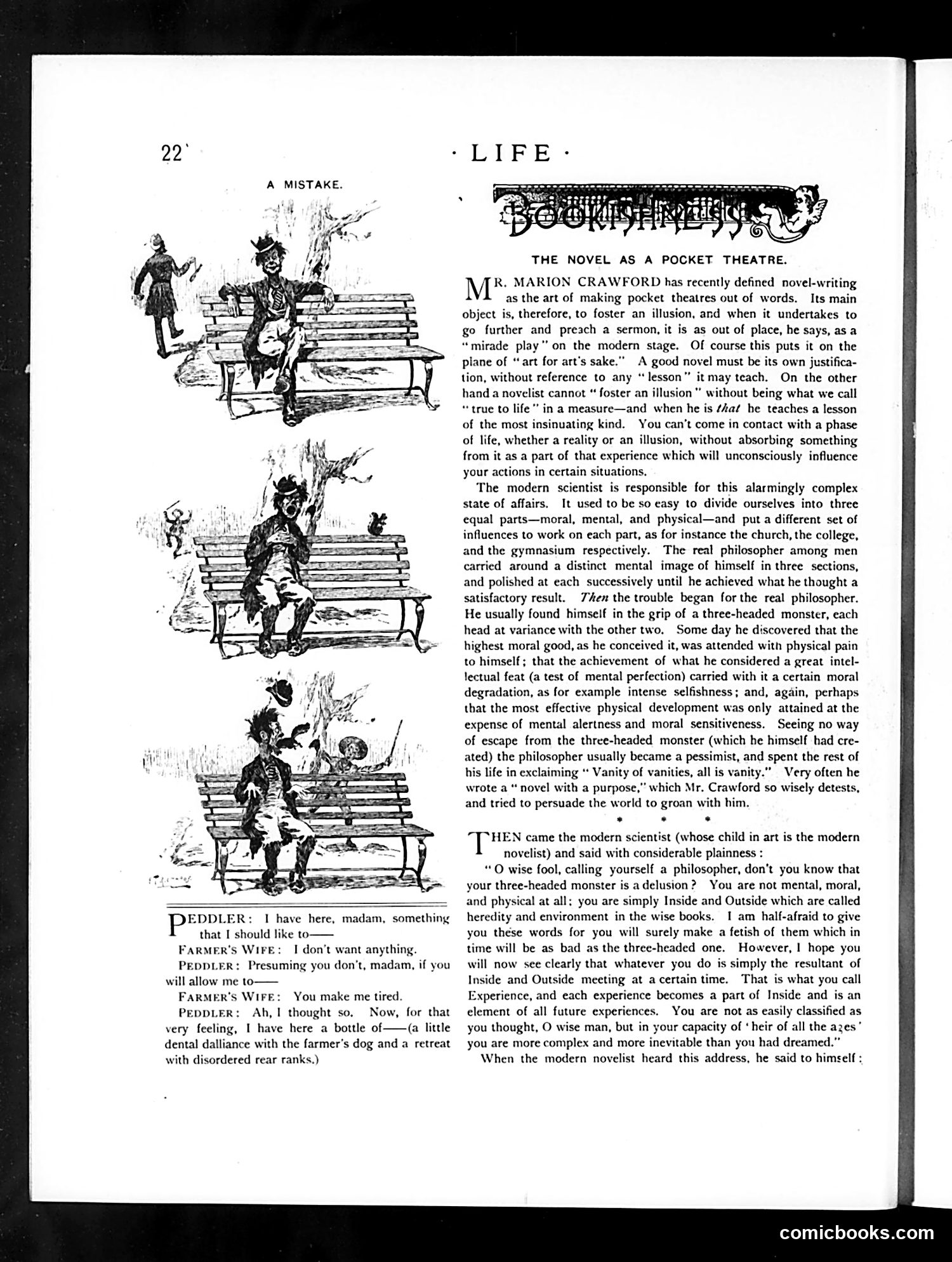
The left side shows a three-panel cartoon titled "A Mistake." A man repeatedly attempts to sit on a park bench, but each time a woman rises and departs—suggesting he's somehow driving her away through his presence or behavior, though his actions appear innocent. The humor lies in his confusion about why she keeps leaving. The right side discusses Marion Crawford's concept of the novel as "pocket theatre"—intimate psychological narratives that shape readers unconsciously. The text critiques modern science's fragmentation of human experience into separate moral, mental, and physical categories, arguing novelists must portray humans holistically. The dialogue at bottom satirizes philosophers who oversimplify human nature, depicting them as foolishly rigid compared to the novelist's nuanced understanding. The satire defends literary art against reductive philosophical thinking.
📄 Transcribed text from this page (OCR, searchable)
Machine-transcribed from the original scan — historical spelling and the odd misread are preserved.
A MISTAKE. THE NOVEL AS A POCKET THEATRE. M R. MARION CRAWFORD has recently defined novel-writing as the art of making pocket theatres out of words. Its main object is, therefore, to foster an illusion, and when it undertakes to go further and preach a sermon, it is as out of place, he says, as a “mirade play” on the modern stage. Of course this puts it on the plane of ‘art for art's sake.” A good novel must be its own justifica- tion, without reference to any “lesson” it may teach. On the other hand a novelist cannot “ foster an illusion” without being what we call “true to life” in a measure—and when he is that he teaches a lesson of the most insinuating kind. You can’t come in contact with a phase of life, whether a reality or an illusion, without absorbing something from it as a part of that experience which will unconsciously influence your actions in certain situations, The modern scientist is responsible for this alarmingly complex state of affairs. It used to be so easy to divide ourselves into three equal parts—moral, mental, and physical—and put a different set of influences to work on each part, as for instance the church, the college, and the gymnasium respectively. The real philosopher among men carried around a distinct mental image of himself in three sections, and polished at each successively until he achieved what he thought a satisfactory result. 7/en the trouble began for the real philosopher. He usually found himself in the grip of a three-headed monster, each head at variance with the other two. Some day he discovered that the highest moral good, as he conceived it, was attended with physical pain to himself; that the achievement of what he considered a great intel- lectual feat (a test of mental perfection) carried with it a certain moral degradation, as for example intense selfishness; and, again, perhaps that the most effective physical development was only attained at the expense of mental alertness and moral sensitiveness. Seeing no way of escape from the three-headed monster (which he himself had cre- ated) the philosopher usually became a pessimist, and spent the rest of his life in exclaiming “ Vanity of vanities, all is vanity.” Very often he wrote a “ novel with a purpose,” which Mr. Crawford so wisely detests, and tried to persuade the world to groan with him, . . . THEN came the modern scientist (whose child in art is the modern novelist) and said with considerable plainness : “O wise fool, calling yourself a philosopher, don’t you know that your three-headed monster is adelusion? You are not mental, moral, and physical at all; you are simply Inside and Outside which are called ZDDLER: I have here, madam, something heredity and environment in the wise books. I am_half-afraid to give that I should like to—. you these words for you will surely make a fetish of them which in FARMER'S WIFE: I don’t want anything. time will be as bad as the three-headed one. However, 1 hope you PEDDLER: Presuming you don’t, madam, if you — will now see clearly that whatever you do is simply the resultant of will allow me to— Inside and Outside meeting at a certain time. That is what you call FARMER'S WIFE: You make me tired. Experience, and each experience becomes a part of Inside and is an PEDDLER: Ah, I thought so, Now, for that element of all future experiences. You are not as easily classified as very feeling, I have here a bottle of —(a little you thought, O wise man, but in your capacity of ‘heir of all the azes* dental dalliance with the farmer's dog and a retreat’ you are more complex and more inevitable than you had dreamed.” with disordered rear ranks.) When the modern novelist heard this address, he said to himself : comicbooks.com