
Life, 1892-09-01 · page 4 of 16
Life — September 1, 1892 — page 4: what you’re looking at
What you’re looking at
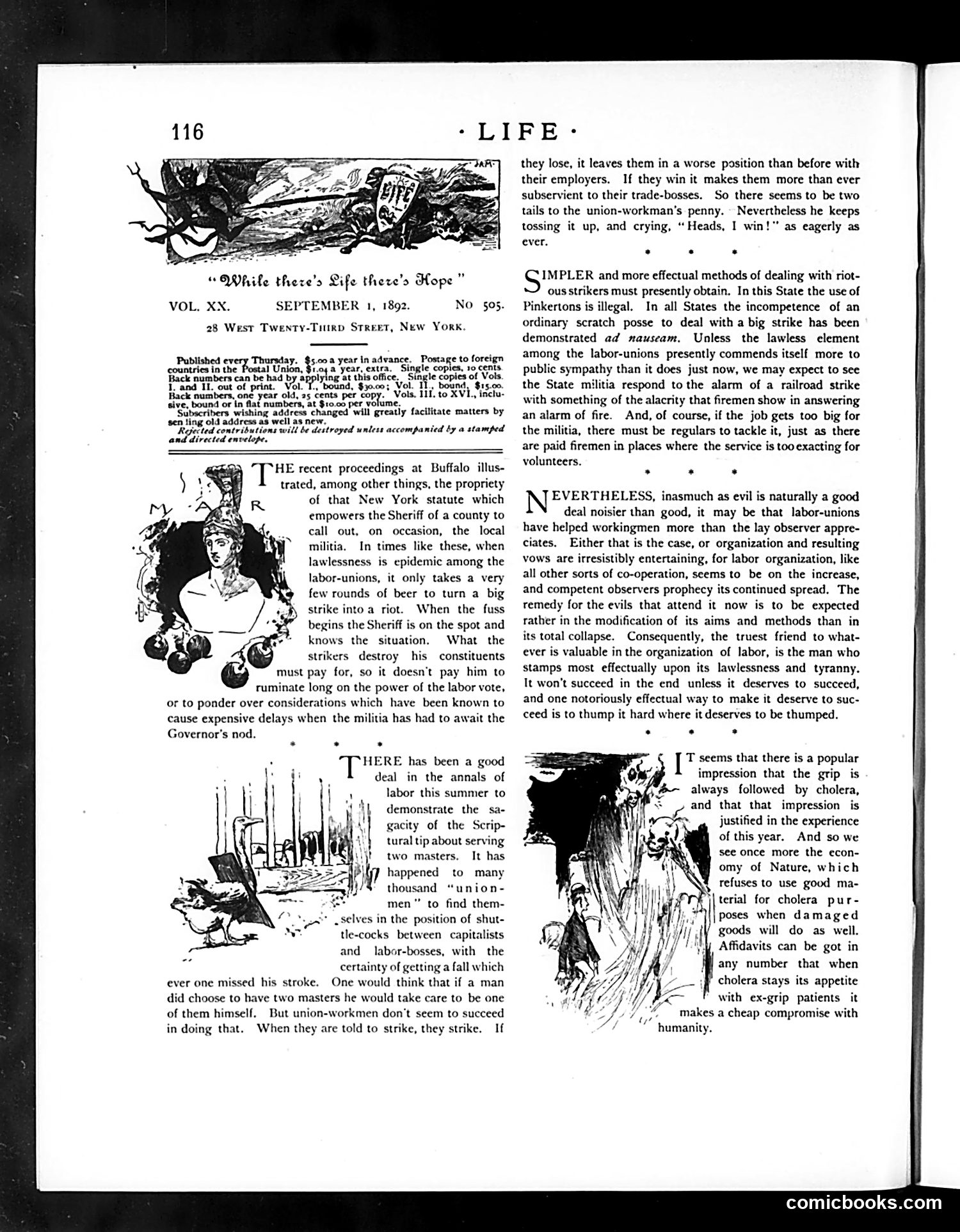
This page contains editorial commentary on labor strikes and union organization. The text discusses the use of militia to suppress strikers and criticizes both violent labor tactics and state responses. The illustrations appear to be decorative vignettes typical of Life's style—one shows a woman's head emerging from foliage (top left), another depicts figures in an industrial or dock setting (bottom left), and a third shows what appears to be a dramatic scene (right side). The central argument warns that unless labor unions moderate their methods and aims, they risk losing public sympathy and triggering harsher state crackdowns. The author argues that effective labor reform requires abandoning destructive tactics in favor of legitimate advocacy. The piece reflects 1892's turbulent labor disputes and anxieties about strikes, militia response, and cholera—which the text suggests spreads during labor unrest due to unsanitary conditions.
📄 Transcribed text from this page (OCR, searchable)
Machine-transcribed from the original scan — historical spelling and the odd misread are preserved.
LIFE “WMhile there's Life there's Hope ” VOL. XX. SEPTEMBER 1, No 28 West Twenty-Tiirp STREE 1892. 505. New York. Lip ¢ to foreign copies, 10 cents, mata copies of Vols $15.00. inclu- Published every Thursday. countries in the 1 Union, Back cumbera can be bad by 4 J. and II. out of ol s.00 a year in advance. a year, extra. lng at this office, Miko, $30.00; Vo. scibere. one yes year old, 25 cents Vols. Hits xvi an bound or in flat numbers, at $10.09 ner vol jum Sinecribess wishing address changed will greatly facititate matters by sen ling old address as well as new. Rejected contributions will be destroyed unless accompanied by a stamped and directed envelope. HE recent proceedings at Buffalo illus- trated, among other things, the propriety of that New York statute which empowers the Sheriff of a county to call out, on occasion, the local militia, In times like these, when lawlessness is epidemic among the labor-unions, it only takes a very few rounds of beer to turn a big strike into a riot. When the fuss begins the Sheriff is on the spot and knows the situation, What the strikers destroy his constituents must pay for, so it doesn’t pay him to ruminate long on the power of the labor vote, or to _ over considerations which have been known to cause expensive delays when the militia has had to await the Governor's nod. HERE has been a good deal in the annals of labor this summer to demonstrate the sa- gacity of the Scrip- tural tip about serving two masters. It has happened to many thousand “union- men” to find them- selves in the position of shut- tle-cocks between capitalists and labor-bosses, with the certainty of getting a fall which ever one missed his stroke. One would think that if a man did choose to have two masters he would take care to be one of them himself, But union-workmen don’t seem to succeed in doing that, When they are told to strike, they strike. If they lose, it leaves them in a worse position than before with their employers. If they win it makes them more than ever subservient to their trade-bosses. So there seems to be two tails to the union-workman’s penny. | Nevertheless he keeps tossing it up, and crying, “Heads, I win!" as eagerly as ever. . . . IMPLER and more effectual methods of dealing with riot- ous strikers must presently obtain. In this State the use of Pinkertons is illegal. In all States the incompetence of an ordinary scratch posse to deal with a big strike has been demonstrated ad nauseam. Unless the lawless element among the labor-unions presently commends itself more to public sympathy than it does just now, we may expect to see the State militia respond to the alarm of a railroad strike with something of the alacrity that firemen show in answering an alarm of fire. And, of course, if the job gets too big for the militia, there must be regulars to tackle it, just as there are paid firemen in places where the service is too exacting for volunteers. . . . N EVERTHELESS, inasmuch as evil is naturally a good deal noisier than good, it may be that labor-unions have helped workingmen more than the lay observer appre- ciates. Either that is the case, or organization and resulting vows are irresistibly entertaining, for labor organization, like all other sorts of co-operation, seems to be on the increase, and competent observers prophecy its continued spread. The remedy for the evils that attend it now is to be expected rather in the modification of its aims and methods than in its total collapse. Consequently, the truest friend to what- ever is valuable in the organization of labor, is the man who stamps most effectually upon its lawlessness and tyranny. It won't succeed in the end unless it deserves to succeed, and one notoriously effectual way to make it deserve to suc- ceed is to thump it hard where it deserves to be thumped. . . T seems that there is a popular impression that the grip is )- always followed by cholera, and that that impression is justified in the experience of this year. And so we see once more the econ- omy of Nature, which refuses to use good ma- | terial for cholera pur- |poses when damaged goods will do as well. Affidavits can be got in any number that when cholera stays its appetite with ex-grip patients it ior makes a cheap compromise with “humanity. comicbooks.com