
Life, 1891-09-10 · page 4 of 14
Life — September 10, 1891 — page 4: what you’re looking at
What you’re looking at
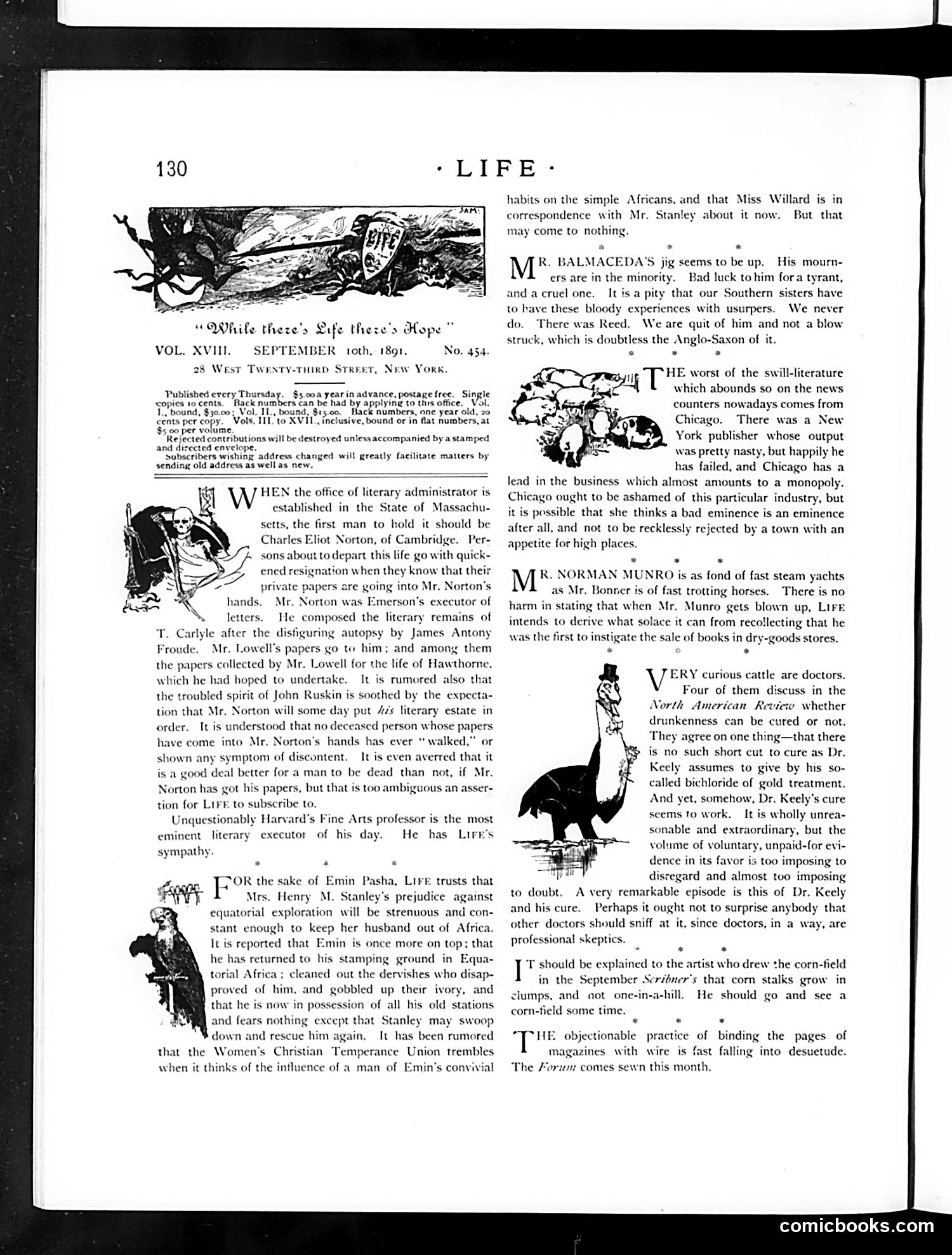
This page contains editorial commentary rather than political cartoons. The text discusses several contemporary figures and issues: **Charles Eliot Norton** is mentioned regarding his reluctance to have his private papers reviewed by executor James Antony Froude—a concern about biographical privacy. **Emin Pasha** is referenced regarding his African expeditions and Henry Stanley's wife's prejudice against him, suggesting tensions over the famous explorer's personal relationships. **Mr. Balmaceda** appears to face political misfortune (likely referring to the Chilean president's recent death in 1891). The page also critiques Chicago's literary culture and discusses fast steam yachts and cattle breeding. Decorative woodcut illustrations accompany the text but don't depict specific identifiable individuals—they're generic satirical vignettes typical of the era's magazine style.
📄 Transcribed text from this page (OCR, searchable)
Machine-transcribed from the original scan — historical spelling and the odd misread are preserved.
‘LIFE: habits on the simple Africans, and that Miss Willard is in correspondence with Mr. Stanley about it now. But that ay come to nothing. * * * M* BALMACEDA’S jig seems to be up. His mourn- ers are in the minority. Bad luck to him fora tyrant, and acruel one. Itisa pity that our Southern sisters have to have these bloody experiences with usurpers. We never “While there's Lyfe theze’s Hope bi do. There was Reed. We are quit of him and not a blow struck, which is doubtless the Anglo-Saxon of it. VOL. XVII. SEPTEMBER oth, 1891. No. 454. 28 West Twenty-tirp STREET, New York. HE worst of) thevewilk literature Published every Thursday. $5.00 year in advance, postage free. Single which abounds so on the news copies to cents, Back numbers can be had by applying to thrs office. Vol. counters nowadays comes from 1., bound, $30.00; Vol. II., bound, $15.00, Back numbers, one year old, 29 ‘ es 7 4 cents per copy. Vols, III. to XVIL., inclusive, bound or in flat numbers, at Chicago. There was a New $5.00 per volume. . ‘ Rejected contributions will be destroyed unless accompanied by a stamped York publisher whose output and directed envelope. ° en appily dubscribers wishing address changed will greatly facilitate matters by was pretty nasty, but happily he sending old address as well as ne: has failed, and Chicago has a = lead in the business which almost amounts to a monopoly. Chicago ought to be ashamed of this particular industry, but it is possible that she thinks a bad eminence is an eminence after all, and not to be recklessly rejected by a town with an appetite for high places. it HEN the office of literary administrator is i established in the State of Massachu- setts, the first man to hold it should be Charles Eliot Norton, of Cambridge. Per- sons about to depart this life go with quick- - Fy a ened resignation when they know that their R. NORMAN MUNRO is as fond of fast steam yachts private papers are going into Mr. Norton's ML P 2 : as Mr. Bonner is of fast trotting horses. There is no hands. Mr. Norton was Emerson's executor of harm in stating that when Mr. Munro gets blown up, LIFE ‘letters. He composed the literary remains of intends to derive what solace it can from recollecting that he T. Carlyle after the disfiguring autopsy by James Antony as the first to instigate the sale of books in dry-goods stores. Froude. Mr. Lowell's papers go to him: and among them Fi the papers collected by Mr. Lowell for the life of Hawthorne, a which he had hoped to undertake. It is rumored also that =RY curious cattle are doctors. the troubled spirit of John Ruskin is soothed by the expecta- 4 Four of them discuss in the tion that Mr. Norton will some day put /és literary estate in North American Review whether order, It is understood that no deceased person whose papers drunkenness can be cured or not. have come into Mr. Norton's hands has ever “ walked,” or ._They agree on one thing—that there shown any symptom of discontent. It is even averred that it BY is no such short cut to cure as Dr. is a good deal better for a man to be dead than not, if Mr. P Keely assumes to give by his so- Norton has got his papers, but that is too ambiguous an asser- : called bichloride of gold treatment. tion for LiFE to subscribe to. . - And yet, somehow, Dr. Keely’s cure Unquestionably Harvard's Fine Arts professor is the most seems to work. It is wholly unrea- eminent literary executor of his day. He has. Lire’s : sonable and extraordinary, but the sympathy. j volume of voluntary, unpaid-for evi- ? “ * * dence in its favor is too imposing to Broan Ta OR the sake of Emin Lire trusts that disregard and almost too imposing RT Mrs. Henry M. Stanley's prejudice against 0 doubt. A very remarkable episode is this of Dr. Keely P equatorial exploration will be strenuous and con- nd his cure. Perhaps it ought not to surprise anybody that stant enough to keep her husband out of Africa. other doctors should sniff at it, since doctors, in a way, are \ It is reported that Emin is once more on top; that Professional skeptics. . . T should be explained to the artist who drew the corn-field in the September Scvzéner’s that corn stalks grow in clumps, and aot one-in-a-hill. He should go and see a corn-tield some time. and fears nothing except that Stanley may swoop * . . down and rescue him again. It been rumored HE objectionable practice of binding the pages of that the Women’s Christian Temperance Union trembles magazines with wire is fast falling into desuetude. when it thinks of the influence of a man of Emin’s convivial The For comes sewn this month, he has returned to his stamping ground in Equa- torial Africa ; cleaned out the dervishes who disap- proved of him, and gobbled up their ivory, and that he is now in possession of all his old stations comicbooks.com