
Life, 1891-07-30 · page 6 of 14
Life — July 30, 1891 — page 6: what you’re looking at
What you’re looking at
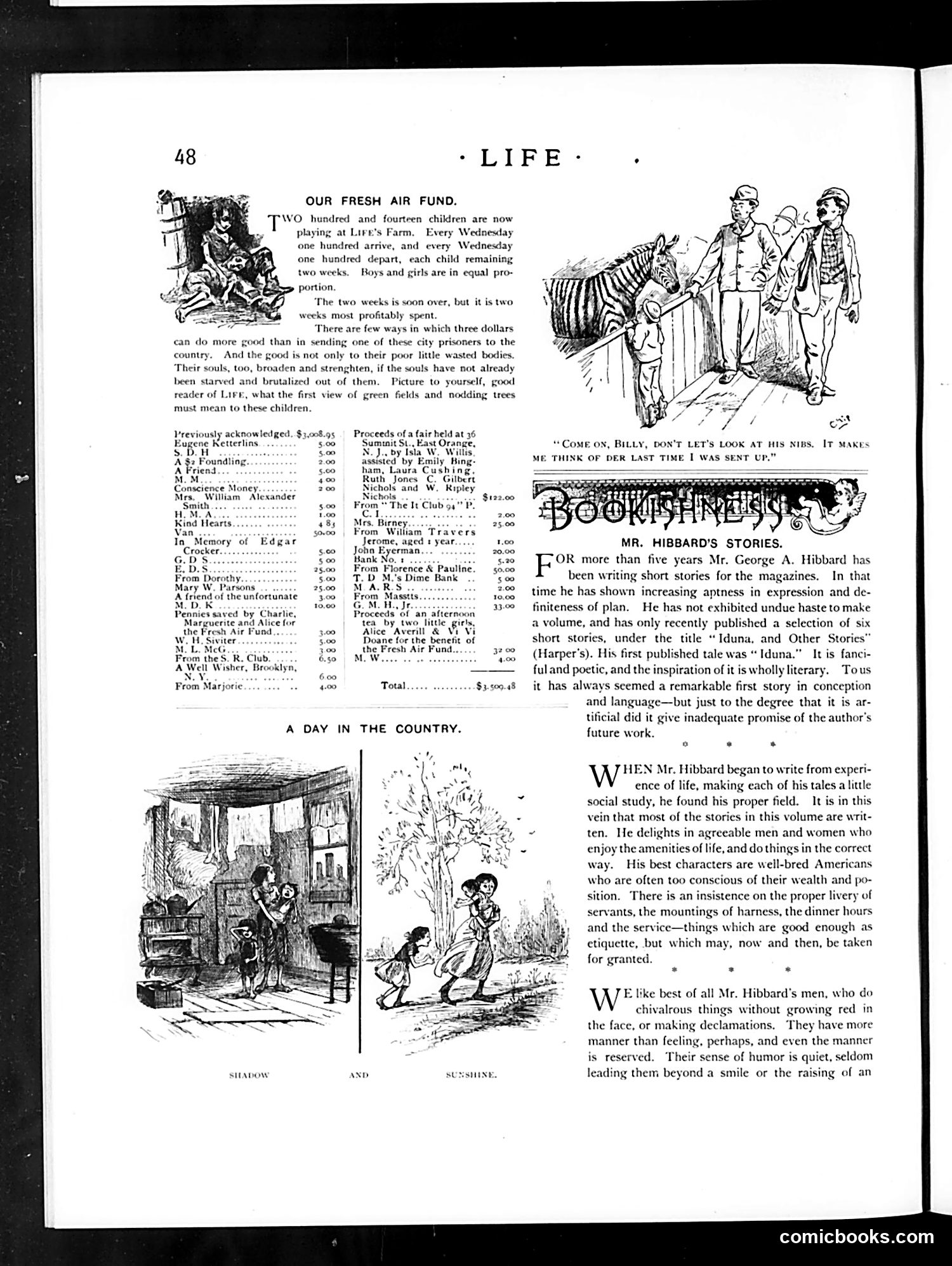
This page combines three distinct elements: **"Our Fresh Air Fund"** (left): A charitable appeal describing a program sending poor urban children to "Litt's Farm" for summer respite. The text argues this is worthwhile philanthropy—three dollars can benefit city children more than sending prisoners to the countryside. **"A Day in the Country"** (bottom): Two sketch illustrations titled "Shadow" and "Sunshine" showing rural domestic scenes, likely complementing the Fresh Air Fund message about nature's benefits for children. **"Bookshelf" and "Mr. Hibbard's Stories"** (right): A literary review of author George A. Hibbard's short story collection *"Homo and Other Stories."* The critic praises Hibbard's increasingly refined writing style and his focus on well-developed American characters and social etiquette. The page reflects Progressive Era values emphasizing social welfare and cultural refinement.
📄 Transcribed text from this page (OCR, searchable)
Machine-transcribed from the original scan — historical spelling and the odd misread are preserved.
- LIFE: OUR FRESH AIR FUND. WO hundred and fourteen chikiren are now playing at Lire’s Farm, Every Wednesday one hundred arrive, and every Wednesday one hundred depart, each child remaining two weeks, Boys and girls are in equal pro- portion ‘The two weeks is soon over, but it is two weeks most profitably spent. ‘There are few ways in which three dollars can do more good than in sending one of these city prisoners to the country. And the good is not only to their poor little wasted bodies. Their souls, too, broaden and strenghten, if the souls have not already been starved and brutalized out of them. Picture to yourself, good reader of Lire, what the first view of green fields and nodding trees must mean to these children. wt or Vreviously acknowledged. $3,008.95 Proceeds of a fair held at 36 Eugene Ketterlins.... $.00 Summit St., East Orange, “CoME ON, BILLY, DON'T LET'S LOOK AT HIS NIBS. IT MAKES 9. DOH * soo ON. J., by Isla W. Willis, A $2 Foundling. 300 assisted by Emily Bing: A Friend 5.00 ham, Laura Cushing. M.M soo Ruth Jones C Conscience Money 300 Nichols and W. Mrs. William Alexander ichols E Smith... é seo From“ The It Club 94” HOM.AL és CI = : Kind Hearts... 8; Mrs. Birney. ‘ " Van . < From William Travers In_ Memory of a Jerome, aged 1 year... MR. HIBBARD’S STORIES. Crocker........+ John Eyerman, : A gp $ eas Hank NO. 8 oe pauliae OR more than five years Mr. George A. Hibbard has .S exacvans . rom Florence & Pauline. aa i . From Dorothy. T.D M.'s Dime Bank been writing short stories for the magazines. In that pi aiden Prom Ma ioe 2. time he has shown increasing aptness in expression and de- Posies cared by Chaciiel finiteness of plan. He has not exhibited undue haste to make Marguerite and Alice for tea by two little girls, a volume, and has only recently published a selection of six h Air Fund,. 3 Alice Averill & Vi Vi . ., Senet, f ae Doane for the benefit of short stories, under the title “Iduna, and Other Stories’ Bi MOG os eigen De aAla aihaeeerel (Harper's). His first published tale was “Iduna.” It is fanci- A wel Wisher, Brooklyn, ful and poetic, and the inspiration of it is wholly literary. Tous From Marjorie +e ate it has always scemed a remarkable first story in conception and language—but just to the degree that it is ar- tificial did it give inadequate promise of the author's future work. A DAY IN THE COUNTRY. o ° * HEN Mr. Hibbard began to write from experi- ence of life, making each of his tales a little social study, he found his proper field. It is in this vein that most of the stories in this volume are writ- ten. He delights in agreeable men and women who enjoy the amenities of life, and do things in the correct way. His best characters are well-bred Americans who are often too conscious of their wealth and po- sition. There is an insistence on the proper livery of servants, the mountings of harness, the dinner hours and the service—things which are good enough as etiquette, but which may, now and then, be taken for granted. W = like best of all Mr. Hibbard’s men, who do chivalrous things without growing red in the face, or making declamations, They have more manner than feeling, perhaps, and even the manner is reserved. Their sense of humor is quiet, seldom SILADOW leading them beyond a smile or the raising of an comicbooks.com