
Life, 1891-07-23 · page 6 of 14
Life — July 23, 1891 — page 6: what you’re looking at
What you’re looking at
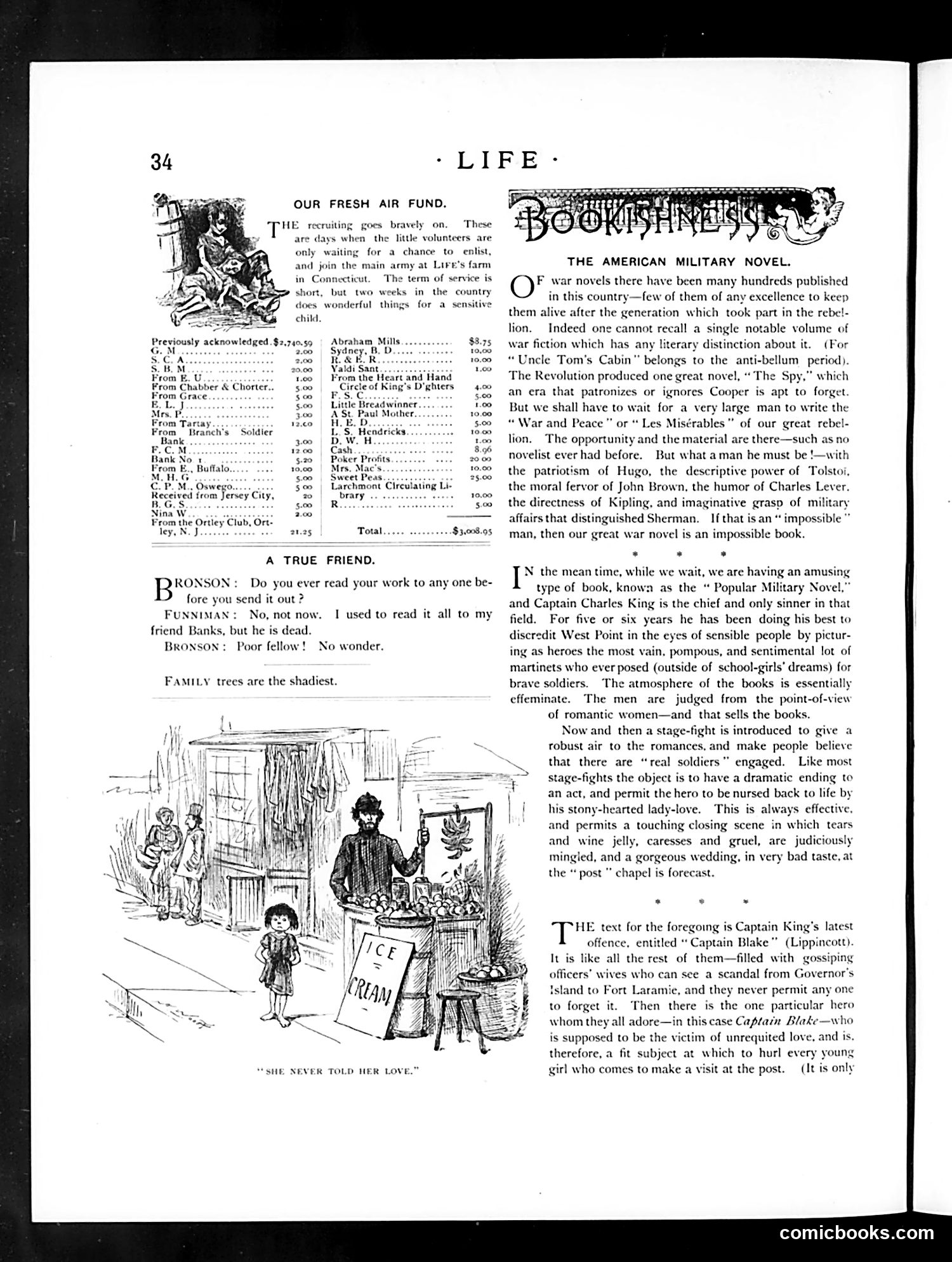
This page contains two distinct sections: **"Our Fresh Air Fund"** (top left): A fundraising list for a charitable program providing outdoor relief to urban children. The accompanying illustration shows a poor child at an ice cream vendor's cart, captioned "SHE NEVER TOLD HER LOVE"—a sentimental reference suggesting the child's unspoken gratitude or longing. **"Bookishness: The American Military Novel"** (right): A critical essay mocking popular military fiction, particularly novels by Captain Charles King. The author ridicules these books for romanticizing soldiers through melodramatic plots featuring "stony-hearted lady-loves," stage-fight heroics, and implausible scenarios. The satire targets how these novels misrepresent military life through sentimentality and poor literary quality, contrasting them unfavorably with serious war literature like *Uncle Tom's Cabin* or *War and Peace*. Both pieces reflect Life magazine's satirical voice on social conditions and cultural tastes.
📄 Transcribed text from this page (OCR, searchable)
Machine-transcribed from the original scan — historical spelling and the odd misread are preserved.
OUR FRESH AIR FUND. THE recruiting goes bravely on. These . are days when the little volunteers are only waiting for a chance to and join the main army at Lre’s farm in Connecticut enlist, term of service is the country a sensitive short, but two weeks in does wonderful child. things for Previously acknowledged $2,740.39 | Abraham Mills. Moserees ¥ Sydney, B. D.. SCAN: sorecaas R.& ER 5. 8. M sraees Yaldi Sant... From E.U : From the Heart and Hand From Chabber & Chorter.. Circle of King's D'ghters From Grace.. F.S.C en EL. J Little Breadwinner.- Mrs. P. A St. Paul Mother. From Tartay HOE. D. 3 From Branch’s LS. Hendricks D.W.H Cash Poker Profits Mrs. Mac's. Sweet Pe. Larchmont brary . $8.75 1.00 4.00 5.00 1.00, Soldier Total... A TRUE FRIEND. Do you ever read your work to any one be- fore you send it out ? FUNNIMAN: No, not now, friend Banks, but he is dead. Bronsoy I used to read it all to my Poor fellow! No wonder. FAMILY trees are the shadiest. “SHE NEVER TOLD HER LOVE.” THE AMERICAN MILITARY NOVEL. OF war novels there have been many hundreds published in this country—few of them of any excellence to keep them alive after the generation which took part in the rebel- Indeed one cannot recall a single notable volume of war fiction which has any literary distinction about it. (For “Uncle Tom's Cabin" belongs to the anti-bellum_ period). The Revolution produced one great novel, “The Spy,” which an era that patronizes or ignores Cooper is apt to forget But we shall have to wait for a very large man to write the “ War and Peace" or * Les Mis lion. lion. rables” of our great rebel- The opportunity and the material are there—such as no novelist ever had before. But what aman he must be !—with the patriotism of Hugo, the descriptive power of Tolstoi, the moral fervor of John Brown, the humor of Charles Lever. the directness of Kipling, and imaginative grasp of military affairs that distinguished Sherman. If that is an “ impossible” man, then our great war novel is an impossible book. . * * I N the mean time, while we wait, we are having an amusing type of book, known as the “ Popular Military Novel,” and Captain Charles King is the chief and only sinner in that field. For five or six years he has been doing his best to discredit West Point in the eyes of sensible people by pictur- ing as heroes the most vain, pompous, and sentimental lot of martinets who ever posed (outside of school-girls’ dreams) for brave soldiers. The atmosphere of the books is essentially effeminate. The men are judged from the point-of-view of romantic women—and that sells the books. Now and then a stage-fight is introduced to give a robust air to the romances, and make people believe that there are “real soldiers" engaged. Like most stage-fights the object is to have a dramatic ending to an act, and permit the hero to be nursed back to life by his stony-hearted lady-love. This is always effective, and permits a touching closing scene in which tears and wine jelly, caresses and gruel, are judiciously mingled, and a gorgeous wedding, in very bad taste, at the “ post ” chapel is forecast. HE text for the foregoing is Captain King’s latest offence, entitled “ Captain Blake” (Lippincott). It is like all the rest of them—filled with gossiping officers’ wives who can sce a scandal from Governor's Island to Fort Laramie, and they never permit any one to forget it. Then there is the one particular hero whom they all adore—in this case Captain Blake is supposed to be the victim of unrequited love, and is. therefore, a fit subject at which to hurl every young girl who comes to make a visit at the post. (It is only who comicbooks.com