
Life, 1891-04-30 · page 8 of 14
Life — April 30, 1891 — page 8: what you’re looking at
What you’re looking at
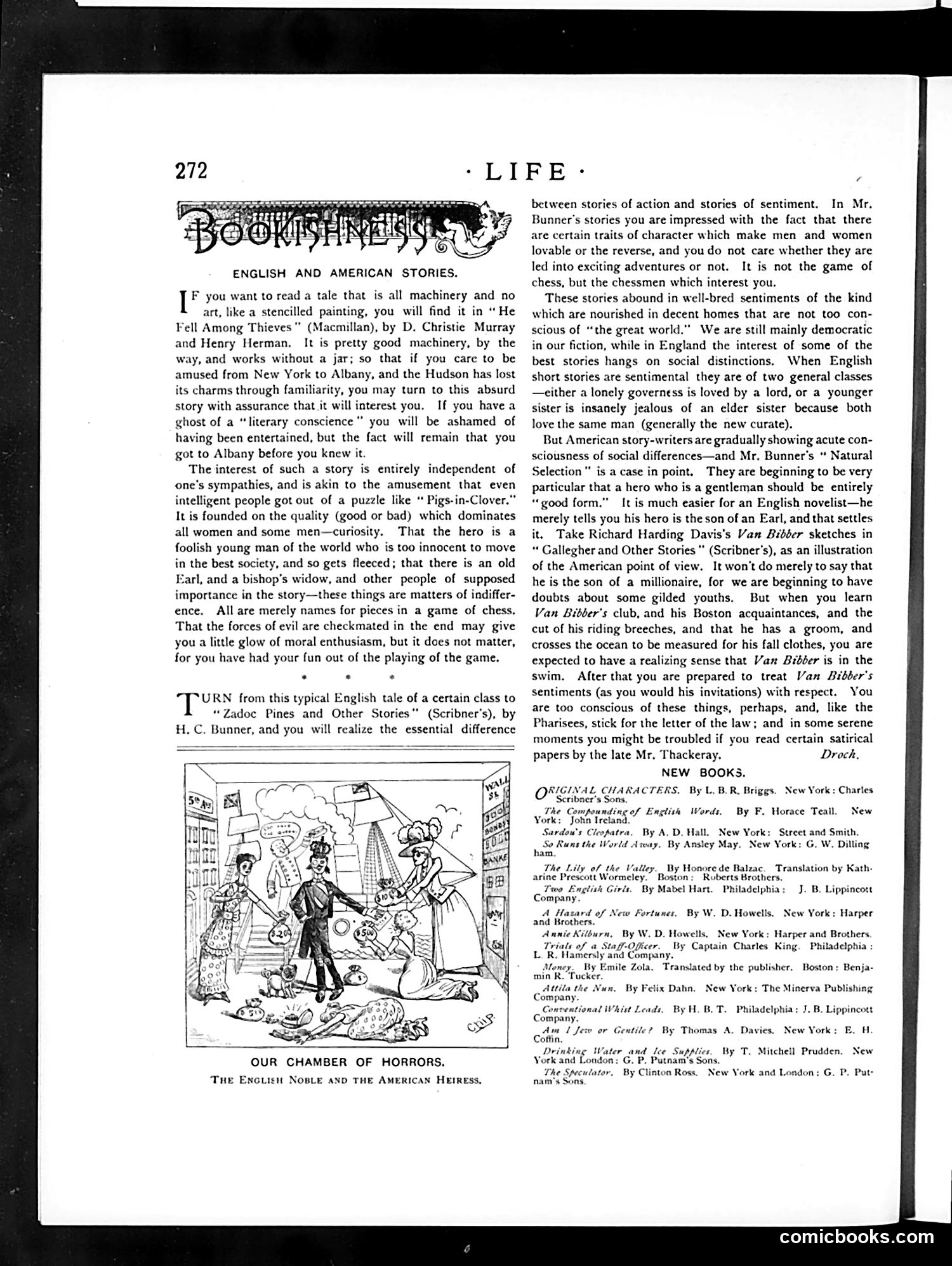
This cartoon satirizes the contrast between English and American social hierarchies. The illustration depicts a chaotic domestic scene labeled "The English Noble and the American Heiress" — likely referencing the contemporary phenomenon of wealthy American women marrying impoverished European aristocrats. The accompanying text discusses how English fiction emphasizes social distinctions and propriety, while American stories focus on individual character rather than class status. The cartoon appears to mock this cultural clash: the "chamber of horrors" shows the disorder and impropriety resulting when an American heiress (accustomed to wealth and informality) encounters English nobility's rigid codes of conduct and decorum. The satire critiques both cultures' pretensions regarding social class and matrimonial arrangements.
📄 Transcribed text from this page (OCR, searchable)
Machine-transcribed from the original scan — historical spelling and the odd misread are preserved.
‘LIFE: j ENGLISH AND AMERICAN STORIES. I* you want to read a tale that is all machinery and no art, like a stencilled painting, you will find it in “He Fell Among Thieves” (Macmillan), by D. Christie Murray and Henry Herman. It is pretty good machinery, by the way, and works without a jar; so that if you care to be amused from New York to Albany, and the Hudson has lost its charms through familiarity, you may turn to this absurd story with assurance that it will interest you. If you havea ghost of a “literary conscience” you will be ashamed of having been entertained, but the fact will remain that you got to Albany before you knew it. The interest of such a story is entirely independent of one’s sympathies, and is akin to the amusement that even intelligent people got out of a puzzle like “ Pigs-in-Clover.” It is founded on the quality (good or bad) which dominates all women and some men—curiosity. That the hero is a foolish young man of the world who is too innocent to move in the best society, and so gets fleeced; that there is an old Earl, and a bishop's widow, and other people of supposed importance in the story—these things are matters of indiffer- ence. All are merely names for pieces in a game of chess. That the forces of evil are checkmated in the end may give you a little glow of moral enthusiasm, but it does not matter, for you have had your fun out of the playing of the game. URN from this typical English tale of a certain class to “Zadoc Pines and Other Stories" (Scribner's), by H.C. Bunner, and you will realize the essential difference OUR CHAMBER OF HORRORS. THe ENGiisn NoBLe AND THE AMERICAN HEIRESS, between stories of action and stories of sentiment. In Mr. Bunner’s stories you are impressed with the fact that there are certain traits of character which make men and women lovable or the reverse, and you do not care whether they are led into exciting adventures or not. It is not the game of chess, but the chessmen which interest you. These stories abound in well-bred sentiments of the kind which are nourished in decent homes that are not too con- scious of “the great world.” We are still mainly democratic in our fiction, while in England the interest of some of the best stories hangs on social distinctions. When English short stories are sentimental they are of two general classes —cither a lonely governess is loved by a lord, or a younger sister is insanely jealous of an elder sister because both love the same man (generally the new curate). But American story-writers are gradually showing acute con- sciousness of social differences—and Mr. Bunner's “ Natural Selection a case in point, They are beginning to be very particular that a hero who is a gentleman should be entirely “good form.” It is much easier for an English novelist—he merely tells you his hero is the son of an Earl, and that settles it. Take Richard Harding Davis's Van Bidder sketches in sallegher and Other Stories ” (Scribner's), as an illustration of the American point of view. It won't do merely to say that he is the son of a millionaire, for we are beginning to have doubts about some gilded youths. But when you learn Van Bibber's club, and his Boston acquaintances, and the cut of his riding breeches, and that he has a groom, and crosses the ocean to be measured for his fall clothes, you are expected to have a realizing sense that Van Bidder is in the swim. After that you are prepared to treat Van Bibber's sentiments (as you would his invitations) with respect. You are too conscious of these things, perhaps, and, like the Pharisees, stick for the letter of the law; and in some serene moments you might be troubled if you read certain satirical papers by the late Mr. Thackeray. Droch, NEW BOOKS. O®IGINAL CHARACTERS, By L. B.R. Briggs. Scribner's Sons. The Compounding of English York: John Ireland. Sardou's Cleopatra So Runs the World A ham, The Lily of the Valley. By Honore de Balzac. Translation by Kath: arine Prescott Wormeley. Boston: Ruberts Brothers. igtish Girls. By Mabel Hart. Philadelphia ; New York : Charles Words. By F, Horace Teall. New By A. D. Hall, New York: Street and Smith. . By Ansley May. New York: G. W. Dilling J. B. Lippincott A Hazard of New Fortunes. and Brothers. Annie Kilburn, rials of a Staff-Officer. L_R. Hamersly and Company. Money. By Emile Zola. Translated by the publisher. min R. Tucker, Attila the Nun, Company. Ce ational Whist Leads. Company. Am I Jew or Gentile? Coffin. Drinking Water and Ice Supplies. York and London: G. P, Putnam's Sons. The Specutator, By Clinton Ross. New York and London: G. P. Put- nam’s Sons. By W. D. Howells, New York: Harper By W. D. Howells, New York: Harper and Brothers By Captain Charles King. Philadelphia : Boston : Benja- By Felix Dahn, New York: The Minerva Publishing By H. B. T. Philadelphia: J. B. Lippincott By Thomas A. Davies. New York: E. By T. Mitchell Prudden. New comicbooks.com