
Life, 1885-05-21 · page 7 of 16
Life — May 21, 1885 — page 7: what you’re looking at
What you’re looking at
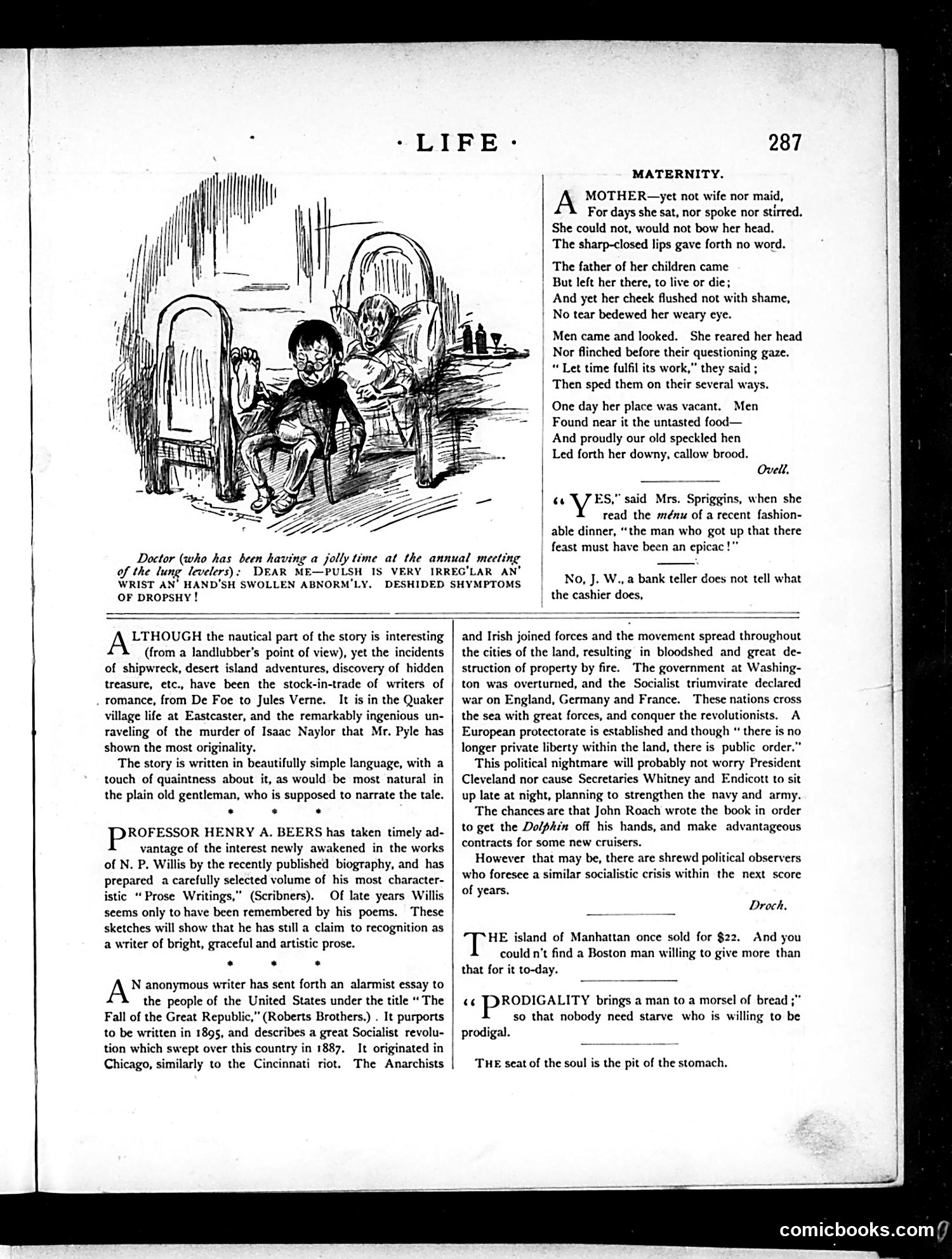
**The Cartoon:** The sketch depicts a thin, gaunt mother with children in a sparse interior, illustrating the poem "Maternity" below it. The image shows domestic poverty and maternal suffering—a woman who has borne children but received no support from their father, left "to live or die." **The Satire:** The accompanying text satirizes social indifference to poverty. One anecdote mocks a wealthy dinner guest who complained about an "epicure" waiter—suggesting the rich obsess over trivial dining details while mothers and children starve. Another quip jokes that a bank teller wouldn't reveal what a cashier does, implying financial corruption. **Context:** This reflects late-19th-century Progressive Era criticism of social inequality, inadequate labor wages, and abandonment of poor mothers—issues that motivated Socialist movements and reform efforts of the period.
📄 Transcribed text from this page (OCR, searchable)
Machine-transcribed from the original scan — historical spelling and the odd misread are preserved.
: Sie. ( Doctor (who has been having a jolly time at the ani of the lung levelers): DEAR ME—PULSH IS VERY IRI WRIST AN’ HAND'SH SWOLLEN ABNORM'LY, DESHIDED SHYMPTOMS OF DROPSHY ! IFE-: 287 MATERNITY. MOTHER~yet not wife nor maid, For days she sat, nor spoke nor stirred. She could not, would not bow her head. The sharp-closed lips gave forth no word. The father of her children came But left her there, to live or die; And yet her cheek flushed not with shame, No tear bedewed her weary eye. Men came and looked. She reared her head Nor flinched before their questioning gaze. | “Let time fulfil its work,” they said ; Then sped them on their several ways. One day her place was vacant. Men Found near it the untasted food— And proudly our old speckled hen Led forth her downy, callow brood. Ovell, oe ES,” said Mrs. Spriggins, when she tead the ménu of a recent fashion- able dinner, “the man who got up that there feast must have been an epicac !" nual meeting REG'LAR AN’ | No, J. W., a bank teller does not tell what the cashier does, LTHOUGH the nautical part of the story is interesting (from a landlubber’s point of view), yet the incidents of shipwreck, desert island adventures, discovery of hidden treasure, etc., have been the stock-in-trade of writers of romance, from De Foe to Jules Verne. It is in the Quaker village life at Eastcaster, and the remarkably ingenious un- raveling of the murder of Isaac Naylor that Mr. Pyle has shown the most originality. The story is written in beautifully simple language, with a touch of quaintness about it, as would be most natural in the plain old gentleman, who is supposed to narrate the tale. . . . ROFESSOR HENRY A. BEERS has taken timely ad- vantage of the interest newly awakened in the works of N. P. Willis by the recently published biography, and has prepared a carefully selected volume of his most character- istic “Prose Writings,” (Scribners). Of late years Willis seems only to have been remembered by his poems. These sketches will show that he has still a claim to recognition as | a writer of bright, graceful and artistic prose. . . . A’ anonymous writer has sent forth an alarmist essay to the people of the United States under the title “ The Fall of the Great Republic,” (Roberts Brothers.) . It purports to be written in 1895, and describes a great Socialist revolu- tion which swept over this country in 1887. It originated in Chicago, similarly to the Cincinnati riot. The Anarchists and Irish joined forces and the movement spread throughout the cities of the land, resulting in bloodshed and great de- | struction of property by fire. The government at Washing- ton was overturned, and the Socialist triumvirate declared war on England, Germany and France. These nations cross the sea with great forces, and conquer the revolutionists. A European protectorate is established and though “ there is no longer private liberty within the land, there is public order.” This political nightmare will probably not worry President Cleveland nor cause Secretaries Whitney and Endicott to sit up late at night, planning to strengthen the navy and army. The chances are that John Roach wrote the book in order to get the Dolphin off his hands, and make advantageous contracts for some new cruisers. However that may be, there are shrewd political observers who foresee a similar socialistic crisis within the next score of years, Droch. HE island of Manhattan once sold for $22. And you could n't find a Boston man willing to give more than that for it to-day. “ RODIGALITY brings a man to a morsel of bread ;” so that nobody need starve who is willing to be | prodigal. ‘THE seat of the soul is the pit of the stomach. comicbooks.com/) }