
Life, 1884-11-06 · page 6 of 16
Life — November 6, 1884 — page 6: what you’re looking at
What you’re looking at
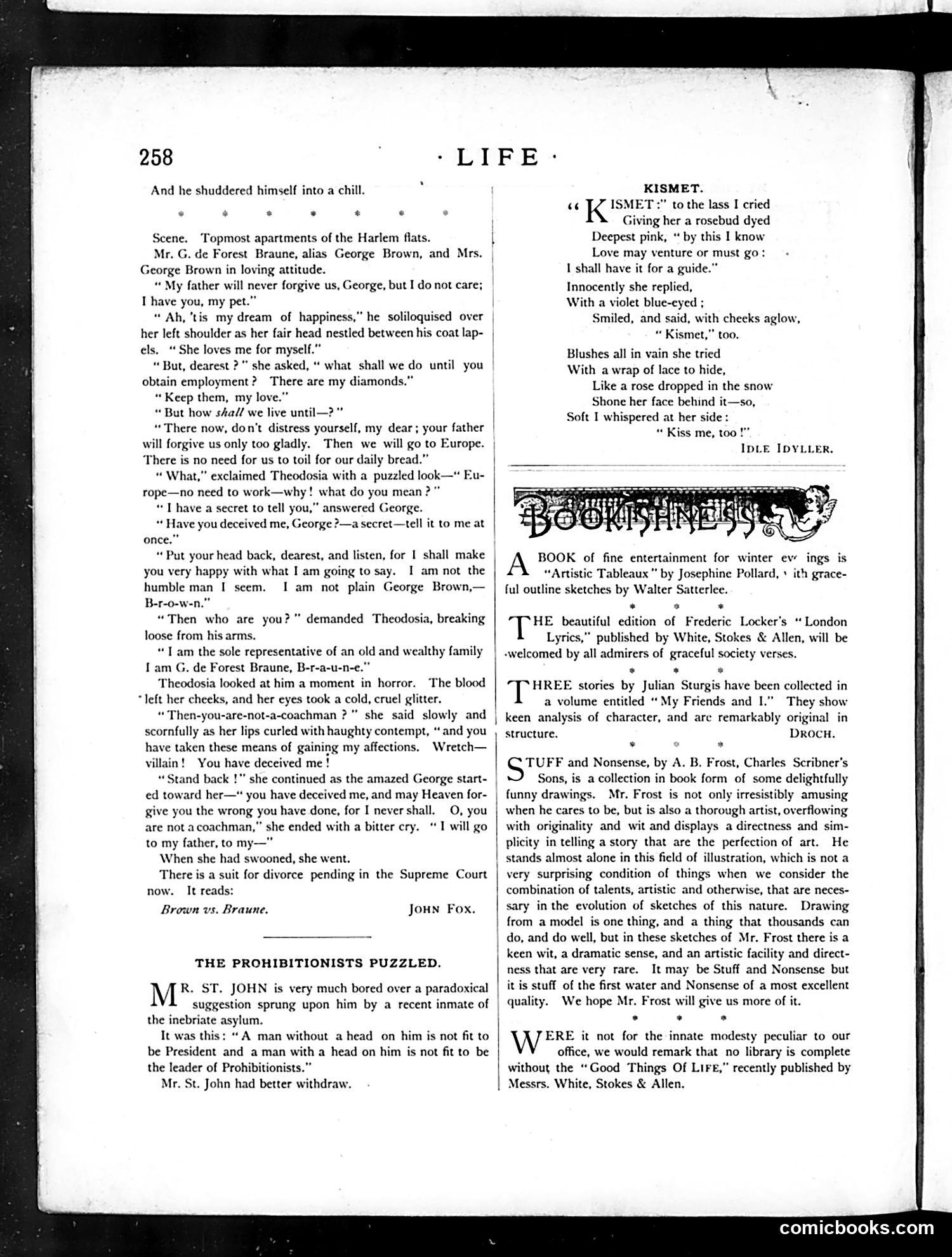
This page contains literary content rather than political cartoons. The main section titled "THE PROHIBITIONISTS' PUZZLED" features a brief satirical piece about Mr. St. John, apparently a Prohibitionist leader, who received a paradoxical riddle from an asylum inmate: "A man without a head on him is not fit to be President and a man with a head on him is not fit to be the leader of Prohibitionists." The satire mocks Prohibitionist leadership as intellectually deficient—suggesting they're unfit regardless of their mental capacity. This reflects early 20th-century cultural debates over Prohibition, positioning the reform movement's leaders as absurdly contradictory or foolish. The page also contains book reviews and a poem titled "Kismet" by Idle Idyller.
📄 Transcribed text from this page (OCR, searchable)
Machine-transcribed from the original scan — historical spelling and the odd misread are preserved.
258 And he shuddered himself into a chill. . * * . * * Scene. Topmost apartments of the Harlem flats. Mr. G. de Forest Braune, alias George Brown, and Mrs. George Brown in loving attitude. “ My father will never forgive us, George, but I do not care; I have you, my pet.” “Ah, ‘tis my dream of happiness,” he soliloquised over her left shoulder as her fair head nestled between his coat lap- els. “She loves me for myself.” “ But, dearest ?" she asked, * what shall we do until you obtain employment? There are my diamonds.” “Keep them, my love.” “ But how sha// we live until—?"” “There now, don’t distress yourself, my dear; your father | will forgive us only too gladly. Then we will go to Europe. There is no need for us to toil for our daily bread.” “ What,” exclaimed Theodosia with a puzzled look—“ Eu- | rope—no need to work—why! what do you mean?” « T have a secret to tell you,” answered George. “ Have you deceived me, George ?—a secret—tell it to me at once.” “Put your head back, dearest, and listen, for | shall make you very happy with what I am going to say. I am not the humble man I seem. I am not plain George Brown,— B-r-o-w-n.” “Then who are you?” demanded Theodosia, breaking loose from his arms. “Tam the sole representative of an old and wealthy family I am G. de Forest Braune, B-r-a-u-n-c.” ‘Theodosia looked at him a moment in horror. The blood “left her cheeks, and her eyes took a cold, cruel glitter. “ Then-you-are-not-a-coachman ?" she said slowly and scornfully as her lips curled with haughty contempt, “and you have taken these means of gaining my affections. Wretch— villain! You have deceived me! tand back !" she continued as the amazed George start- ed toward her—“ you have deceived me, and may Heaven for- give you the wrong you have done, for I never shall. O, you are not acoachman,” she ended with a bitter cry. “1 will go to my father, to my When she had swooned, she went. There is a suit for divorce pending in the Supreme Court now. It reads: Brown vs. Braune. JouN Fox. THE PROHIBITIONISTS PUZZLED. R. ST. JOHN is very much bored over a paradoxical suggestion sprung upon him by a recent inmate of the inebriate asylum. Tt was this: “A man without a head on him is not fit to be President and a man with a head on him is not fit to be the leader of Prohibitionists.” Mr. St. John had better withdraw. | quality. KISMET. “ ISMET:” to the lass I cried Giving her a rosebud dyed Deepest pink, “ by this I know Love may venture or must go: I shall have it for a guide.” Innocently she replied, With a violet blue-eyed ; Smiled, and said, with cheeks aglow, “ Kismet,” too. Blushes all in vain she tried With a wrap of lace to hide, Like a rose dropped in the snow Shone her face behind it—so, Soft 1 whispered at her side : “ Kiss me, too !”” IDLE IDYLLER. BOOK of fine entertainment for winter ew ings is “Artistic Tableaux” by Josephine Pollard, » ith grace- ful outline sketches by Walter Satterlee. * ° * HE beautiful edition of Frederic Locker's “London Lyri published by White, Stokes & Allen, will be | -welcomed by all admirers of graceful society verses. * . * HREE stories by Julian Sturgis have been collected in a volume entitled “My Friends and I." They show keen analysis of character, and are remarkably original in structure, Drocu. . ‘ * TUFF and Nonsense, by A. B. Frost, Charles Scribner's Sons, is a collection in book form of some delightfully funny drawings. Mr. Frost is not only irresistibly amusing when he cares to be, but is also a thorough artist, overflowing with originality and wit and displays a directness and sim- plicity in telling a story that are the perfection of art. He stands almost alone in this field of illustration, which is not a very surprising condition of things when we consider the combination of talents, artistic and otherwise, that are neces- sary in the evolution of sketches of this nature. Drawing from a model is one thing, and a thing that thousands can do, and do well, but in these sketches of Mr. Frost there is a keen wit, a dramatic sense, and an artistic facility and direct- ness that are very rare. It may be Stuff and Nonsense but it is stuff of the first water and Nonsense of a most excellent We hope Mr. Frost will give us more of it. . * * ERE it not for the innate modesty peculiar to our office, we would remark that no library is complete without the “Good Things Of Lire,” recently published by | Messrs. White, Stokes & Allen. comicbooks.com