
Life, 1884-01-24 · page 6 of 14
Life — January 24, 1884 — page 6: what you’re looking at
What you’re looking at
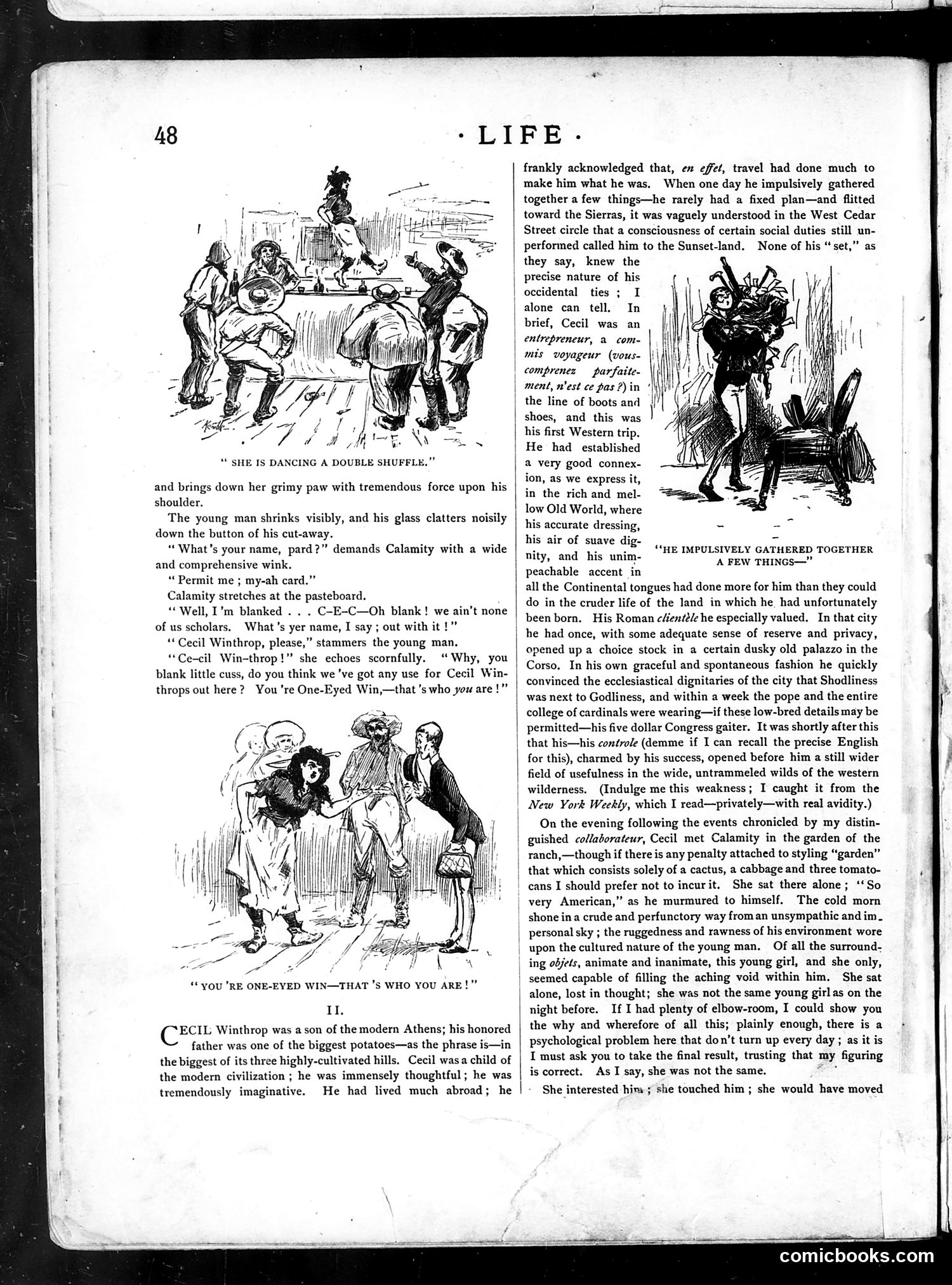
This page contains three sketch illustrations accompanying a narrative about Cecil Winthrop, described as "a son of the modern Athens" (likely New York). The sketches depict social scenes: one shows a woman dancing a "double shuffle," another shows a confrontation between men, and a third shows figures on a street. The text describes Cecil as a wealthy, well-traveled entrepreneur who established himself in fashionable circles and later opened a stock business in the Gorge (likely a geographical reference). The satirical point concerns his pretensions to sophistication and cultural refinement despite humble origins—a common Life magazine theme mocking nouveau riche social climbers of the era. The illustrations humorously capture his attempts at respectability and social elevation.
📄 Transcribed text from this page (OCR, searchable)
Machine-transcribed from the original scan — historical spelling and the odd misread are preserved.
‘LIFE - “ SHE IS DANCING A DOUBLE SHUFFLE.” and brings down her grimy paw with tremendous force upon his shoulder. The young man shrinks visibly, and his glass clatters noisily down the button of his cut-away. “What's your name, pard?” demands Calamity with a wide and comprehensive wink. “ Permit me ; my-ah card.” Calamity stretches at the pasteboard. “Well, I’m blanked . . . C-E-C—Oh blank! we ain’t none of us scholars, What’s yer name, I say ; out with it !”” “Cecil Winthrop, please,” stammers the young man. “Ce-cil Win-throp!” she echoes scornfully. “Why, you blank little cuss, do you think we ’ve got any use for Cecil Win- | throps out here? You ’re One-Eyed Win,—that ’s who you are !” | performed called him to the Sunset-land. | occidental | comprenes | ment, n'est ce pas ?)in | the line of boots and | nity, and his unim- frankly acknowledged that, en effet, travel had done much to make him what he was. When one day he impulsively gathered together a few things—he rarely had a fixed plan—and flitted toward the Sierras, it was vaguely understood in the West Cedar Street circle that a consciousness of certain social duties still un- None of his “set,” as they say, knew the precise nature of his ties ; I alone can tell. In brief, Cecil was an entrepreneur, 4 com- mis voyageur (vous- parfaite. shoes, and this was his first Western trip. | He had established a very good connex- ion, as we express it, in the rich and mel- low Old World, where his accurate dressing, his air of suave dig- “HE IMPULSIVELY GATHERED TOGETHER m A FEW THINGS—” peachable accent in all the Continental tongues had done more for him than they could do in the cruder life of the land in which he. had unfortunately been born. His Roman clientele he especially valued. In that city he had once, with some adequate sense of reserve and privacy, opened up a choice stock in a certain dusky old palazzo in the Corso. In his own graceful and spontaneous fashion he quickly convinced the ecclesiastical dignitaries of the city that Shodliness was next to Godliness, and within a week the pope and the entire college of cardinals were wearing—if these low-bred details may be permitted—his five dollar Congress gaiter. It was shortly after this that his—his controle (demme if I can recall the precise English for this), charmed by his success, opened before him a still wider field of usefulness in the wide, untrammeled wilds of the western wilderness. (Indulge me this weakness; I caught it from the New York Weekly, which I read—privately—with real avidity.) On the evening following the events chronicled by my distin- | guished collaborateur, Cecil met Calamity in the garden of the | ranch,—though if there is any penalty attached to styling “garden” “YOU 'RE ONE-EYED WIN—THAT ’S WHO YOU ARE!” Il. (CECHL Winthrop was ason of the modern Athens; his honored father was one of the biggest potatoes—as the phrase is—in the biggest of its three highly-cultivated hills. Cecil wasa child of the modern civilization ; he was immensely thoughtful ; he was tremendously imaginative. He had lived much abroad; he | | seemed capable of filling the aching void within him. that which consists solely of a cactus, a cabbage and three tomato- cans I should prefer not to incurit. She sat there alone; ‘‘So very American,” as he murmured to himself. The cold morn shone ina crude and perfunctory way from an unsympathic and im. personal sky ; the ruggedness and rawness of his environment wore upon the cultured nature of the young man. Of all the surround- ing odjets, animate and inanimate, this young girl, and she only, She sat alone, lost in thought; she was not the same young girl as on the night before. If I had plenty of elbow-room, I could show you the why and wherefore of all this; plainly enough, there is a psychological problem here that don’t turn up every day ; as it is I must ask you to take the final result, trusting that my figuring is correct. As I say, she was not the same. . She interested him ; she touched him ; she would have moved comicbooks.com