
Life, 1884-01-24 · page 4 of 14
Life — January 24, 1884 — page 4: what you’re looking at
What you’re looking at
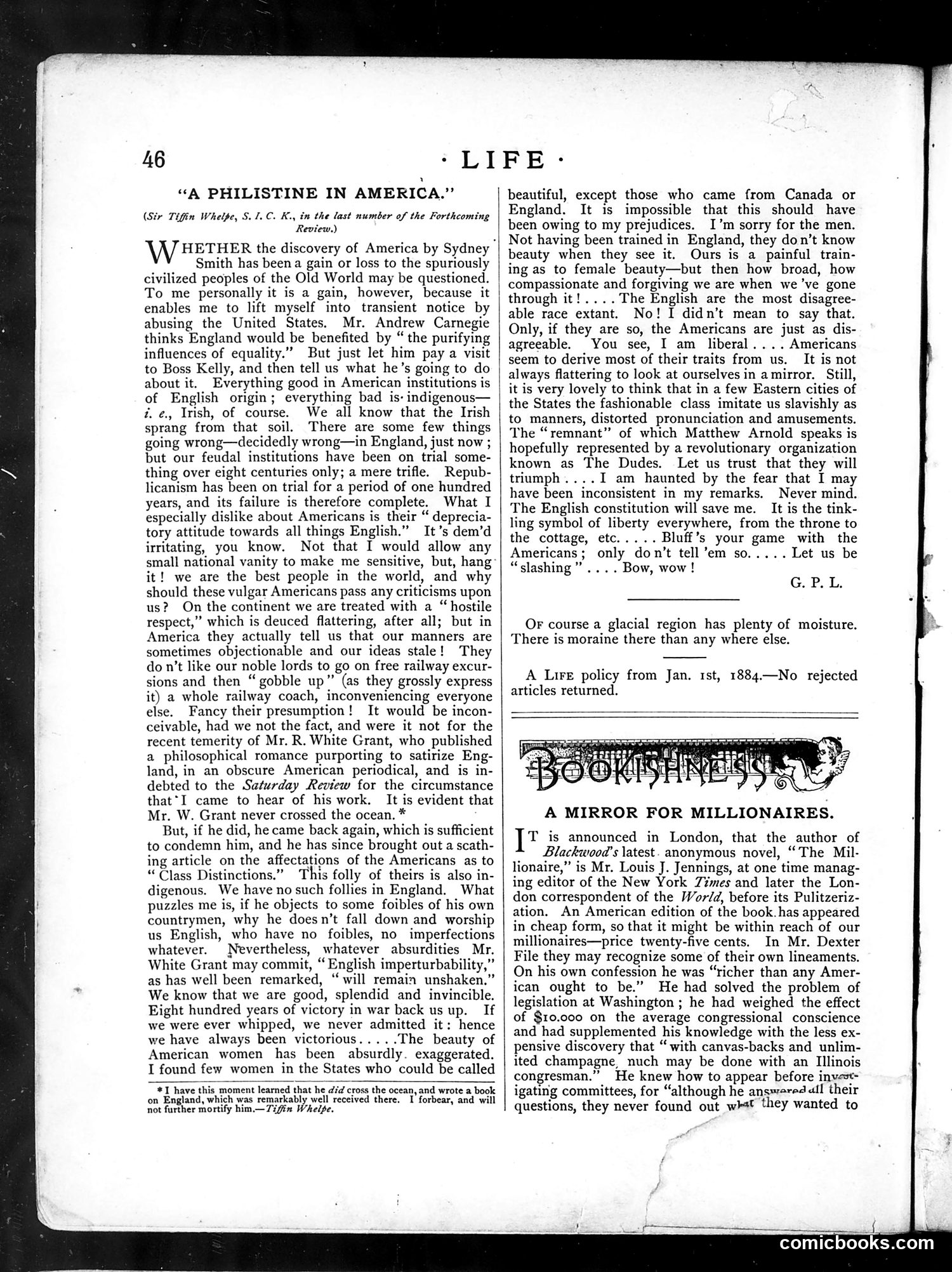
This page contains two distinct pieces: **"A Philistine in America"** (top): A lengthy satirical letter critiquing American attitudes toward English culture and institutions. The author defends England's traditions while mocking Americans who simultaneously admire and resent British superiority. References include criticism of R. White Grant's work and commentary on American "Class Distinctions." **"A Mirror for Millionaires"** (bottom): A book review announcing Louis J. Jennings' new novel *"The Millionaire,"* published by Blackwood's. The satire suggests wealthy Americans might recognize themselves in this work. It humorously describes how Jennings supposedly solved Washington legislative problems through strategic bribery of congressmen—implying American political corruption as satirical commentary. Both pieces employ ironic critique of American and Anglo-American social pretensions.
📄 Transcribed text from this page (OCR, searchable)
Machine-transcribed from the original scan — historical spelling and the odd misread are preserved.
46 “A PHILISTINE IN AMERICA.” (Sir Tifin Whelpe, S.1.C. K., in the last number of the Forthcoming Review.) \ NV HETHER the discovery of America by Sydney’ Smith has been a gain or loss to the spuriously civilized peoples of the Old World may be questioned. To me personally it is a gain, however, because it enables me to lift myself into transient notice by abusing the United States. Mr. Andrew Carnegie thinks England would be benefited by “ the purifying influences of equality.” But just let him pay a visit to Boss Kelly, and then tell us what he’s going to do about it. of English origin; everything bad is-indigenous— z. é., Irish, of course. We all know that the Irish sprang from that soil. There are some few things going wrong—decidedly wrong—in England, just now ; but our feudal institutions have been on trial some- thing over eight centuries only; a mere trifle. Repub- licanism has been on trial for a period of one hundred years, and its failure is therefore complete. What I especially dislike about Americans is their “ deprecia- tory attitude towards all things English.” It’s dem’d irritating, you know. Not that I would allow any small national vanity to make me sensitive, but, hang~ it! we are the best people in the world, and why should these vulgar Americans pass any criticisms upon us? On the continent we are treated with a “hostile respect,” which is deuced flattering, after all; but in America they actually tell us that our manners are sometimes objectionable and our ideas stale! They do n’t like our noble lords to go on free railway excur- sions and then “gobble up” (as they grossly express it) a whole railway coach, inconveniencing everyone else. Fancy their presumption! It would be incon- ceivable, had we not the fact, and were it not for the recent temerity of Mr. R. White Grant, who published a philosophical romance purporting to satirize Eng- land, in an obscure American periodical, and is in- debted to the Saturday Review for the circumstance that*I came to hear of his work. It is evident that Mr. W. Grant never crossed the ocean. * But, if he did, he came back again, which is sufficient to condemn him, and he has since brought out a scath- ing article on the affectations of the Americans as to “Class Distinctions.” This folly of theirs is also in- digenous. We have no such follies in England. What puzzles me is, if he objects to some foibles of his own countrymen, why he doesn’t fall down and worship us English, who have no foibles, no imperfections whatever. Nevertheless, whatever absurdities Mr. White Grant may commit, “English imperturbability,” as has well been remarked, “ will remain unshaken.” We know that we are good, splendid and invincible. Eight hundred years of victory in war back us up. If we were ever whipped, we never admitted it: hence we have always been victorious The beauty of American women has been absurdly. exaggerated. I found few women in the States who could be called *I have this moment learned that he did cross the ocean, and wrote a book on England, which was remarkably well received there. I’ forbear, and will not further mortify him —7ifin Whelpe. | seem to derive most of their traits from us. Everythi ‘din Ameri sietitations ia | always flattering to look at ourselves in a mirror. Still, verything good in éAmerican institutions Is | it is very lovely to think that in a few Eastern cities of - LIFE: beautiful, except those who came from Canada or England. It is impossible that this should have been owing to my prejudices. I’m sorry for the men. | Not having been trained in England, they don’t know beauty when they see it. Ours is a painful train- ing as to female beauty—but then how broad, how compassionate and forgiving we are when we ’ve gone The English are the most disagree- able race extant. No! I didn’t mean to say that. Only, if they are so, the Americans are just as dis- agreeable. You see, I am liberal. ... Americans It is not the States the fashionable class imitate us slavishly as to manners, distorted pronunciation and amusements. The “remnant” of which Matthew Arnold speaks is hopefully represented by a revolutionary organization known as The Dudes. Let us trust that they will triumph ....I am haunted by the fear that I may have been inconsistent in my remarks. Never mind. The English constitution will save me. It is the tink- ling symbol of liberty everywhere, from the throne to the cottage, etc Bluff’s your game with the Americans; only don’t tell ’em so. Let us be “slashing” .... Bow, wow! G.P.L. Or course a glacial region has plenty of moisture. There is moraine there than any where else. A Lire policy from Jan. 1st, 1884.—No rejected articles returned. A MIRROR FOR MILLIONAIRES. is announced in London, that the author of Blackwood’s latest. anonymous novel, “The Mil- I" lionaire,” is Mr. Louis J. Jennings, at one time manag- ing editor of the New York Z?mes and later the Lon- don correspondent of the World, before its Pulitzeriz- ation. An American edition of the book. has appeared in cheap form, so that it might be within reach of our millionaires—price twenty-five cents. In Mr. Dexter File they may recognize some of their own lineaments. On his own confession he was “richer than any Amer- ican ought to be.” He had solved the problem of legislation at Washington ; he had weighed the effect of $10,000 on the average congressional conscience and had supplemented his knowledge with the less ex- pensive discovery that “ with canvas-backs and unlim- ited champagne, nuch may be done with an Illinois congresman.” He knew how to appear before invet- igating committees, for “although he answered ull their questions, they never found out wt they wanted to comicboo! ks.com