
Life, 1884-01-24 · page 2 of 14
Life — January 24, 1884 — page 2: what you’re looking at
What you’re looking at
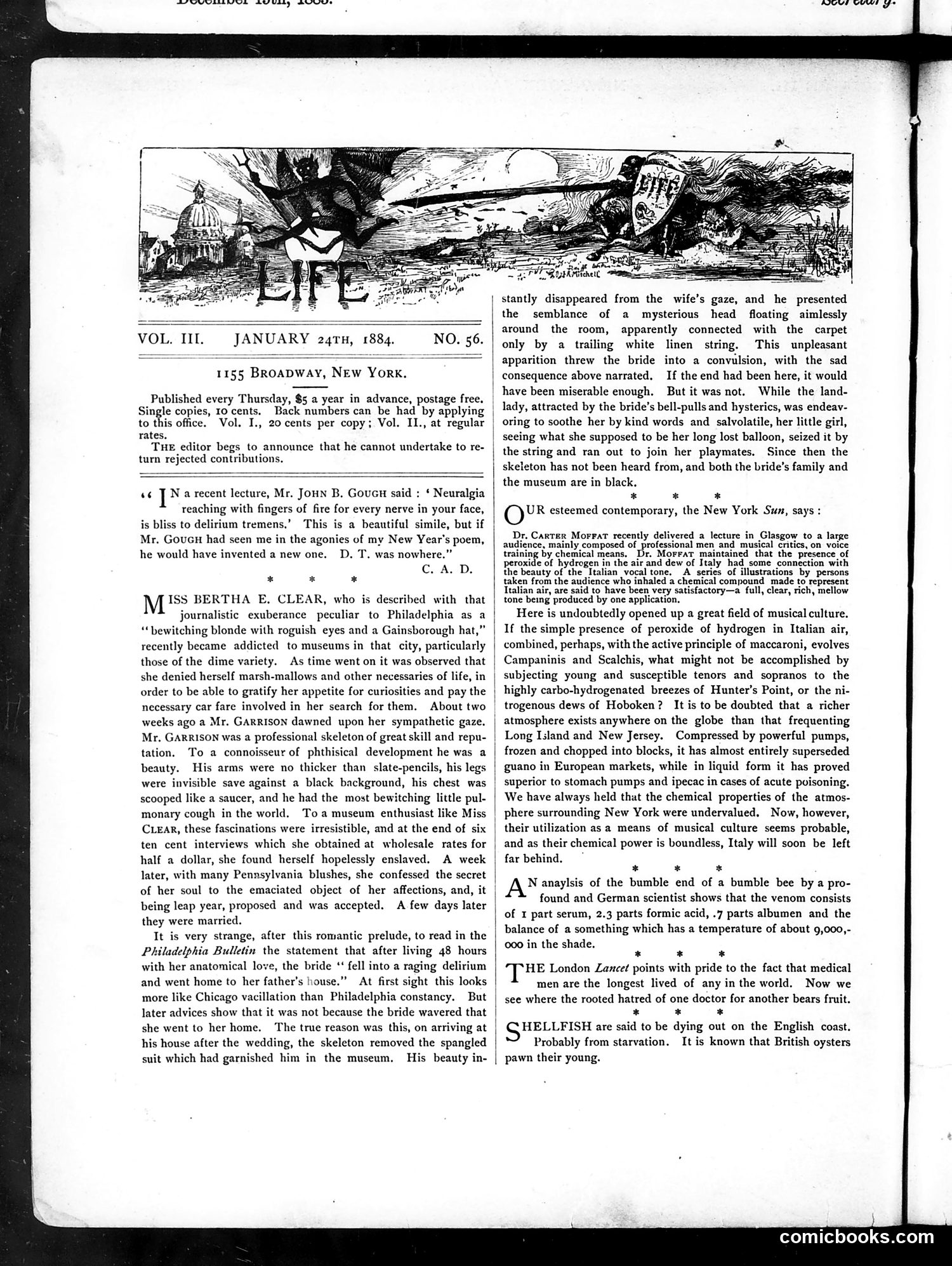
The masthead illustration depicts a skeletal "LIFE" figure beneath a gnarled tree—a memento mori design emphasizing Life magazine's satirical focus on mortality and human folly. The page contains anecdotal humor rather than political cartoons. Notable items include: 1. **John B. Gough reference**: A quip about Gough's lecture on neuralgia, suggesting he would have "invented a new one" had he attended the speaker's New Year's poem. 2. **Bertha E. Clear story**: A lengthy anecdote about a Philadelphia woman obsessed with museums who married a professional skeleton lecturer. The tale mocks Victorian eccentricity and museum culture through absurdist humor—her husband eventually removes his skeleton suit, disappointing her. The content reflects 1880s American satirical interests: intellectual pretension, museum culture, and romantic peculiarities.
📄 Transcribed text from this page (OCR, searchable)
Machine-transcribed from the original scan — historical spelling and the odd misread are preserved.
a ee ee ha ah Published every Thursday, $5 a year in advance, postage free. Single copies, 10 cents. Back numbers can be had by applying to this office. Vol. I., 20 cents per copy; Vol. II., at regular rates. THE editor begs to announce that he cannot undertake to re- turn rejected contributions. «¢ [Na recent lecture, Mr. Joun B. GouGu said : ‘ Neuralgia reaching with fingers of fire for every nerve in your face, is bliss to delirium tremens,’ This is a beautiful simile, but if Mr. GouGH had seen me in the agonies of my New Year's poem, he would have invented a new one. D, T. was nowhere.” c. A. D. * * * ISS BERTHA E, CLEAR, who is described with that journalistic exuberance peculiar to Philadelphia as a “bewitching blonde with roguish eyes and a Gainsborough hat,” recently became addicted to museums in that city, particularly | those of the dime variety. As time went on it was observed that she denied herself marsh-mallows and other necessaries of life, in order to be able to gratify her appetite for curiosities and pay the necessary car fare involved in her search for them. tation. To a connoisseur of phthisical development he was a beauty. His arms were no thicker than slate-pencils, his legs were invisible save against a black background, his chest was scooped like a saucer, and he had the most bewitching little pul- monary cough in the world. CLEAR, these fascinations were irresistible, and at the end of six ten cent interviews which she obtained at wholesale rates for half a dollar, she found herself hopelessly enslaved. A week later, with many Pennsylvania blushes, she confessed the secret of her soul to the emaciated object of her affections, and, it being leap year, proposed and was accepted. A few days later they were married. It is very strange, after this romantic prelude, to read in the Philadelphia Bulletin the statement that after living 48 hours with her anatomical love, the bride “ fell into a raging delirium and went home to her father’s house.” At first sight this looks more like Chicago vacillation than Philadelphia constancy. But later advices show that it was not because the bride wavered that | The true reason was this, on arriving at she went to her home. his house after the wedding, the skeleton removed the spangled suit which had garnished him in the museum. His beauty in- | consequence above narrated. To a museum enthusiast like Miss | | stantly disappeared from the wife’s gaze, and he presented | the semblance of a mysterious head floating aimlessly the room, apparently connected with the carpet only by a trailing white linen string. This unpleasant apparition threw the bride into a convulsion, with the sad If the end had been here, it would have been miserable enough. But it was not. While the land- lady, attracted by the bride’s bell-pulls and hysterics, was endeav- oring to soothe her by kind words and salvolatile, her little girl, seeing what she supposed to be her long lost balloon, seized it by the string and ran out to join her playmates. Since then the around skeleton has not been heard from, and both the bride’s family and | the museum are in black. * * * CER esteemed contemporary, the New York Sun, says : Dr. Carrer Morar recently delivered a lecture in Glasgow to a large audience, mainly composed of professional men and musical enities, on voice training by chemical means, Dr. Morrat maintained that the presence of peroxide of hydrogen in the air and dew of Italy had some connection with the beauty of the Italian vocal tone. A series of illustrations by persons taken from the audience who inhaled a chemical compound made to represent Italian air, are said to have been very satisfactory—a full, clear, rich, mellow tone being produced by one application, Here is undoubtedly opened up a great field of musical culture. If the simple presence of peroxide of hydrogen in Italian air, combined, perhaps, with the active principle of maccaroni, evolves Campaninis and Scalchis, what might not be accomplished by subjecting young and susceptible tenors and sopranos to the | highly carbo-hydrogenated breezes of Hunter's Point, or the ni- About two | weeks ago a Mr. GARRISON dawned upon her sympathetic gaze. | Mr. GARRISON was a professional skeleton of great skill and repu- | trogenous dews of Hoboken? It is to be doubted that a richer atmosphere exists anywhere on the globe than that frequenting Long Island and New Jersey. Compressed by powerful pumps, frozen and chopped into blocks, it has almost entirely superseded | guano in European markets, while in liquid form it has proved superior to stomach pumps and ipecac in cases of acute pvisoning. We have always held that the chemical properties of the atmos- phere surrounding New York were undervalued. Now, however, their utilization as a means of musical culture seems probable, and as their chemical power is boundless, Italy will soon be left far behind, * * * AN amayisis of the bumble end of a bumble bee by a pro- found and German scientist shows that the venom consists of 1 part serum, 2.3 parts formic acid, .7 parts albumen and the balance of a something which has a temperature of about 9,000,- 000 in the shade, * * * HE London Lancet points with pride to the fact that medical men are the longest lived of any in the world. Now we see where the rooted hatred of one doctor for another bears fruit. * * * GHELLFISH are said to be dying out on the English coast Probably from starvation. It is known that British oysters pawn their young. ae ae comicbooks.com