
Life, 1884-01-24 · page 12 of 14
Life — January 24, 1884 — page 12: what you’re looking at
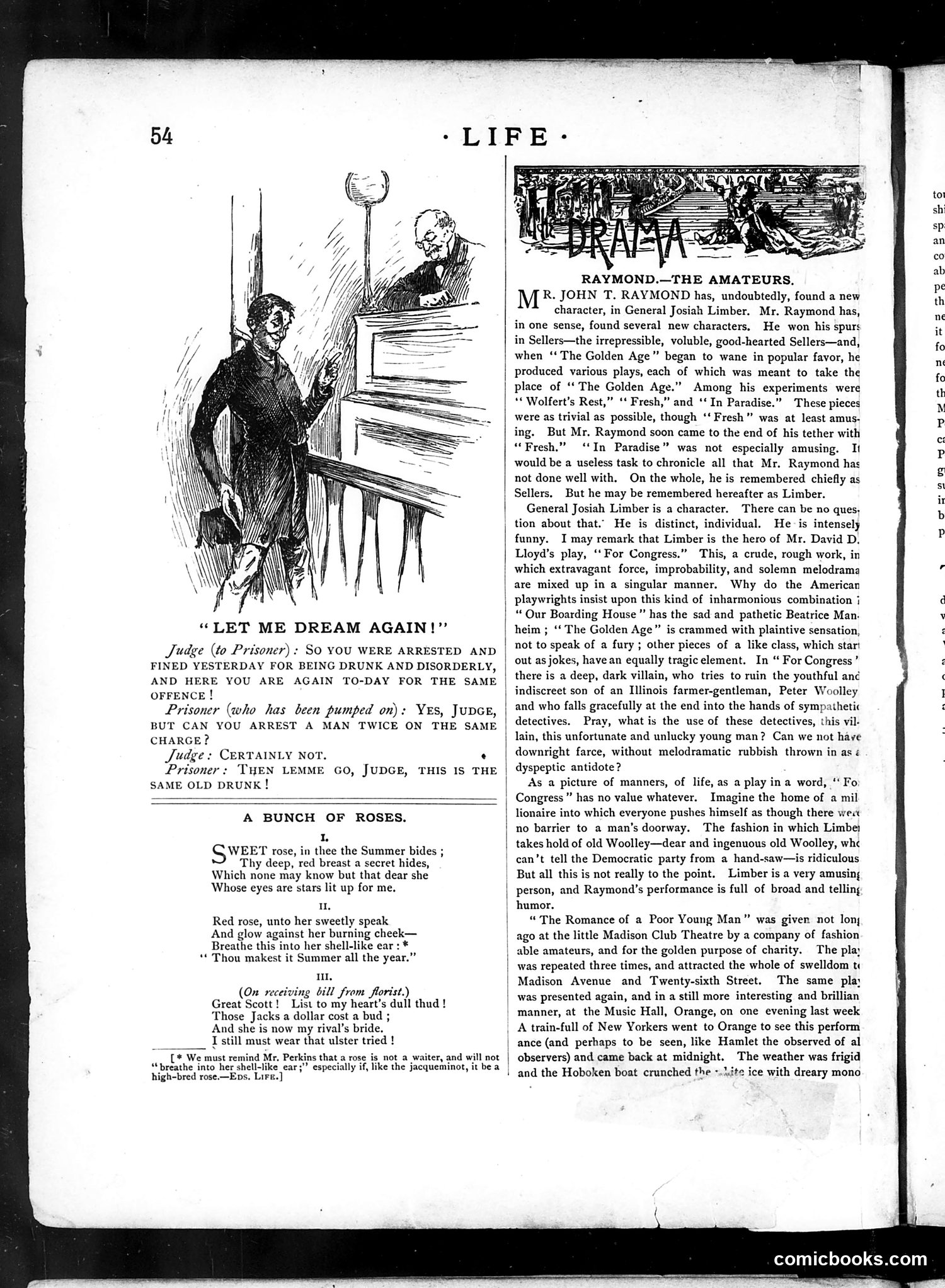
What you’re looking at
The cartoon depicts a drunk prisoner attempting to exploit a legal technicality. Having been arrested and fined yesterday for drunk and disorderly conduct, he appears again today for the same offense. He argues that a judge cannot arrest a man twice on the same charge—therefore, the judge must release him. The joke satirizes both the prisoner's criminal recidivism and the absurdity of trying to evade justice through legal semantics. The prisoner's nickname ("the same old drunk") suggests his habitual offending. The humor lies in his desperate, flawed reasoning: he assumes a loophole exists when obviously the law addresses *separate incidents*, not repeated offenses of the same type. The cartoon mocks the criminal's cunning while exposing the foolishness of his strategy.
📄 Transcribed text from this page (OCR, searchable)
Machine-transcribed from the original scan — historical spelling and the odd misread are preserved.
“LET ME DREAM AGAIN!” Judge (to Prisoner): SO YOU WERE ARRESTED AND FINED YESTERDAY FOR BEING DRUNK AND DISORDERLY, AND HERE YOU ARE AGAIN TO-DAY FOR THE SAME OFFENCE ! Prisoner (who has been pumped on): Yes, Juvce, BUT CAN YOU ARREST A MAN TWICE ON THE SAME | CHARGE? Judge; CERTAINLY NO’ Prisoner: THEN LEMME GO, JUDGE, THIS SAME OLD DRUNK! A BUNCH OF ROSES. L WEET rose, in thee the Summer bides ; Thy deep, red breast a secret hides, Which none may know but that dear she Whose eyes are stars lit up for me. n. Red rose, unto her sweetly speak And glow against her burning cheek— Breathe this into her shell-like ear : * “Thou makest it Summer all the year.” ll. (On receiving bill from florist.) Great Scott! List to my heart’s dull thud ! Those Jacks a dollar cost a bud ; And she is now my rival’s bride. I still must wear that ulster tried ! [ * We must remind Mr, Perkins that_a rose is not a waiter, and will not | “breathe into her shell-like ear ;” especially if, like the jacqueminot, it be a high-bred rose.—Eps, Lire.] BG RAYMOND.—THE AMATEURS, R. JOHN T. RAYMOND has, undoubtedly, found a new character, in General Josiah Limber. Mr. Raymond has, in one sense, found several new characters. He won his spurs in Sellers—the irrepressible, voluble, good-hearted Sellers—and, when “The Golden Age” began to wane in popular favor, he produced various plays, each of which was meant to take the | place of “The Golden Age.” Among his experiments were ** Wolfert’s Rest,” ‘* Fresh,” and ‘‘In Paradise.” These pieces were as trivial as possible, though ‘‘ Fresh” was at least amus- ing. But Mr. Raymond soon came to the end of his tether with “Fresh.” ‘In Paradise” was not especially amusing. It would be a useless task to chronicle all that Mr. Raymond has not done well with, On the whole, he is remembered chiefly as Sellers. But he may be remembered hereafter as Limber. General Josiah Limber is a character. There can be no ques, tion about that.. He is distinct, individual. He is intensely funny. I may remark that Limber is the hero of Mr. David D. Lloyd’s play, “For Congress.” This, a crude, rough work, in which extravagant force, improbability, and solemn melodrama are mixed up in a singular manner. Why do the American playwrights insist upon this kind of inharmonious combination i “ Our Boarding House” has the sad and pathetic Beatrice Man. heim ; ‘‘ The Golden Age” is crammed with plaintive sensation, not to speak of a fury; other pieces of a like class, which stari out as jokes, have an equally tragicelement. In “ For Congress’ there is a deep, dark villain, who tries to ruin the youthful an¢ indiscreet son of an Illinois farmer-gentleman, Peter Woolley and who falls gracefully at the end into the hands of sympathetic detectives. Pray, what is the use of these detectives, this vil- lain, this unfortunate and unlucky young man? Can we not have downright farce, without melodramatic rubbish thrown in as é dyspeptic antidote? As a picture of manners, of life, as a play ina word, ‘ Fo Congress” has no value whatever. Imagine the home of a mil | lionaire into which everyone pushes himself as though there wee | no barrier to a man’s doorway. The fashion in which Limbe) takes hold of old Woolley—dear and ingenuous old Woolley, wh¢ can’t tell the Democratic party from a hand-saw—is ridiculous But all this is not really to the point. Limber is a very amusing person, and Raymond’s performance is full of broad and telling | humor. “The Romance of a Poor Young Man” was given not lon; | ago at the little Madison Club Theatre by a company of fashion | able amateurs, and for the golden purpose of charity. The play was repeated three times, and attracted the whole of swelldom t Madison Avenue and Twenty-sixth Street. The same play was presented again, and ina still more interesting and brillian manner, at the Music Hall, Orange, on one evening last week | A train-full of New Yorkers went to Orange to see this perform ance (and perhaps to be seen, like Hamlet the observed of al observers) and came back at midnight. The weather was frigid \ and the Hoboken boat crunched the -...ite ice with dreary mono tor ia Ze ag