
Judge, 1929-06-22 · page 15 of 40
Judge — June 22, 1929 — page 15: what you’re looking at
What you’re looking at
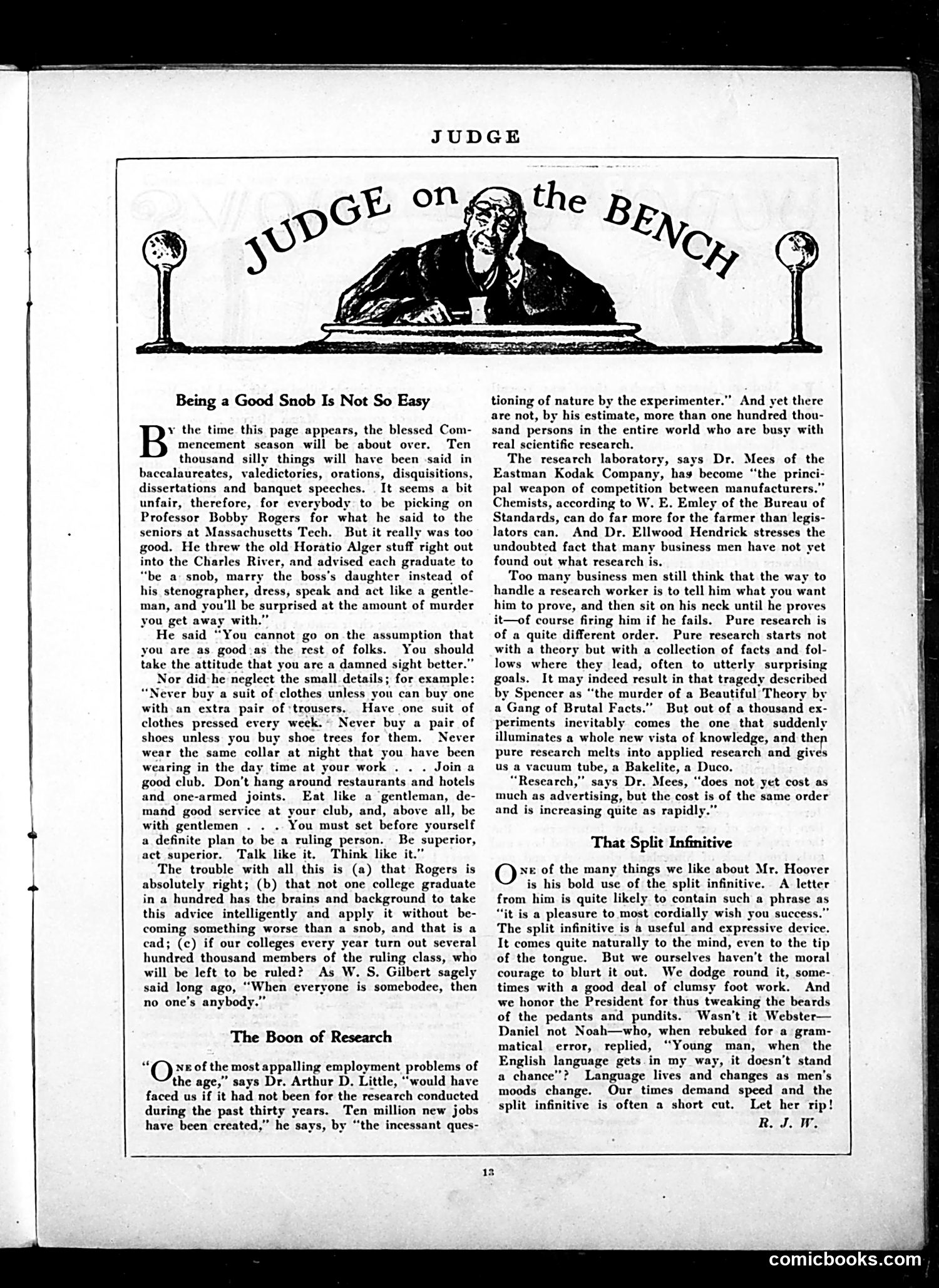
This page contains three satirical pieces: **"Being a Good Snob Is Not So Easy"** mocks Professor Bobby Rogers of MIT, who advised graduates to adopt aristocratic manners and superiority. The satire's point: Rogers is *correct* in his cynical advice, but this creates a problem. If colleges produce hundreds of thousands of "ruling class" graduates annually, who remains to be ruled? The reference is W.S. Gilbert's famous principle that universal somebody-ness means nobody-ness. The joke attacks both the pretentiousness of upper-class aspiration and the absurdity of mass higher education producing elites. **"The Boon of Research"** praises industrial research's job-creation while noting businessmen still misunderstand it—treating researchers as hired hands to prove predetermined conclusions rather than pursuing genuine inquiry. The satire celebrates pure research's unpredictability and practical benefits. **"That Split Infinitive"** defends using split infinitives (to "boldly go"), invoking President Hoover's example and Webster-Daniel Noah's linguistic flexibility, arguing language naturally evolves. All three pieces reflect 1920s-30s concerns: class anxiety, industrial modernization, and linguistic prescription.
📄 Transcribed text from this page (OCR, searchable)
Machine-transcribed from the original scan — historical spelling and the odd misread are preserved.
Being a Good Snob Is Not So Easy B the time this page appears, the blessed Com- mencement season will be about over. Ten thousand silly things will have been said in baccalaureates, valedictories, orations, disquisitions, dissertations and banquet speeches. . It seems a bit unfair, therefore, for everybody to be picking on Professor Bobby Rogers for what he said to the seniors at Massachusetts Tech. But it really was too good. He threw the old Horatio Alger stuff right out into the Charles River, and advised each graduate to “be a snob, marry the boss's daughter instead of his stenographer, dress, speak and act like a gentle- man, and you'll be surprised at the amount of murder you get away with.” He said “You cannot go on the assumption that you are as good as the rest of folks. You should take the attitude that you are a damned sight better.” Nor did he neglect the small details; for example: Never buy a suit of clothes unless you can buy one with an extra pair of ‘trousers. Have one suit of clothes pressed every week.~ Never buy a pair of shoes unless you buy shoe trees for them. Never wear the same collar at night that you have been wearing in the day time at your work . . . Join a good club. Don’t hang around restaurants and hotels and one-armed joints. Eat like a gentleman, de- mand good service at your club, and, above all, be with gentlemen . . . You must set before yourself a definite plan to be a ruling person. Be superior, act superior. Talk like it. Think like it.” The trouble with all this is (a) that Rogers is absolutely right; (b) that not one college graduate in a hundred has the brains and background to take this advice intelligently and apply it without be- coming something worse than a snob, and that is a cad; (c) if our colleges every year turn out several hundred thousand members of the ruling class, who will be left to be ruled? As W. S. Gilbert sagely said long ago, “When everyone is somebodee, then no one’s anybody.” The Boon of Research “(ye of the most appalling employment problems of the age,” says Dr. Arthur D. Little, “would have faced us if it had not been for the research conducted during the past thirty years. Ten million new jobs have been created,” he says, by “the incessant ques- tioning of nature by the experimenter.” And yet there are not, by his estimate, more than one hundred thou- sand persons in the entire world who are busy with real scientific research, The research laboratory, says Dr. Mees of the Eastman Kodak Company, hag become “the princi- pal weapon of competition between manufacturers.” Chemists, according to W. E. Emley of the Bureau of Standards, can do far more for the farmer than legis- lators can. And Dr. Ellwood Hendrick stresses the undoubted fact that many business men have not yet found out what research is. Too many business men still think that the way to handle a research worker is to tell him what you want him to prove, and then sit on his neck until he proves it—of course firing him if he fails. Pure research is of a quite different order. Pure research starts not with a theory but with a collection of facts and fol- lows where they lead, often to utterly surprising goals. It may indeed result in that tragedy described by Spencer as “the murder of a Beautiful Theory by a Gang of Brutal Facts.” But out of a thousand ex- periments inevitably comes the one that suddenly illuminates a whole new vista of knowledge, and the; pure research melts into applied research and gives us a vacuum tube, a Bakelite, a Duco. “Research,” says Dr. Mees, ‘does not yet cost as much as advertising, but the cost is of the same order and is increasing quite as rapidly.” That Split Infinitive ne of the many things we like about Mr. Hoover is his bold use of the split infinitive. A letter from him is quite likely to contain such a phrase as “it is a pleasure to most cordially wish you success.” The split infinitive is & useful and expressive device. It comes quite naturally to the mind, even to the tip of the tongue. But we ourselves haven't the moral courage to blurt it out. We dodge round it, some- times with a good deal of clumsy foot work. And we honor the President for thus tweaking the beards of the pedants and pundits. Wasn't it Webster— Daniel not Noah—who, when rebuked for a gram- matical error, replied, “Young man, when the English language gets.in my way, it doesn’t stand a chance’? Language lives and changes as men’s moods change. Our times demand speed and the split infinitive is often a short cut. Let her rip! RJ. W. 13 comicbooks.com