
Judge, 1929-01-05 · page 20 of 36
Judge — January 5, 1929 — page 20: what you’re looking at
What you’re looking at
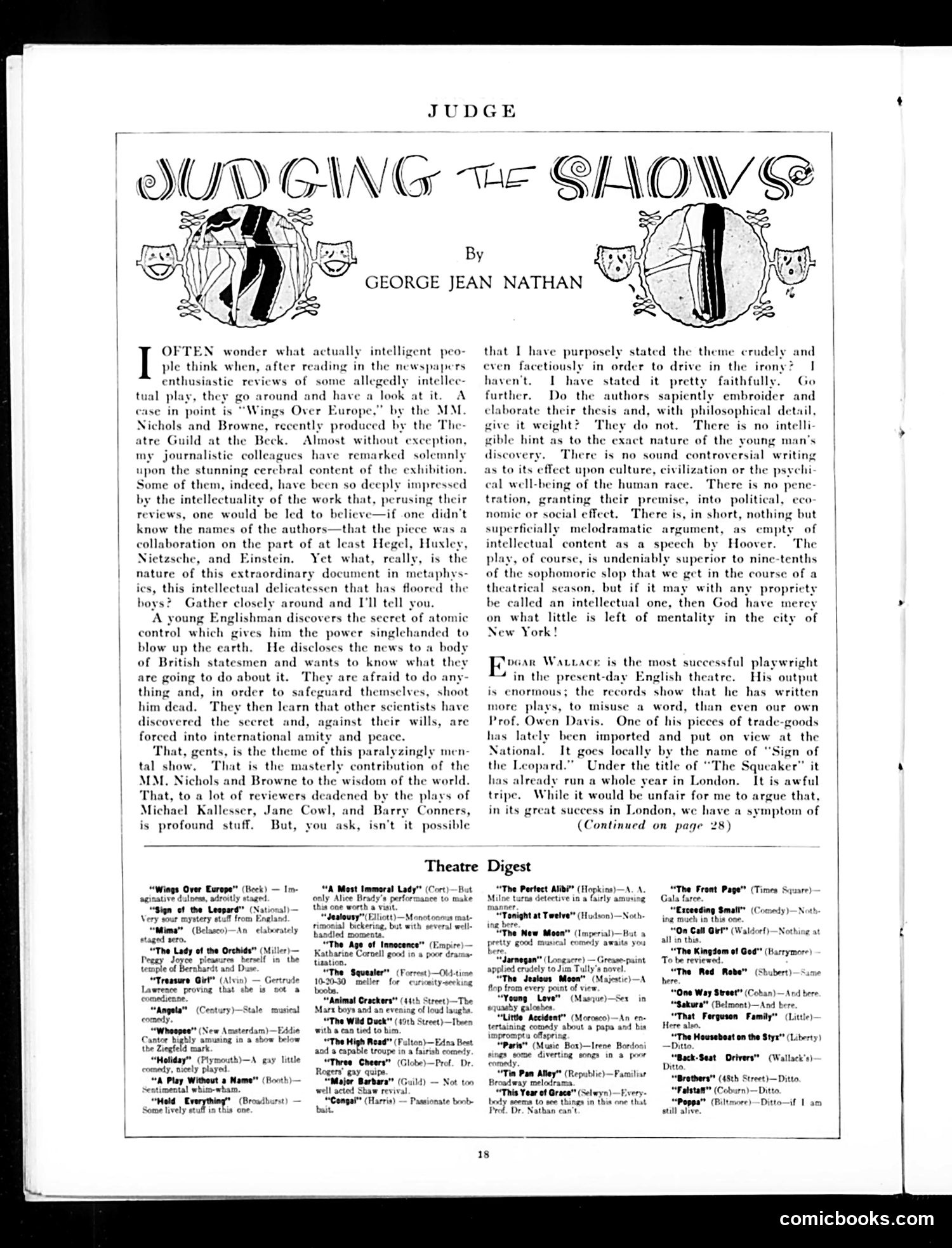
This is a theater review column by George Jean Nathan critiquing the play "Wings Over Europe" by Nichols and Browne. Nathan sarcastically attacks what he sees as pretentious critical reception of an intellectually shallow work. **The Satire:** Nathan mocks his fellow theater critics for praising the play as profound philosophical drama when its actual plot is simple and underdeveloped: a young Englishman discovers atomic weapons, tells British statesmen, they kill him, other scientists discover it too, and peace results. Nathan argues the authors provide no genuine intellectual engagement—no exploration of the discovery's nature, cultural impact, or philosophical implications. **The Point:** Nathan is satirizing critical groupthink and intellectual pretension in theater reviewing. Reviewers like those who praised Michael Kallesser and Barry Conners plays have become so deadened that they mistake mediocrity for genius, crediting the play with profundity it doesn't possess. The page includes a "Theatre Digest" of current Broadway shows—standard for Judge magazine's entertainment coverage.
📄 Transcribed text from this page (OCR, searchable)
Machine-transcribed from the original scan — historical spelling and the odd misread are preserved.
JUDGE OFTEN wonder what actually intelligent peo- ple think when, after reading in the newspapers enthusiastic reviews of some allegedly intellec- tual play, they go around and have a look at it. A case in point is “Wings Over Europe,” by the MM Nichols and Browne, recently produced by the The- atre Guild at the Beck. Almost without exception, my journalistic colleagues have remarked solemnly upon the stunning cerebral content of the exhibition, Some of them, indeed, have been so deeply impressed by the intellectuality of the work that, perusing their reviews, one would be led to believe—if one didn’t know the names of the authors—that the piece was a collaboration on the part of at least Hegel, Husle. Nietzsche, and Einstein. Yet what, really, is the nature of this extraordinary document in metaphys- ics, this intellectual delicatessen that has floored the boys? Gather closely around and I'll tell you. ‘A young Englishman discovers the secret of atomic control which gives him the power singlehanded to blow up the earth. He discloses the news to a body of British statesmen and wants to know what they are going to do about it. They are afraid to do any- thing and, in order to safeguard themselves, shoot him d They then learn that other scientists have discovered the secret and, against their wills, are forced into international amity and peace. That, gents, is the theme of this paralyzingly men- tal show. That is the masterly contribution of the MM. Nichols and Browne to the wisdom of the world. That, to a lot of reviewers deadened by the plays of Michael Kallesser, Jane Cowl, and Barry Conners, is profound stuff. But, you ask, isn't it possible Theatre “A Most Immoral Lady" (Cort) —But only Alice Brady's performance to make “Wings Over Eurepe” (Leck) — Im- aginative dulnes, adroitly staged “Sign of the Leopard’ (National) — Very sour mystery stuff from England. Monotoneus mat- “Mima” (Belasco)—An elaborately Au ecreral wet staged ero. pe ta The Age of Innocence” (Empire) — "The Lady of the Orchids” (Miller) Katharine Cornell good in » poor drama Peexy Joyce pleasures herself in the thastion, temple of Bernhardt and Duse ‘The. Squealer" (F ou. “Treasure Girt” (Alvin) — Gertrude 10.2030 meller for eurosity-serking Lawrence proving that she is not a boobs. comedienne “Animal Crackers" (44th Street) —The “angela” (Century)—Stale musical Marx boys and an evening of loud laugh comedy. “The Wild Duck" (49tb Street) —Thwen msterdam)—EAdie ing in a show below can tied to him. “The High Read” (Fulton)—EAna Beet aod a eapable troupe in a fairish comety “Three Cheers” (Globe)—Prof. Dr. Rogers’ gay quips “Majer Barbara” (Guild) — Not too well acted Shaw revival ‘Congai™ (Harris) jeliday” ( Plymouth’ comedy, nicely played. Play Without a Name” (Rooth)— mental whiro-wham. someliely ead tah A gay little (Broadhurst) — one. bai Passionate bonb- that I have purposely stated the theme crudely and even facetiously in order to drive in the irony? I haven't. I have stated it pretty faithfully. Go further. Do the authors sapiently embroider and claborate their thesis and, with philosophical detail, give it weight? They do not. There is no intelli- gible hint as to the exact nature of the young man’s discovery. There is no sound controversial writing as to its effect upon culture, civilization or the psychi al well-being of the human race. There is no pene tration, granting their premise, into political, eco nomic or social effect. There is, in short, nothing but superficially melodramatic argument, as empty of intellectual content as a speech by Hoover. | Th play, of course, is undeniably superior to nine-tenths of the sophomoric slop that we get in the course of a theatrical season, but if it may with any propriety be called an intellectual one, then God have merey on what little is left of mentality in the city of New York! Giocar Wartack is the most successful playwright 4 in the present-day English theatre. His output is enormous; the records show that he has written more plays, to misuse a word, th Prof. Owen Davis. One of his pieces of trade-goods has lately been imported and put on view at the National. It goes locally by the name of “Sign of the Leopard.” Under the title of “The Squeaker” it has already run a whole year in London. It is awful tripe. While it would be unfair for me to argue that. in its great success in London, we have a symptom of (Continued on page 28) n even our own Digest “The Pertect Alibi” (Hopkins) —A. 4 Milne turns detective in a fairly amusing — G: "The Front Page” (Times Square) 1 Tatight at Taelve®(HHooon) Noth ng ae ting Sener” (Comedy)—Noth “The New Moen” (1 “On Call Git" (Waldorf) —Nothing at all in this “The Kingdom ef Ged" (Barrymore) To be reviewed, Robe” (Shubert) Betty good eousical corey awaits you * darnegan” (Loogacte) — Gresse-paint applied erudely to Jim Tully's novel “The dealows Moon™ (Majestic)—A flop from every point of view. “Young Love” (Masque)—Sex in equasby galoabes. “Little Accident” (Moroeco) ‘ohan)—And bere “Sakura” (Belmont)—And bere. “That Ferguson Family" (Little) An ene tertaining comedy about a papa and bis Here also. impromptu offspring “The Houseboat on the Styx” (Liberty) “Paris (Music Bot)—Irene Bordosi —Ditto, sings some diverting songs in a poor “Back-Seat Orivers* (Wallack’s) corned Ditto. Berke n Alay” (Repablic)—Farmiliar — segrathary™ (48th Street) —Ditto “This Year of Grace” (Selweyn)—Every- “*Falstaf” (Coburn) —Ditto body seems to see Prof. Dr. Nathan can't in thie one that (Biltmore) Ditto—if 1 am comicbooks.com