
Judge, 1928-11-03 · page 2 of 36
Judge — November 3, 1928 — page 2: what you’re looking at
What you’re looking at
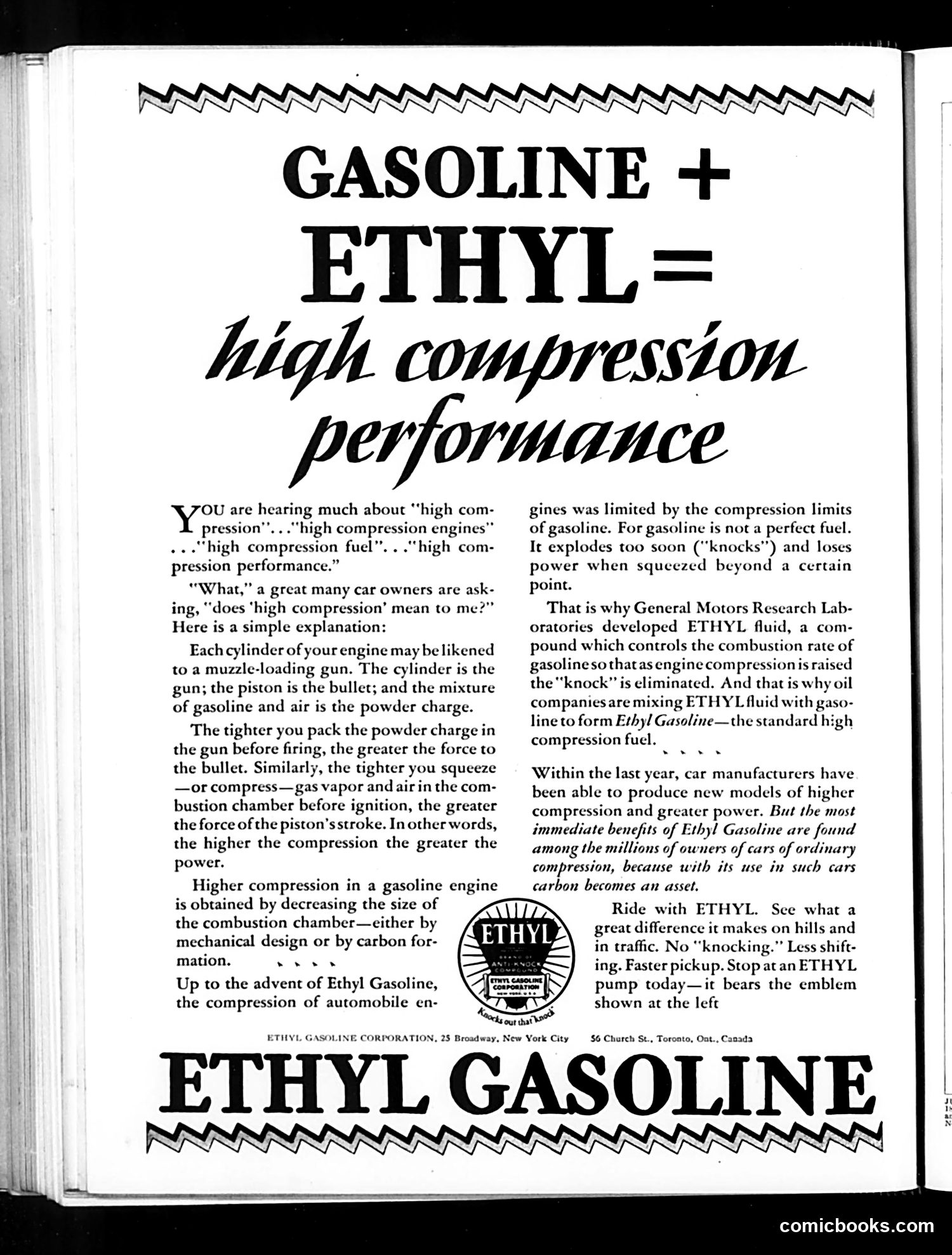
This page is **primarily an advertisement, not satire or editorial content**. It's a promotional piece for Ethyl Gasoline, published by the Ethyl Gasoline Corporation. The ad explains a technical concept to lay readers: engine compression and how adding ethyl fluid to gasoline improves performance. It uses an accessible analogy comparing cylinder compression to a muzzle-loading gun's powder charge. The "cartoon" element is minimal—just a circular emblem/logo for Ethyl brand at the center. There is **no political satire, caricature, or social commentary** on this page. This reflects Judge magazine's business model: satirical publications survived partly through advertising revenue. The page demonstrates how early 20th-century ads educated consumers about new automotive technology while promoting a specific fuel product.
📄 Transcribed text from this page (OCR, searchable)
Machine-transcribed from the original scan — historical spelling and the odd misread are preserved.
GASOLINE + ETHYL= high. compression pel, OMMMICE OU are hearing much about “high com- pression”’.. "high compression engines” ..."high compression fuel”. . .“high com- pression performance.” “What,” a great many car owners are ask- ing, “does ‘high compression’ mean to me?” Here is a simple explanation: Each cylinder of your engine may be likened to a muzzle-loading gun. The cylinder is the gun; the piston is the bullet; and the mixture of gasoline and air is the powder charge. The tighter you pack the powder charge in the gun before firing, the greater the force to the bullet. Similarly, the tighter you squeeze —or compress—gas vapor and air in the com- bustion chamber before ignition, the greater the force of the piston’s stroke. In other words, the higher the compression the greater the power. Higher compression in a gasoline engine is obtained by decreasing the size of the combustion chamber—either by mechanical design or by carbon for- mation. Sa Up to the advent of Ethyl Gasoline, the compression of automobile en- gines was limited by the compression limits of gasoline. For gasoline is not a perfect fuel. It explodes too soon (“knocks”) and loses power when squcezed beyond a certain point. That is why General Motors Research Lab- oratories developed ETHYL fluid, a com- pound which controls the combustion rate of gasolinesothatas engine compression is raised the knock” is eliminated. And that is why oil companies are mixing ETHYL fluid with gaso- line to form Ethyl Gasoline—the standard high compression fuel. Within the last year, car manufacturers have been able to produce new models of higher compression and greater power, But the most immediate benefits of Ethyl Gasoline are found among the millions of owners of cars of ordinary compression, because with its use in such cars carbon becomes an asset. Ride with ETHYL. Sce what a great difference it makes on hills and in trafic. No “knocking.” Less shift- ing. Faster pickup. Stop atan ETHYL pump today—it bears the emblem shown at the left ETHYL GASOLINE CORPORATION, 25 Broadway, New York City $6 Church St., Toronto, Ont., Canada ETHYL GASOLINE comicbooks.com