
Judge, 1928-09-08 · page 21 of 36
Judge — September 8, 1928 — page 21: what you’re looking at
What you’re looking at
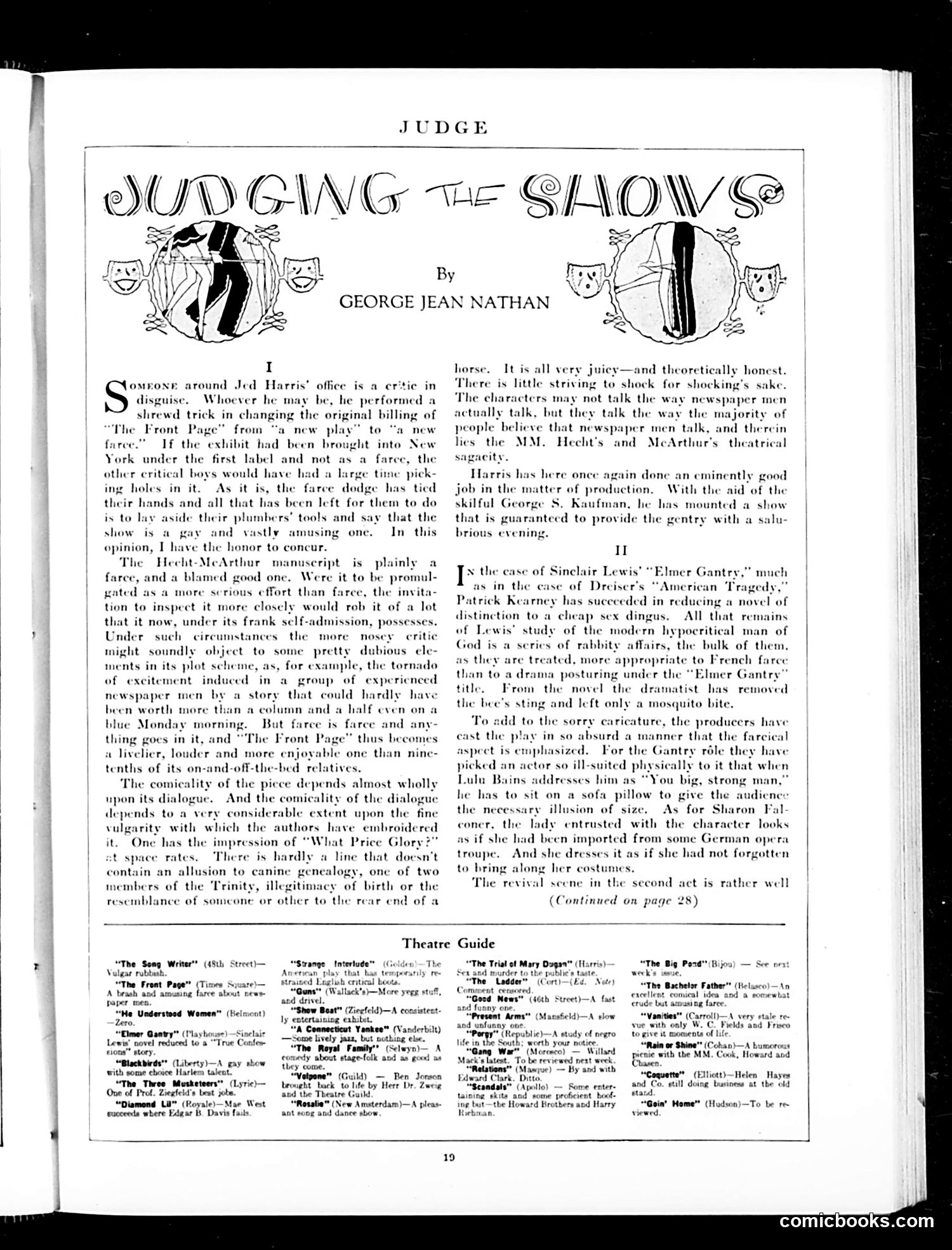
This page reviews theatrical productions, primarily discussing **"The Front Page,"** a play by Hecht and MacArthur produced by Jed Harris. The critic praises Harris's strategic marketing decision: labeling the work a "farce" rather than a serious drama allowed it to bypass harsh critical scrutiny of its plot implausibilities (like an unrealistic tornado of newspaper men converging on a scene). The vulgar, colloquial dialogue works because audiences *believe* newspaper men talk this way, even if they don't. The second section critiques **"Elmer Gantry,"** adapted from Sinclair Lewis's novel. The adaptation allegedly reduces Lewis's satirical examination of religious hypocrisy to mere sexual scandal. The critic mocks the casting—particularly an actor physically unsuited to the role, requiring a sofa pillow to appear large enough, and a leading actress who looks like she belongs in a German opera company. The piece exemplifies Judge's theatrical criticism: witty, irreverent commentary on Broadway productions and their producers' commercial decisions.
📄 Transcribed text from this page (OCR, searchable)
Machine-transcribed from the original scan — historical spelling and the odd misread are preserved.
JUD GE oMrO. on disguise. round Jed Harris’ office ie in Whoever he be, he performed a shrewd trick in changing the original billing of Front Page” from new play” is a erit to “a new farce.” If the ‘exhibit iad been brought into New York under the first Tall and not as a farce, the other critical boys would have had a large time piek- ing holes in it.” As it is, the farce dodge has tied their hands and all that has been left for them to do is to lay aside their plumbers’ tools and say that the show is a gay and vastly amusing one. In_ this opinion, I have the honor to concur. The Hecht-MeArthur manuscript is plainly a farce, and a blamed good one. Were it to be promul- ed serious effort than farce, the invita- tion to inspect it more closely would rob it of a lot that it now, under its frank self-admission, possesses. as a more wa Under such circumstances the more nosey critic might soundly object to some pretty dubious cle- ments in its plot scheme, as, for example, the tornado of newspaper men induced by a been worth more t excitement in mp of experienced that could hardly have yaccolumn and a half even on blue Monday morning. But faree is farce and thing goes in it, and “The Front P: thus becomes a livelier, louder and more en. than nine- tenths of its on-and-off-the-b The comics upon its dis story a any- one ives. the piece depends almost wholly And the comicality of the dialogue depends to a very considerable extent upon the fine vulgarity with which the authors have embroidere it. One has the impression of “What Price Glory at space There is hardly that doesn't lusion to canine gene of two r line an contain logy, one IG He G By It is all very juic : is little striving to shock for shocking’s sake. he characters may not talk the way newspaper men actually talk, but they talk the way the majority of people believe that newspaper men talk, and therein lies the MM. Hecht’s and) MeArthur's theatrical sagacity. Harris has here once again done an eminently good job in the matter of production. With the aid of the skilful € ge S. Kaufman, he has mounted a show that is guaranteed to provide the gentry with a salu- brious evenin I the case of Sinclair Lewis’ “Elmer Gantry,” as in the of Dreiser's “American Tre Patrick Kearney has succeeded in reducing a nove distinction to a cheap sex dingus. All that remains of Lewis’ study of the modern hypocritical man of God is a series of rabbity affairs, the bulk of them, ure treated, more appropriate to French farce than to a drama posturing under the “Elmer Gantry” title. From the the dramatist has the bee's sting and left only a mosquito b To add to the cast the absurd a manner that the aspect is emphasized. For the Gantry réle th picked an actor so ill-suited physically to it the Lulu Bains addresses him as “ II much case as they ovel removed sorry caricature, ts have farcical have when u big, strong man,” he has to sit on a sofa pillow to give the audience the necessary illusion of size. As for Sharon Fal coner, the lady entrusted with the character looks as if she had been imported from some German opera troupe. And she dresses it as if she had not forgotten to bring along her costumes. the produc play in so members of the ‘Trinity, illegitimacy of birth or the The revival scene in the second act is rather well resemblance of someone or other to the rear end of a (Continued on page 28) Theatre Guide “The Song Writer’ (48th Street)— Vulgar rubtash, “Strange Interlude” The American play that b bent and di “Show Beat” (Zierfeld)—A consistert- paper men. “He Understood Women” (Keim Let ee” (Vanderbilt) Fs pyc Br —Some lively jazz, but nothing else ons” story a) Royal Famity’* (Selwyn)— A “Blackbirdy”* (Liberty) conn about eagetolk and ae gat at with some choice Harlem Se cau)’ == “Bea Said “The Three Musketeers” (Ly One of Prof. Ziegfeld’s best jobe “Diamond Lil” (Royale)—Mar West eucceeds where Edgar B. Davis faits brought back to life by Hert Dr. Zerg and the Theatre Guild “Rosalie” (New Amsterdam)—A pleas fant song and dance show 16"*(Bijou) — See next he Trial of Mary Dagan" (Ilr) “The murder i week's ‘The Bachelor Father" (Hel An | idea and a romewhat Gea ae Gteellet Feed Mews” (46th Street) —A fast Crude but amas ng farce “Present Arms” (Mansfeld) slow Vanities” (Carroll) —\ very rtal and ° vue with oly W. C. Piekls and Frisco “Porgy” (Republic)—A study of negro togive i moments of hie Ife in the South: worth your no “Rake br Shine? (Cohan) A Woasares War" Mack's latest, pienie with the MM. Cook, Howard and Cha ieed Chr “Coquette” (Elliott)—Helen Hayes “Scand me enter- and Co. still doing business at the old taining # proficient book tata. ing but rd ire Abe ts and Harry “Gein’ Home” (Hudson)—To be re eebrnan viewed comicbooks.com