
Judge, 1928-02-04 · page 21 of 36
Judge — February 4, 1928 — page 21: what you’re looking at
What you’re looking at
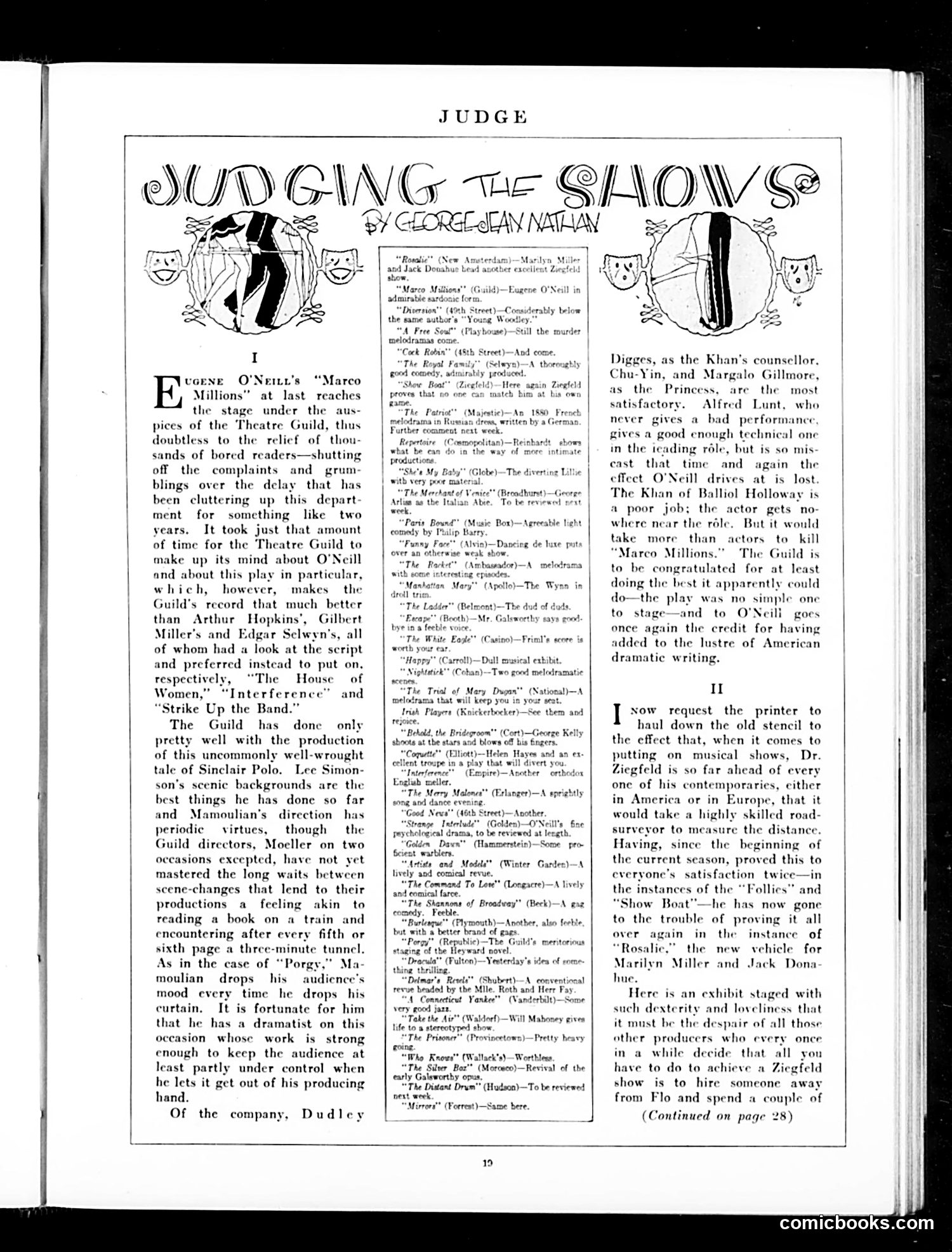
This is a theater review column by George Jean Nathan critiquing Eugene O'Neill's play "Marco Millions," which the Theatre Guild has finally staged after a two-year delay. Nathan praises the production's scenic design by Lee Simonson but criticizes director Rouben Mamoulian for creating awkward pauses between scenes that disrupt audience engagement—comparing the experience to reading interrupted by tunnel passages on a train. The review critiques specific performances: Alfred Lunt is miscast in the lead role; Dudley Digges and Margalo Gillmore perform satisfactorily; Balliol Holloway's portrayal of the Khan is weak. Nathan argues that despite these flaws, O'Neill's strong writing keeps the audience engaged. The column also lists brief notices of other Broadway productions currently running, offering quick judgments on shows like "Porgy," "Interference," and "The Merry Malones."
📄 Transcribed text from this page (OCR, searchable)
Machine-transcribed from the original scan — historical spelling and the odd misread are preserved.
4 eitt’s “Marco Millions” at last reaches the stage under the aus- pices of the Theatre Guild, thus doubtless to the relief of thou- sands of bored readers—shutting off the complaints and grum- blings over the delay that has been cluttering up this depart ment for something like two years. It took just that amount of time for the Theatre Guild to make up its mind about O'Neill and about this play in particular, which, however, makes the Guild's record that much better than Arthur Hopkins’, Gilbert Miller’s and Edgar Selwyn’s, all of whom had a look the script and preferred instead to put on, respectively, “The House of Women,” “Interference” and “Strike Up the Band.’ The Guild has done only pretty well with the production of this uncommonly well-wrought tale of Sinclair Polo. Lee Simon- son’s scenic backgrounds are the best things he has done so far and Mamoulian’s periodic virtues, though the Guild directors, Moeller on two occasions excepted, have not yet mastered the long waits between scene-changes that lend to their productions a feeling akin to reading a book on a train and encountering after every fifth or sixth page a three-minute tunnel. As in the case of “Porgy.” M moulian drops _ his mood every time he drops his curtain, It is fortunate for him that he has a dramatist on this occasion whose work is strong enough to keep the audience at least partly under control when he lets it get out of his producing hand. Of the direction has audience's company, Dudley MCRL fae Eugene O'Neill in ferably below on yase)—Still the mm (48th Street)—And come. “The Mercha r Arliss aa the Italisn Atte, To be renew: werk, “Paris Bound" (Music Bor) comedy by Pualip Bar Agreeable light Alvin)—Dancirg de luxe puts ise weak show. mbaseador)—A me bye in a feeble voice The White Eagle’ (Casino)—Friml’s score is Dull ssusical exhibit. 2) Two good meleairamatic Trial of Mary Dugan ma that will keep you in your se Irish Players (Knickerbocker)—See them and Behold. the Bridegroom" (Cort)—George Kelly shoots at the stars and blows off his Engers ‘ Helen Hayes and an ex. 1 divert you “Interfere Engluh meller. “The Merry Malones’* (Eslanger)—A sprightly song and treet)—Another. logical drama, to be reviewed at length. Daven" (Hammerttein)—Some pro- warblers, Artiste end Models’ (Winter Garden)—A lively and comical revue “The Command To Love" (Loegacte)—A lively and comical farce. jone of Broadway’® (Beck)—A gaz mouth)—Another, also f with a better brand of gues Porgy" (Repabiie)—The Gi Heyward novel. Fulton)—Yeeterday’s ides of rome. Delmar’s Revels" (Shubert) —A_ conventional revue headed by the Mlle. Roth and Herr Fay “A Connecticut Yankee” (Vanderbilt)—Some very good jazz. “Take the Air"* (Waldorf)—Will Mahoney gives life to a stereotyped show The Prisoner” (Provincetown)—Pretty heavy going Who Knows” (Wallack’s)—Worthlese “The Silver Bez" (Morceco)—Revival of the early Galeworthy opus, “The Distant Drom” (Hudson) —To be reviews! “Mirrors’® (Forrest)—Same here. Digges, as the Khan's counsellor, Chu-Yin, and Margalo Gillmore, as the Princess, are the most satisfactory. Alfred Lunt, who never s a bad performance gives a good enough technical one in the ieading réle, but is so mis- cast that time and again. the effect O'Neill drives at is lost The Khan of Balliol Holloway is a poor job; the actor gets no where near the réle. But it would take more than actors to— kill “Marco Millions.” The Guild is to be congratulated for at least doing the best it apparently could do—the play was no simple one to stage—and to O'Neill once again the credit for hav added to the lustre of American dramatic writing. II I Now request the printer to haul down the old stencil to the effect that, when it comes to putting on musical shows, Dr. Ziegfeld is so far ahead of every one of his contemporaries, either in America or in Europe, that it would take a highly skilled road- surveyor to measure the distance Having, since the beginning of the current season, proved this to everyone's satisfaction twice—in the instances of the “Follies” and how Boat"—he has now gone to the trouble of proving it all n in the instance of “Rosalie.” the new vehicle for Marilyn Miller and Jack Dona hue. Here is an exhibit staged with such dexterity and loveliness that it must be the despair of all those other producers who every once in a while decide that all you have to do to achieve a Ziegfeld show is to hire someone away from Flo and spend a couple of (Continued on page 28) comicbooks.com