
Judge, 1924-11-08 · page 9 of 36
Judge — November 8, 1924 — page 9: what you’re looking at
What you’re looking at
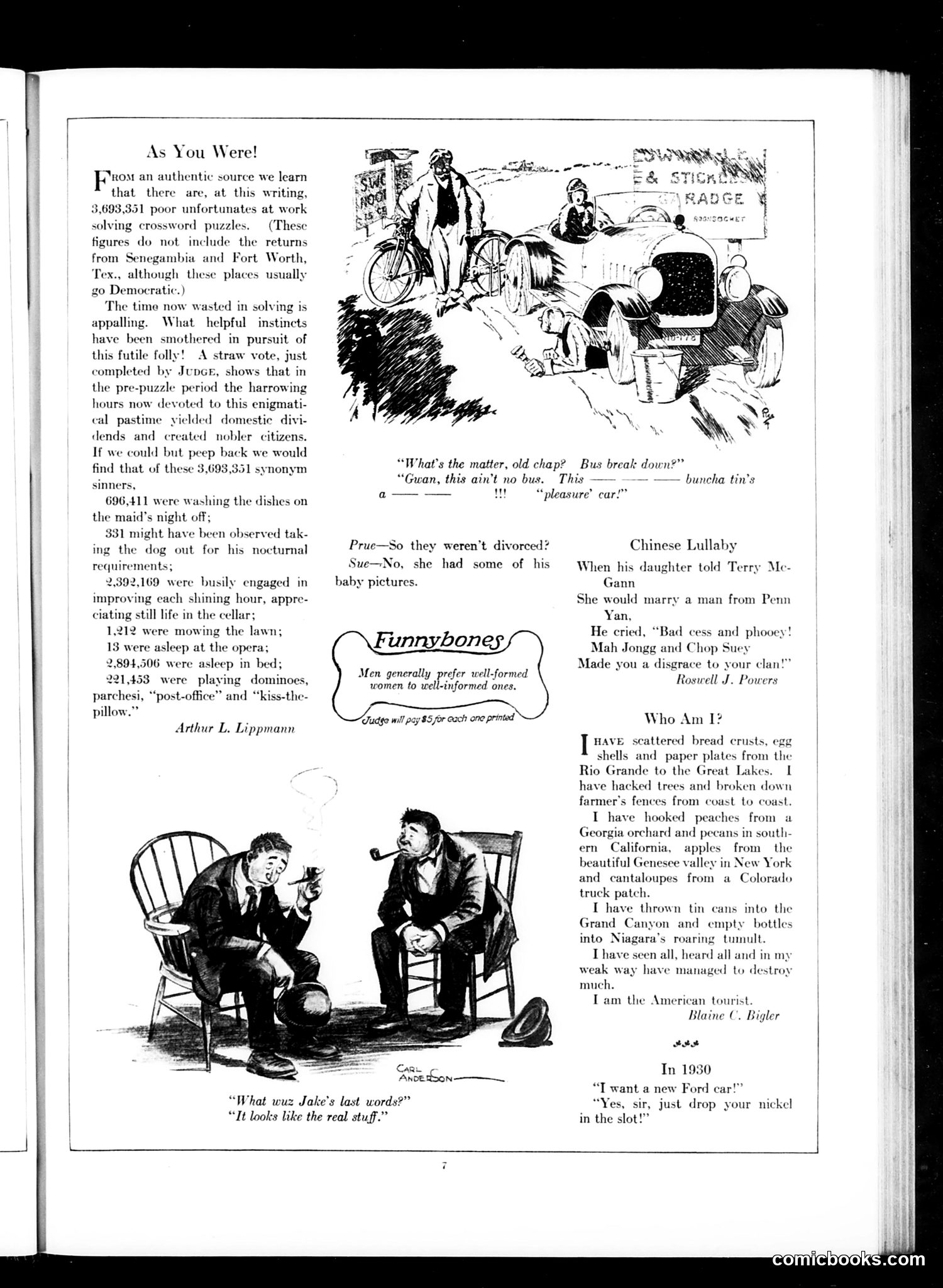
This satirical page mocks the American obsession with crossword puzzles, a craze of the 1920s-30s. The lead article by Arthur L. Lippmann claims 3.6 million people waste time solving puzzles instead of productive activities—washing dishes, walking dogs, or mowing lawns. The satire suggests this fad has replaced genuine civic engagement and family responsibility. The cartoons support this theme: one shows people abandoning vehicles for puzzle-solving; another depicts two men discussing someone's "last words" being "real stuff"—likely cocaine or alcohol, implying crossword addiction rivals substance abuse. The "Funnybones" section, various jokes, and pieces like "Who Am I?" (the American tourist) and the Ford car joke provide lighter humor about contemporary life—divorce, dating, and consumer culture. The overall message: modern Americans prioritize trivial amusements over genuine living and citizenship. A pointed critique of 1920s-30s leisure culture and its social costs.
📄 Transcribed text from this page (OCR, searchable)
Machine-transcribed from the original scan — historical spelling and the odd misread are preserved.
As You Were! Frees an authentic source we learn that there are, at this writing, 3,693,351 poor unfortunates at work (These figures do not include the returns from Senegambia and Fort Worth, Tex., although these places usually go Democratic.) The time now wasted in solving is appalling. What helpful instincts have been smothered in pursuit of this futile folly! A straw vote, just completed by Juve, shows that in the pre-puzzle period the harrowing hours now devoted to this enigmati- cal pastime yielded domestic divi- dends and created nobler citizens. If we could but peep back we would find that of these 3,693,351 synonym sinners, solving crossword puzzles. 696,411 were washing the dishes on the maid’s night off; 331 might have been observed tak- ing the dog out for his nocturnal requirements; 2,392,169 were busily engaged in improving each shining hour, appre- ciating still life in the e 1,212 were mowing the lawn; 13 were asleep at the opera; 2,894,506 were asleep in bed; lar; 221,453 were playing dominoes, parchesi, “post-office” and “kiss-the- pillow.” Arthur L. Lippmann “What's the matter, old chap? “Gwan, this ain’t no bus. tt Prue—So they weren't divorced? Sue—No, she had some of his baby pictures. Funnybones Men generally prefer well-formed women to well-informed ones. ——_ — Tuadge will pay 85 for Gach one printed Cane ¢ ANDERSON—————_ “What wuz Jake's last words?” “It looks like the real stuff.” Thi: “ pleasure’ car!” Bus break down?” - —— buncha tin’s Chinese Lullaby When his daughter told Terry Me- Gann She would marry a man from Penn Yan, He cried, “Bad cess and phooey! Mah Jongg and Chop Suey Made you a disgrace to your clan!” Roswell J. Powers Who Am I? HAVE scattered bread crusts, egg shells and paper plates from the Rio Grande to the Great Lakes. | have hacked trees and broken down farmer’: I have hooked peaches from a Georgia orchard and pecans in south- ern California, apples from the beautiful Genesee valley in New York and cantaloupes from a Colorado truck patch. I have thrown tin cans into the Grand Canyon and empty bottles into Niagara’s roaring tumult. Thave seen all, heard all and in my weak way have managed to destroy much. Tam the American tourist. Blaine C. Bigler fences from coast to coast. ttt In 1930 “T want a new Ford car!” “Yes, sir, just drop your nickel in the slot!”