
Judge, 1924-11-08 · page 18 of 36
Judge — November 8, 1924 — page 18: what you’re looking at
What you’re looking at
This is a theater review by George Jean Nathan, a prominent drama critic. He's satirizing contemporary Broadway plays and their stars. **"Ashes"**: Nathan mocks the play as pretentious melodrama that allows star Florence Reed to recite Shakespeare snippets and emote unconvincingly, merely to prove she *could* do classical work if circumstances allowed. He dismisses both the play and Reed's performance as self-indulgent vanity. **"Tiger Cats"**: He criticizes this Danish play as derivative bad theater (poor Strindberg/Wedekind imitation). The male lead is a self-important neurologist whose "wisdom" is actually trivial. The female character, played by acclaimed actress Katharine Cornell, is written as a cartoonish villain so exaggerated she belongs in burlesque—not serious drama. **The satire's point**: Nathan skewers both mediocre contemporary playwrights and ambitious actors for using flimsy vehicles to showcase themselves rather than serve good dramatic material. The "Star Spangled Drama" title is ironic—these aren't exemplary American theater. The illustrations appear unrelated to the review content.
📄 Transcribed text from this page (OCR, searchable)
Machine-transcribed from the original scan — historical spelling and the odd misread are preserved.
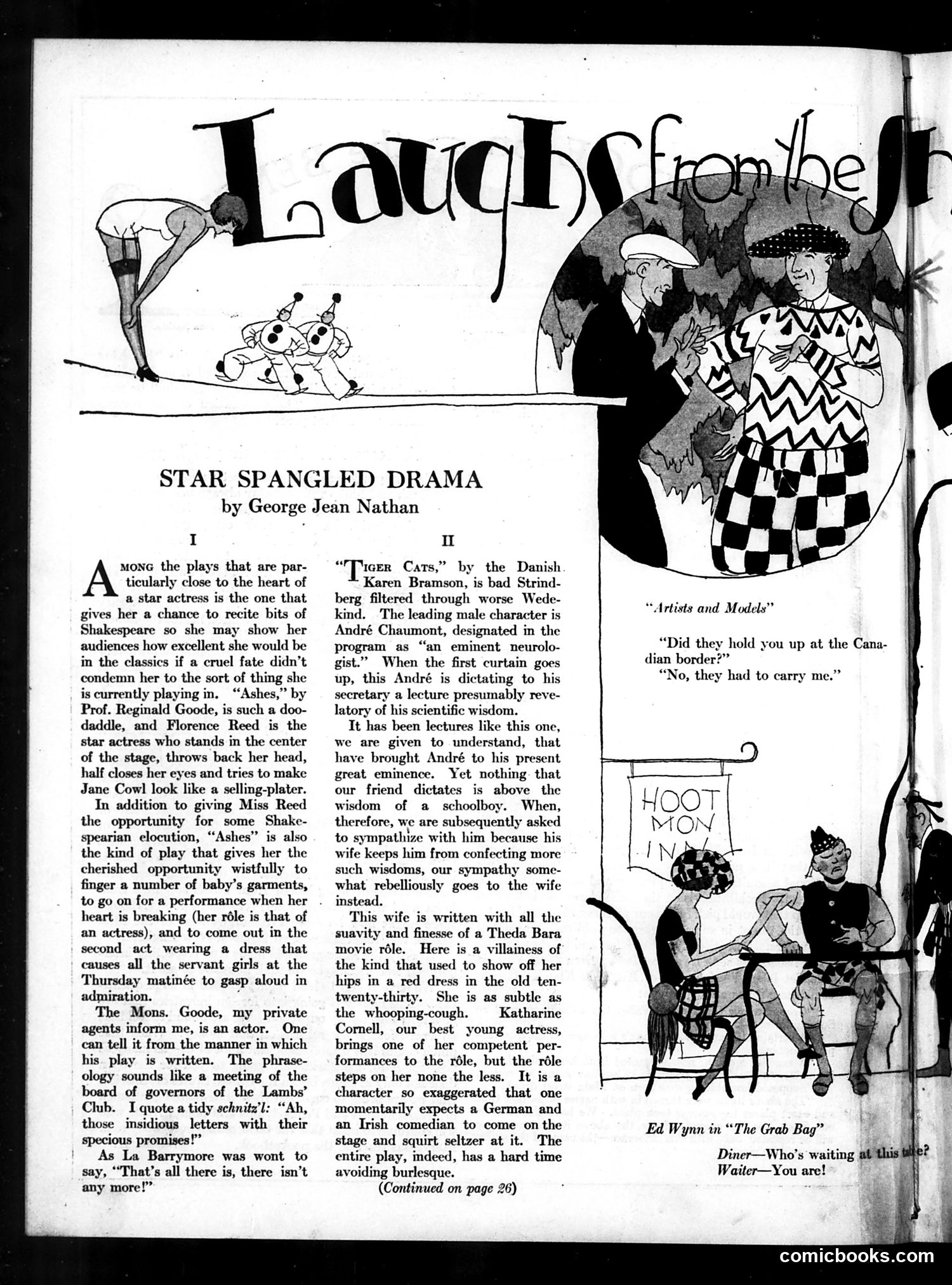
STAR SPANGLED DRAMA by George Jean Nathan I mon the plays that are par- A ticularly close to the heart of a star actress is the one that gives her a chance to recite bits of Shakespeare so she may show her audiences how excellent she would be in the classics if a cruel fate didn’t condemn her to the sort of thing she is currently playing in. “‘Ashes,” by Prof. Reginald Goode, is such a doo- daddle, and Florence Reed is the star actress who stands in the center of the stage, throws back her head, half closes her eyes and tries to make Jane Cowl look like a selling-plater. In addition to giving Miss Reed the opportunity for some Shake- spearian elocution, “Ashes” is also the kind of play that gives her the cherished opportunity wistfully to finger a number of baby’s garments, to go on for a performance when her heart is breaking (her réle is that of an actress), and to come out in the second act wearing a dress that causes all the servant girls at the Thursday matinée to gasp aloud in admiration. - The Mons. Goode, my private agents inform me, is an actor. One can tell it from the manner in which his play is written. The phrase- ology sounds like a meeting of the board of governors of the Lambs’ Club. I quote a tidy schnitz’l: “Ah, those insidious letters with their specious promises!” As La Barrymore was wont to say, ““That’s all there is, there isn’t any more!” pa “"Pcer Cats,” by the Danish Karen Bramson, is bad Strind- berg filtered through worse Wede- kind. The leading male character is André Chaumont, designated in the program as “an eminent neurolo- gist.” When the first curtain goes up, this André is dictating to his secretary a lecture presumably reve- latory of his scientific wisdom. It has been lectures like this one, we are given to understand, that have brought André to his present great eminence. Yet nothing: that our friend dictates is above the wisdom of a_ schoolboy. When, therefore, we are subsequently asked to sympathize with him because his wife keeps him from confecting more such wisdoms, our sympathy some- what rebelliously goes to the wife instead. This wife is written with all the suavity and finesse of a Theda Bara movie role. Here is a villainess of the kind that used to show off her hips in a red dress in the old ten- twenty-thirty. She is as subtle as the whooping-cough. Katharine Cornell, our best young actress, brings one of her competent per- formances to the réle, but the réle steps on her none the less. It is a character so exaggerated that one momentarily expects a German and an Irish comedian to come on the stage and squirt seltzer at it. The entire play, indeed, has a hard time avoiding burlesque. (Continued on page 26) “Artists and Models” “Did they hold you up at the Cana- dian border?” “No, they had to carry me.” Ed Wynn in “The Grab Bag” “ . i Diner—Who’s waiting at this Waiter—You are! § i : H \} ¥ comicbooks.com