
Judge, 1922-05-13 · page 6 of 36
Judge — May 13, 1922 — page 6: what you’re looking at
What you’re looking at
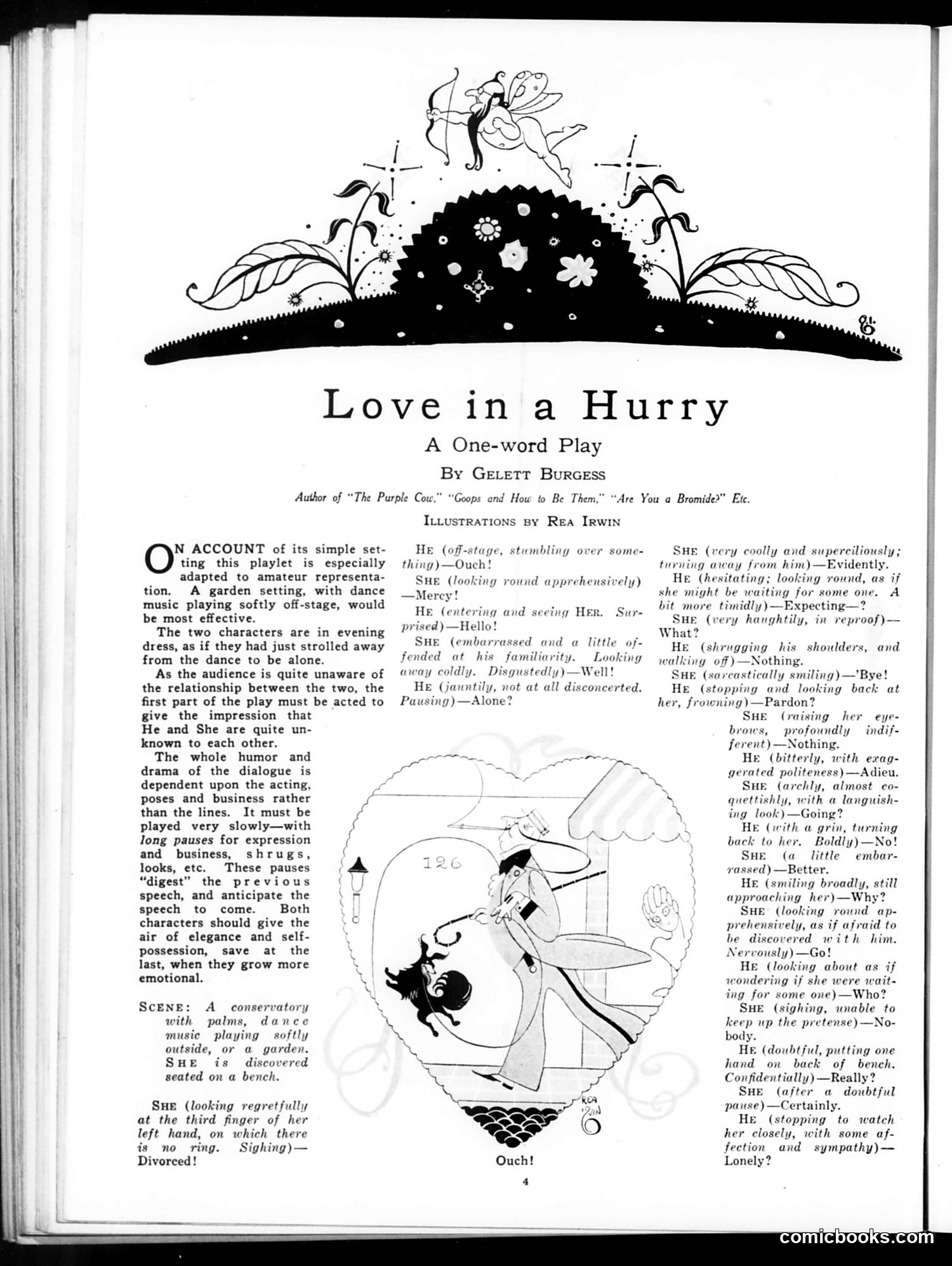
This is a comedic one-act play by Gelett Burgess, illustrated by Rea Irwin. The piece satirizes hasty romantic encounters, likely reflecting early 20th-century anxieties about modern courtship's accelerated pace. The scene depicts a conservatory where a man and woman meet awkwardly—he stumbling in, she sitting alone. The stage directions emphasize physical comedy and misread signals: she interprets his stumbling as rudeness, he mistakes her coldness for disinterest. The dialogue relies on dramatic pauses and exaggerated politeness masking mutual confusion. The satire targets how urbanized, busy modern life leaves little time for genuine romantic connection. The couple's complete miscommunication despite proximity suggests that rushing through courtship produces only awkward, emotionally hollow encounters rather than authentic love.
📄 Transcribed text from this page (OCR, searchable)
Machine-transcribed from the original scan — historical spelling and the odd misread are preserved.
Love in a Hurry Author of “The Purple Cow,” “Goops and How to Be Them,” N ACCOUNT of its simple set- ting this playlet is especially adapted to amateur representa- tion. A garden setting, with dance music playing softly off-stage, would be most effective. The two characters are in evening dress, as if they had just strolled away from the dance to be alone. As the audience is quite unaware of the relationship between the two, the first part of the play must be acted to give the impression that He and She are quite un- known to each other. The whole humor and drama of the dialogue is dependent upon the acting, poses and business rather than the lines. It must be played very slowly—with Jong pauses for expression and business, shrugs, looks, etc. These pauses “digest” the previous speech, and anticipate the speech to come. Both characters should give the air of elegance and self- possession, save at the last, when they grow more emotional. ScENE: A_ conservatory with palms, dance music playing softly outside, or a garden. SHE is discovered seated on a bench. SHE (looking regretfully at the third finger of her left hand, on which there is no ring. Sighing)— Divorced! A One-word Play By Ge.Letr BurceEss ILtustrations By Rea IRwIN HE (off-stage, stumbling over some- thing)—Ouch! SHE (looking round apprehensively) —Mercy HE (entering and seeing Her. Sur- prised) —Hello! SHE (embarrassed and a little of- fended at his familiarity. Looking away coldly. Disgustedly)—Well! HE (jauntily, not at all disconcerted. Pausing)—Alone? ‘Are You a Bromide?” Etc. SHE (very coolly and superciliously; turning away from him)—Evidently. HE (hesitating; looking round, a she might be waiting for some one. bit more timidly)—Expecting—? SHE (very haughtily, in reproof)— What? HE (shrugging his shoulders, and othing. SHE (sarcastically smiling) —'Bye! : ing ing back at if A walking off) — SHE (raising her ey brows, profoundly — indif- ferent)—Nothing. HE (bitterly, with exag- gerated politeness) —Adieu. SHE (archly, almos quettishly, with a languish- ing look) —Going? HE (with a grin, turning to her. Boldly)—No! SHE (a little embar- rassed)—Better. HE (smiling broadly, still approaching her)—Why SHE (looking round ap- prehensively, as if afraid to be discovered with him. Nervously)—Go! HE (looking about as if wondering if she were wait- ing for some one)—Who? SHE (sighing, unable to keep up the pretense) —No- body. HE (doubtful, putting one hand on back of bench. Confidentially) —Really SHE (after a doubtful pause) —Certainly. HE (stopping to watch her closely, with some af- fection and sympathy)— Lonely? co- ba