
Judge, 1919-03-22 · page 22 of 32
Judge — March 22, 1919 — page 22: what you’re looking at
What you’re looking at
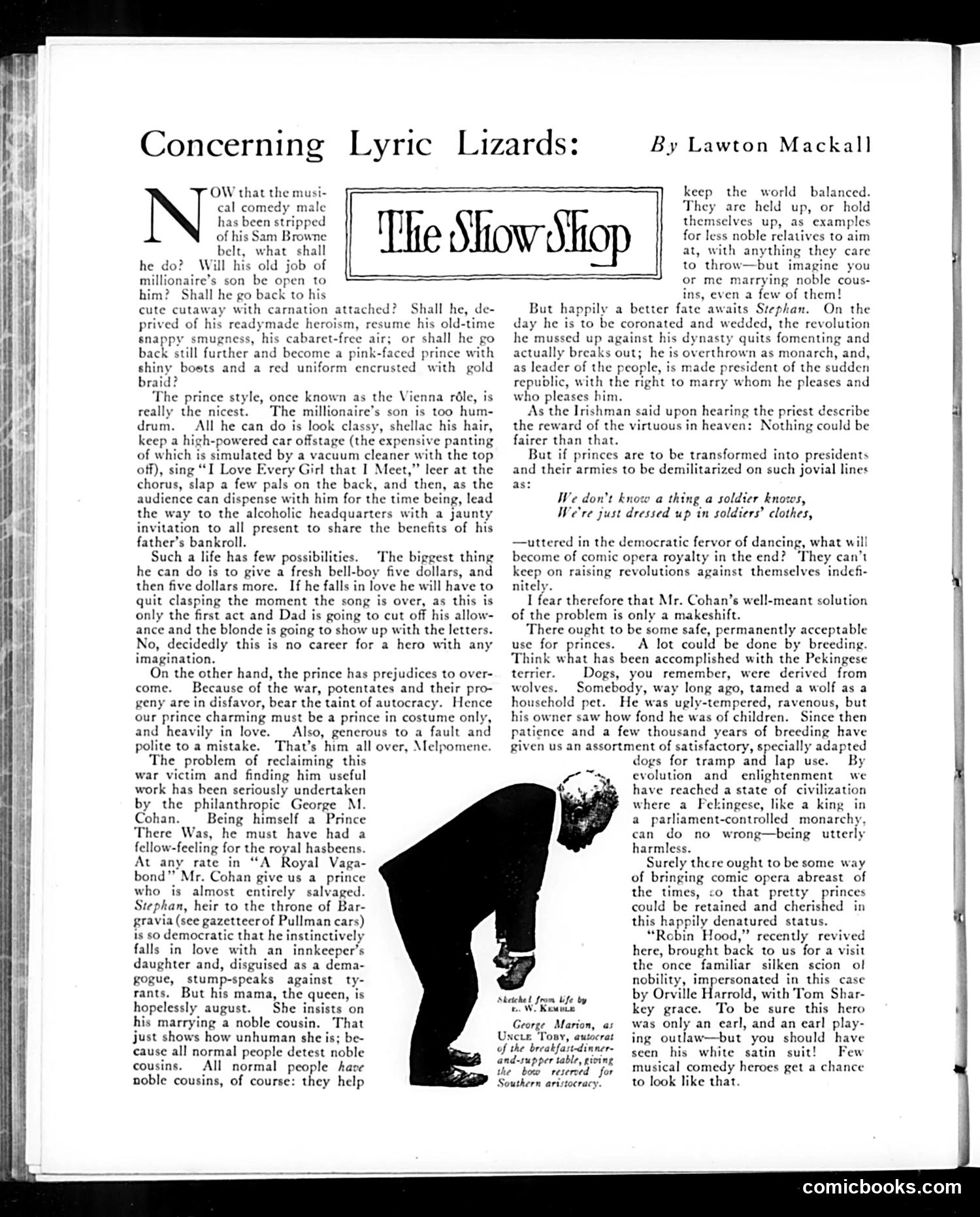
This article by Lawton Mackall satirizes the post-WWI problem of male musical comedy stars who lost their appeal after the war stripped away military glamour. The piece discusses George M. Cohan's solution: the operetta "A Royal Vagabond," featuring a prince character named Stephan. Mackall mocks how composers must now reimagine aristocratic heroes as "democratic" figures who fall in love with commoners and oppose tyranny—ultimately becoming revolutionaries and republic presidents rather than remaining in power. The satire targets both the absurdity of this plot formula and the contradiction it represents: princes-turned-presidents spouting anti-military sentiment ("We're just dressed up in soldiers' clothes") while audiences embrace this fantasy. The illustration shows a figure in formal dress, likely depicting this type of character. Mackall's point: post-war audiences and composers invented implausible character arcs to make princes "safe" and relatable again, transforming wartime heroes into democratic revolutionaries on stage.
📄 Transcribed text from this page (OCR, searchable)
Machine-transcribed from the original scan — historical spelling and the odd misread are preserved.
SS ees a ss ——— Concerning Lyric Lizards: By Lawton Mackall OW that the musi- he do? Will his old job of keep the world balanced. They are held up, or hold themselves up, as examples for less noble relatives to aim at, with anything they care to throw—but imagine you cal comedy male has been stripped of his Sam Browne WV O belt, what shall millionaire’s son be open to him? Shall he go back to his cute cutaway with carnation attached? Shall he, de- prived of his readymade heroism, resume his old-time snappy smugness, his cabaret-free air; or shall he go back still further and become a pink-faced prince with shiny boets and a red uniform encrusted with gold braid? The prince style, once known as the Vienna rdle, is really the nicest. The millionaire’s son is too hum- drum. All he can do is look classy, shellac his hair, keep a high-powered car offstage (the expensive panting of which is simulated by a vacuum cleaner with the top off), sing “I Love Every Girl that I Meet,” leer at the chorus, slap a few pals on the back, and then, as the audience can dispense with him for the time being, lead the way to the alcoholic headquarters with a jaunty invitation to all present to share the benefits of his father’s bankroll. Such a life has few possibilities. The biggest thing he can do is to give a fresh bell-boy five dollars, and then five dollars more. If he falls in love he will have to quit clasping the moment the song is over, as this is only the first act and Dad is going to cut off his allow- ance and the blonde is going to show up with the letters. No, decidedly this is no career for a hero with any imagination. On the other hand, the prince has prejudices to over- come. Because of the war, potentates and their pro- geny are in disfavor, bear the taint of autocracy. Hence our prince charming must be a prince in costume only, and heavily in love. Also, generous to a fault and polite to a mistake. That’s him all over, Melpomene. The problem of reclaiming this war victim and finding him useful work has been seriously undertaken by the philanthropic George M. Cohan. Being himself a Prince There Was, he must have had a fellow-feeling for the royal hasbeens. At any rate in “A Royal Vaga- bond” Mr. Cohan give us a prince who is almost entirely salvaged. Stephan, heir to the throne of Bar- gravia (see gazetteerof Pullman cars) is so democratic that he instinctively falls in love with an_innkeeper’s daughter and, disguised as a dema- gogue, stump-speaks against ty- rants. But his mama, the queen, is hopelessly august. She insists on his marrying a noble cousin. That just shows how unhuman she is; be- cause all normal people detest noble cousins. All normal people have noble cousins, of course: they help or me marrying noble cous- ins, even a few of them! But happily a better fate awaits Stephan. On the day he is to be coronated and wedded, the revolution he mussed up against his dynasty quits fomenting and actually breaks out; he is overthrown as monarch, and, as leader of the people, is made president of the sudden republic, with the right to marry whom he pleases and who pleases him. As the Irishman said upon hearing the priest describe the reward of the virtuous in heaven: Nothing could be fairer than that. But if princes are to be transformed into presidents and their armies to be demilitarized on such jovial lines as: We don’t know a@ thing a soldier knows, We're just dressed up in soldiers’ clothes, —uttered in the democratic fervor of dancing, what will become of comic opera royalty in the end? They can’t keep on raising revolutions against themselves indefi- nitely. I fear therefore that Mr. Cohan’s well-meant solution of the problem is only a makeshift. There ought to be some safe, permanently acceptable use for princes. <A lot could be done by breeding. Think what has been accomplished with the Pekingese terrier. Dogs, you remember, were derived from wolves. Somebody, way long ago, tamed a wolf as a household pet. He was ugly-tempered, ravenous, but his owner saw how fond he was of children. Since then patience and a few thousand years of breeding have given us an assortment of satisfactory, specially adapted dogs for tramp and lap use. By evolution and enlightenment we have reached a state of civilization where a Pekingese, like a king in a parliament-controlled monarchy, can do no wrong—being utterly harmless. Surely there ought to be some way of bringing comic opera abreast of the times, co that pretty princes could be retained and cherished in this happily denatured status. “Robin Hood,” recently revived here, brought back to us for a visit the once familiar silken scion of nobility, impersonated in this case Stetchel from life by by Orville Harrold, with Tom Shar- ©. W, Kewuue key grace. To be sure this hero George Marion, as was only an earl, and an earl play- Uncte Tony, autocrat ing outlaw—but you should have of the breakfast-dinner- seen his white satin suit! Few and-supper table, piving ; musical comedy heroes get a chance the bow resereed for < Southern aristocracy. to look like that. way we comicbooks.com