
Judge, 1912-03-02 · page 10 of 24
Judge — March 2, 1912 — page 10: what you’re looking at
What you’re looking at
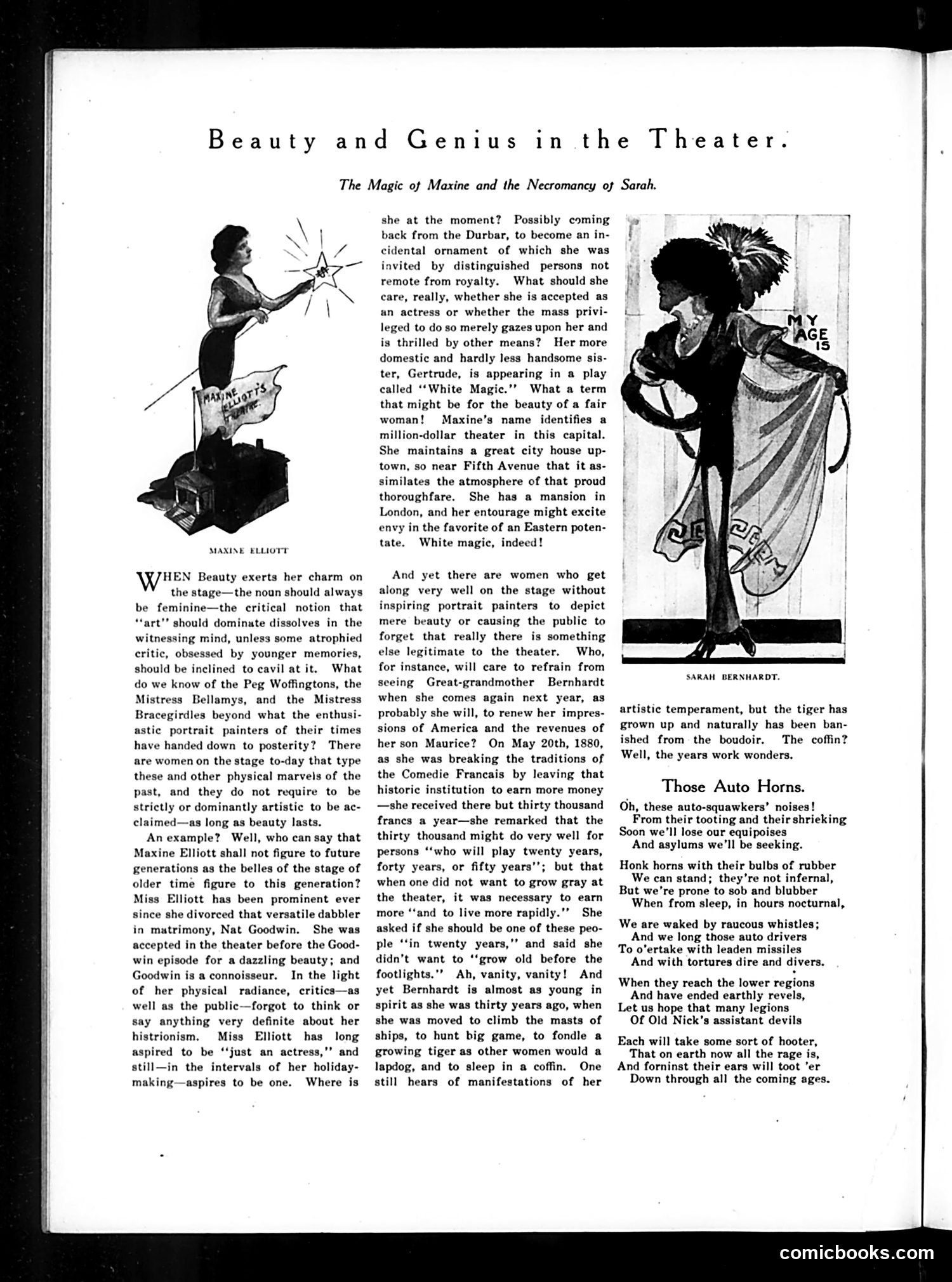
This Judge article compares two famous actresses: **Maxine Elliott** and **Sarah Bernhardt**. Elliott is critiqued as a beautiful but non-serious performer—the piece notes she divorced actor Nat Goodwin, maintains expensive properties on Fifth Avenue and in London, and relies on physical beauty rather than acting talent. The satire questions whether she'll be remembered as anything more than decorative. Bernhardt, by contrast, is praised as a genuine artist. The article quotes her 1880 remark that she couldn't afford to "grow old at the theater" and thus had to earn money rapidly. It celebrates her fierce vitality—hunting game, climbing ship masts, sleeping in a coffin—contrasting her dramatic commitment to Elliott's leisure pursuits. The piece argues that true theatrical genius transcends mere beauty: audiences will always return to Bernhardt, while Elliott's appeal depends entirely on youth and looks.
📄 Transcribed text from this page (OCR, searchable)
Machine-transcribed from the original scan — historical spelling and the odd misread are preserved.
Beauty and Genius in the Theater. The Magic of Maxine and the Necromancy of Sarah. MAXINE ELLIOTT HEN Beauty exerts her charm on the stage—the noun should always be feminine—the critical notion that ‘tart’? should dominate dissolves in the witnessing mind, unless some atrophied critic, obsessed by younger memories, should be inclined to cavil at it. What do we know of the Peg Woffingtons, the Mistress Bellamys, and the Mistress Bracegirdles beyond what the enthusi astic portrait painters of their times have handed down to posterity? There are women on the stage to-day that type these and other physical marvels of the past, and they do not require to be strictly or dominantly artistic to be ac- claimed—as long as beauty lasts. Anexample? Well, who can say that Maxine Elliott shall not figure to future generations as the belles of the stage of older time figure to this generation? Miss Elliott has been prominent ever since she divorced that versatile dabbler in matrimony, Nat Goodwin. She was accepted in the theater before the Good- win episode for a dazzling beauty; and Goodwin is a connoisseur. In the light of her physical radiance, critics—as well as the public—forgot to think or say anything very definite about her histrionism. Miss Elliott has long aspired to be ‘‘just an actress,’’ and still—in the intervals of her holiday- making—aspires to be one. Where is she at the moment? Possibly coming back from the Durbar, to become an in- cidental ornament of which she was invited by distinguished persons not remote from royalty. What should she care, really, whether she is accepted as an actress or whether the mass privi- leged to do so merely gazes upon her and is thrilled by other means? Her more domestic and hardly less handsome sis- ter, Gertrude, is appearing in a play called ‘‘White Magic.’’ What a term that might be for the beauty of a fair woman! Maxine’s name identifies a million-dollar theater in this capital. She maintains a great city house up- town, so near Fifth Avenue that it as- similates the atmosphere of that proud thoroughfare. She has a mansion in London, and her entourage might excite envy in the favorite of an Eastern poten- tate. White magic, indeed! And yet there are women who get along very well on the stage without inspiring portrait painters to depict mere beauty or causing the public to forget that really there is something else legitimate to the theater. Who, for instance, will care to refrain from seeing Great-grandmother Bernhardt when she comes again next year, as probably she will, to renew her impres- sions of America and the revenues of her son Maurice? On May 20th, 1880, as she was breaking the traditions of the Comedie Francais by leaving that historic institution to earn more money —she received there but thirty thousand francs a year—she remarked that the thirty thousand might do very well for persons ‘‘who will play twenty years, forty years, or fifty years’’; but that when one did not want to grow gray at the theater, it was necessary to earn more ‘“‘and to live more rapidly.” She asked if she should be one of these peo- ple ‘tin twenty years,’’ and said she didn’t want to ‘‘grow old before the footlights."” Ab, vanity, vanity! And yet Bernhardt is almost as young in spirit as she was thirty years ago, when she was moved to climb the masts of ships, to hunt big game, to fondle a growing tiger as other women would a lapdog, and to sleep in a coffin. One still hears of manifestations of her SARAH BERNHARDT. artistic temperament, but the tiger has grown up and naturally has been ban- ished from the boudoir. The coffin? Well, the years work wonders, Those Auto Horns. Oh, these auto-squawkers’ noises! From their tooting and their shrieking Soon we'll lose our equipoises And asylums we'll be seeking. Honk horns with their bulbs of rubber We can stand; they’re not infernal, But we’re prone to sob and blubber When from sleep, in hours nocturnal, We are waked by raucous whistles; And we long those auto drivers To o’ertake with leaden missiles And with tortures dire and divers. When they reach the lower regions And have ended earthly revels, Let us hope that many legions Of Old Nick’s assistant devils Each will take some sort of hooter, That on earth now all the rage is, And forninst their ears will toot 'er Down through all the coming ages. comicbooks.com