
Judge, 1910-01-22 · page 4 of 16
Judge — January 22, 1910 — page 4: what you’re looking at
What you’re looking at
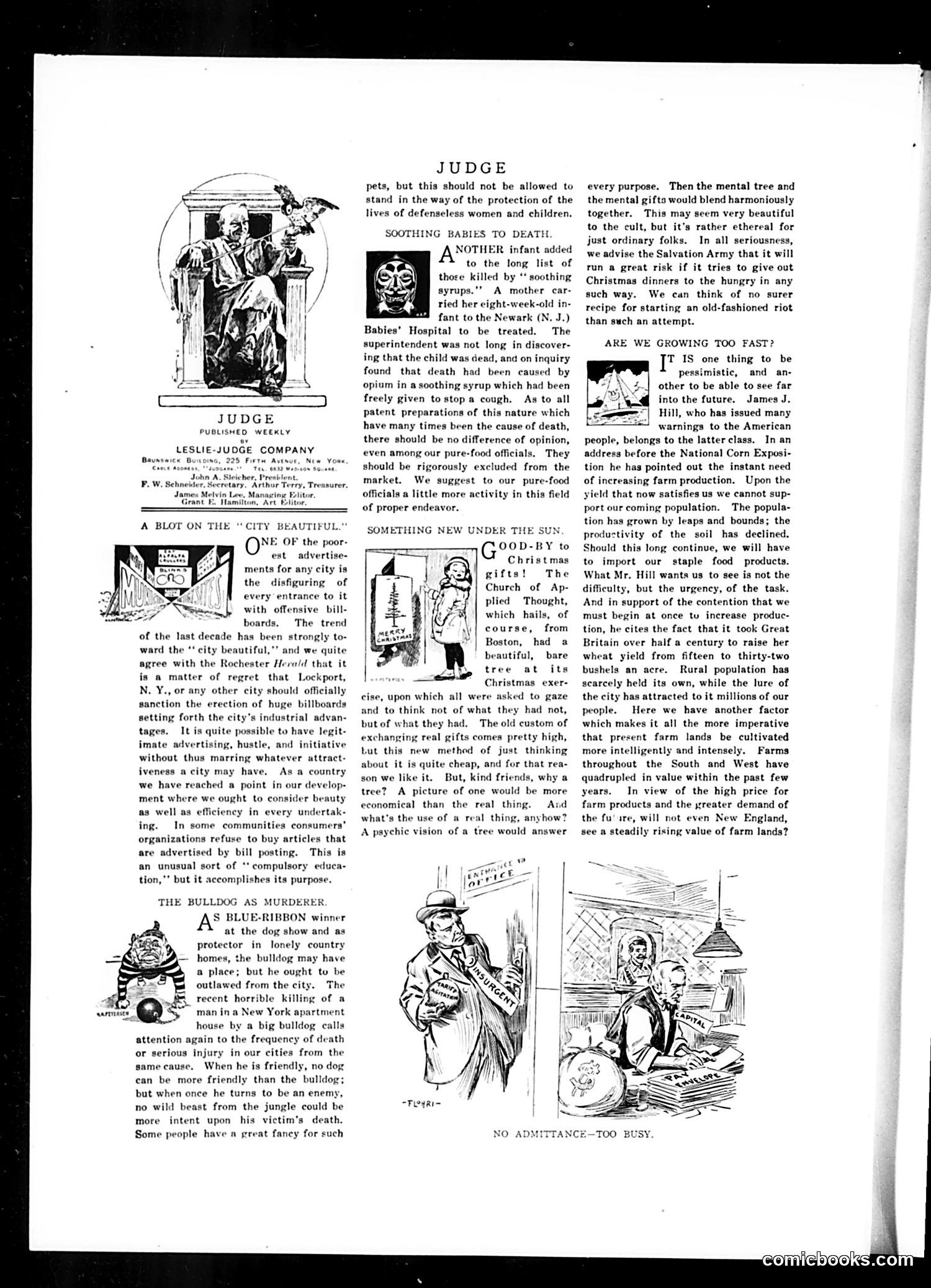
This page contains several satirical pieces addressing early 20th-century American social issues: **"Soothing Babies to Death"** criticizes patent medicines and syrups given to infants, particularly opioid-based products. A Newark hospital discovered a child died from opium in a cough syrup—a common but deadly practice. The satire targets "pure-food officials" for insufficient enforcement. **"Are We Growing Too Fast?"** discusses agricultural productivity and food imports, referencing James J. Hill's warnings about population growth outpacing domestic farm production. **"Good-by to Christmas Gifts"** satirizes the trend of giving mental images or "psychic visions" instead of physical gifts—mocking both consumerism and spiritualism fads. **"The Bulldog as Murderer"** addresses urban dog attacks in New York apartments, advocating for stricter regulation of dangerous breeds in cities.
📄 Transcribed text from this page (OCR, searchable)
Machine-transcribed from the original scan — historical spelling and the odd misread are preserved.
D ¢ armute JUDGE PUBLISHED WEEKLY LESLIE-JUDGE COMPANY John A.Sleicher, Preshlent. retary. Arthur Terry, Treasurer. SITY BEAUTIFUL NE OF the poor- advert ments for any city is the disfiguring of every entrance to it with offensive bill- boards. The trend of the last decade has been strongly to- ward the ‘‘ city beautiful,"’ and we quite agree with the Rochester Herald that it is a matter of regret that Lockport, N. Y., or any other city should officially sanction the erection of huge billboards setting forth the city’s industrial advan- tages. It is quite possible to have legit- imate advertising, hustle, and initi: without thus marring whatever attract- iveness a city may have. As a country we have reached a point in our de ment where we ought to consider beauty as well as efficiency in e undertak- ing. In some communities consumers’ organizations refuse to buy articles that are advertised by bill posting. This is an unusual sort of ‘compulsory educa- tion,’’ but it accomplishes its purpose. est jive lop- THE BULLDOG AS MURDERER AS BLUE-RIBBON winner at the dog show and as protector in lonely country homes, the bulldog may have a place; but he ought tu be outlawed from the city. The recent horrible killing of a man in a New York apartment house by a big bulldog calls attention again to the frequency of death or serious injury in our cities from the same cause. When he is friendly, no dog can be more friendly than the bulldog; but when once he turns to be an enemy, no wild beast from the jungle could be more intent upon his victim's death. Some people have a great fancy for such & JUDGE pets, but this should not be allowed to stand in the way of the protection of the lives of defenseless women and children. SOOTHING BABIES TO DEATH A! NOTHER infant added to the long list of those killed by ‘ soothing syrups."" A mother car- ried her eight-week-old in- fant to the Newark (N. J.) Babies’ Hospital to be treated. The superintendent was not long in discover- ing that the child was dead, and on inquiry found that death had been caused by opium in a soothing syrup which had been freely given to stop a cough. As to all t preparations of this nature which have many times been the cause of death, there should be no difference of opinion, even among our pure-food officials. They should be rigorously excluded from the market. We t to our pure-food officials a little more activity in this field of proper endeavor. ETHING NEW UNDER THE SU? OOD-BY to Christmas gifts! The Church of Ap- plied Thought, which hails, of course, from Boston, had a beautiful, bare tree at its Christmas exer- cise, upon which all were asked to gaze and to think not of what they had not, butof what they had. The old custom of exchanging real gifts comes pretty h Lut this new methed of just thinking about it is quite cheap, and for that rea- son we like it. But, kind friends, why a tree? A picture of one would be more economical than the real thing. And what's the use of a real thing, anyhow? ion of a tree would answer A psychic v every purpose. Then the mental tree and the mental gifts would blend harmoniously together. This may seem very beautiful to the cult, but it’s rather ethereal for just ordinary folks. In all seriousness, we advise the Salvation Army that it will run a great risk if it tries to give out Christmas dinners to the hungry in any such way. We can think of no surer recipe for starting an old-fashioned riot than such an attempt. ARE WE GROWING TOO FAST? T IS one thing to be pessimistic, and an- other to be able to see far into the future. James J. L Hill, who has issued many =<" warnings to the American people, belongs to the latter class. In an address before the National Corn Expos tion he has pointed out the instant need of increasing farm production. Upon the yield that now satisfies us we cannot sup- port our coming population. The popula- tion has grown by leaps and bounds; the productivity of the soil has declined. Should this long continue, we will have to import our staple food products. What Mr. Hill wants us to see is not the difficulty, but the urgency, of the task. And in support of the contention that we must begin at once tu increase produc- tion, he cites the fact that it took Great Britain over half a century to raise her wheat yield from fifteen to thirty-two bushels an acre. Rural population has scarcely held its own, while the lure of the city has attracted to it millions of our people. Here we have another factor which makes it all the more imperative that present farm lands be cultivated more intelligently and intensely, Farms throughout the South and West have quadrupled in value within the past few years. In view of the high price for farm products and the xreater demand of the fu’ ire, will not even New England, see a steadily rising value of farm lands?