
Judge, 1905-08-05 · page 7 of 16
Judge — August 5, 1905 — page 7: what you’re looking at
What you’re looking at
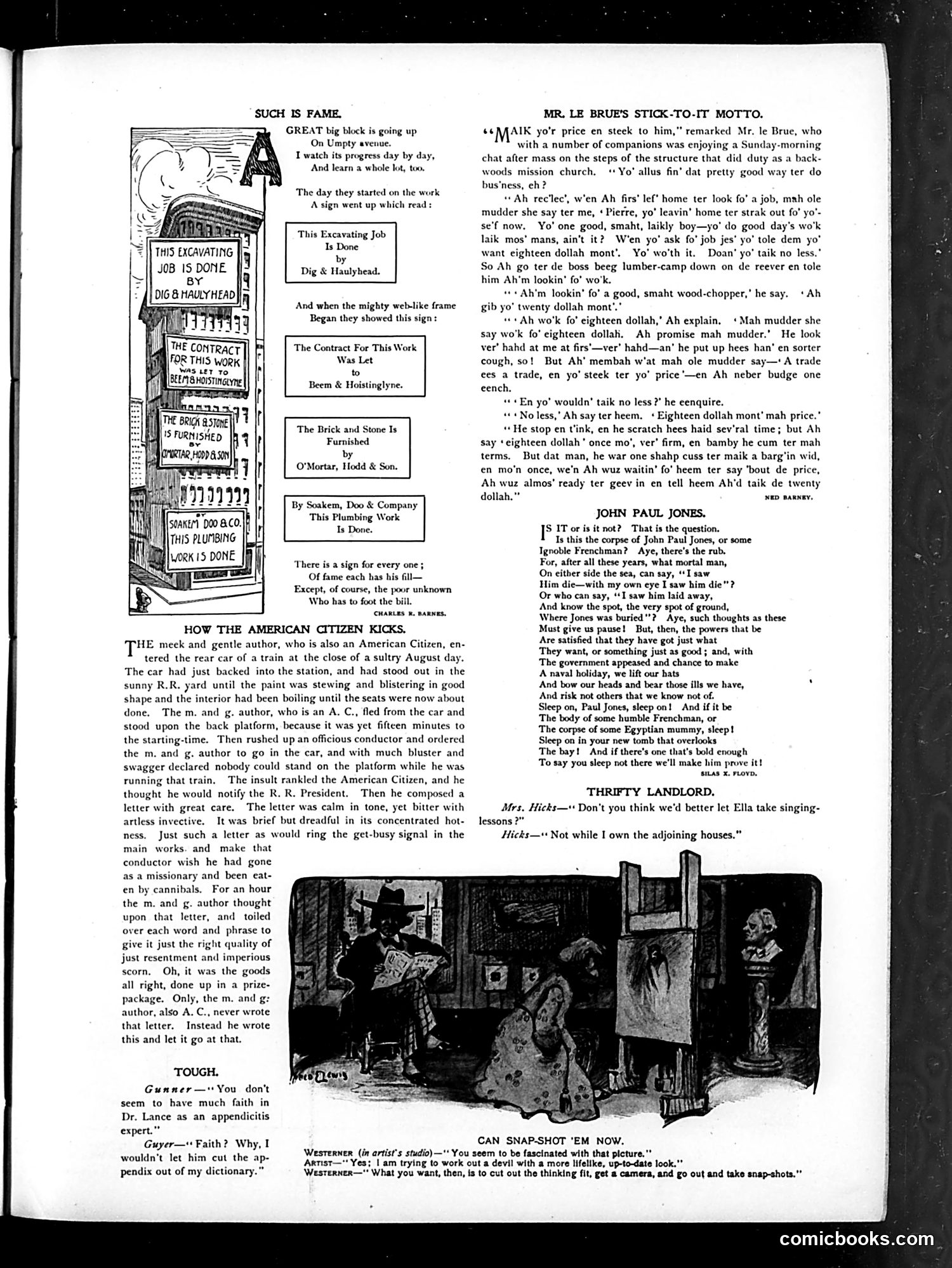
This Judge magazine page contains three separate pieces of social satire: **"Such Is Fame"** mocks construction site signage, where every contractor gets credit with prominent signs—except the unnamed property owner footing the bill. The satire targets how workers claim glory while costs remain invisible. **"How the American Citizen Kicks"** describes a meek traveler wronged by a rude railroad conductor. Despite composing an angry letter of complaint, he never sends it, instead writing this mild piece instead. It satirizes American passivity—citizens tolerate mistreatment without meaningful protest. **"Mr. Le Brue's Stick-to-It Motto"** presents working-class advice in exaggerated dialect. A man recalls his mother's wisdom: stick to your price and never undercut. When a lumber boss tries negotiating down from eighteen dollars monthly, the worker refuses, ultimately succeeding. The satire gently endorses working-class economic self-respect against employer pressure.
📄 Transcribed text from this page (OCR, searchable)
Machine-transcribed from the original scan — historical spelling and the odd misread are preserved.
SUCH IS FAME. GREAT big block is going up On Umpty avenue. I watch its progress day by day, And learn a whole lot, too. ‘The day they started on the work A sign went up which read: This Excavating Job THIS EXCAVATING i Done JOB 1S DONE BY ry Dig & Haulyhead. And when the mighty web-like frame Began they showed this sign: ‘The Contract For This Work Was Let Was Ltt To to SkEMB HorSTINGaynE Beem & Hoistinglyne. The Brick and Stone Is Furnished by O'Mortar, Hodd & Son. By Soakem, Doo & Company This Plumbing Work Is Done. ‘There is a sign for every one; Of fame each has his fill— Except, of course, the poor unknown Who has to foot the bill. CHARLES R. RARNES. HOW THE AMERICAN CITIZEN KICKS. THE meek and gentle author, who is also an American Citizen, en- tered the rear car of a train at the close of a sultry August day. The car had just backed into the station, and had stood out in the sunny R.R. yard until the paint was stewing and blistering in good shape and the interior had been boiling until the seats were now about done. Them. and g. author, who is an A. C., fled from the car and stood upon the back platform, because it was yet fifteen minutes to the starting-time. Then rushed up an officious conductor and ordered the m. and g. author to go in the car, and with much bluster and swagger declared nobody could stand on the platform while he was running that train, The insult rankled the American Citizen, and he thought he would notify the R. R. President. Then he composed a letter with great care. The letter was calm in tone, yet bitter with artless invective. It was brief but dreadful in its concentrated hot- ness, Just such a letter as would ring the get-busy signal in the main works. and make that conductor wish he had gone as a missionary and been eat- en by cannibals. For an hour the m. and g. author thought upon that letter, and toiled over each word and phrase to give it just the right quality of just resentment and imperious scorn, Oh, it was the goods all right, done up in a prize- package. Only, the m. and g: author, also A. C., never wrote that letter, Instead he wrote this and let it go at that. ‘TOUGH. Gunner—"You don't seem to have much faith in Dr. Lance as an appendicitis expert.” Guyer—« Faith? Why, I wouldn’t let him cut the ap- pendix out of my dictionary. MR. LE BRUE'S STICK-TO-IT MOTTO. seMAlK yo’r price en steck to him,” remarked Mr. le Brue, who with a number of companions was enjoying a Sunday-morning chat after mass on the steps of the structure that did duty as a back- woods mission church. « Yo" allus fin’ dat pretty good way ter do bus'ness, eh? ‘Ah rec'lec’, w'en Ah firs’ lef’ home ter look fo’ a job, mah ole mudder she say ter me, ‘Pierre, yo’ leavin’ home ter strak out fo’ yo"- se’f now. Yo" one good, smaht, laikly boy—yo’ do good day's wo'k laik mos’ mans, ain't it? W'en yo’ ask fo’ job jes’ yo’ tole dem yo" want eighteen dollah mont’, Yo" wo'th it. Doan’ yo" taik no less." So Ah go ter de boss beeg lumber-camp down on de reever en tole him Ah'm lookin’ fo" wo'k. +++ Ah'm lookin’ fo" a good, smaht wood-chopper,’ he say. gib yo" twenty dollah mont’.’ *** Ah wo'k fo’ eighteen dollah,’ Ah explain, ‘Mah mudder she say wo'k fo’ eighteen dolla, Ah promise mah mudder.’ He look ver’ hahd at me at firs'—ver’ hahd—an’ he put up hees han’ en sorter cough, so! But Ah’ membah w'at mah ole mudder say—* A trade ees a trade, en yo’ steek ter yo’ price‘—en Ah neber budge one eench, En yo’ wouldn’ taik no less 2" he enquire. ‘No less,’ Ah say ter heem. * ‘hteen dollah mont’ mah price." «He stop en t'ink, en he scratch hees haid sev'ral time; but Ah say ‘eighteen dollah’ once mo’, ver’ firm, en bamby he cum ter mah terms. But dat man, he war one shahp cuss ter maik a barg’in wid, en mo'n once, we'n Ah wuz waitin’ fo’ heem ter say "bout de price, Ah wuz almos’ ready ter geev in en tell heem Ah'd taik de twenty dollah.”” NED BARNEY, ‘Ah JOHN PAUL JONES. [8 1 ovis it not? That is the question. Is this the corpse of John Paul Jones, or some Ignoble Frenchman? Aye, there's the rub. For, after all these years, what mortal man, On either side the sea, can say, “I saw Him die—with my own eye I saw him die"? Or who can say, “I saw him laid away, ‘And know the spot, the very spot of ground, Where Jones was buried"? Aye, such thoughts as these Must give us pause! But, then, the powers that be Are satisfied that they have got just what They want, or something just as good ; and, with ‘The government appeased and chance to make A naval holiday, we lift our hats And bow our heads and bear those ills we have, And risk not others that we know not of. Sleep on, Paul Jones, sleep on! And if it be The body of some humble Frenchman, or The corpse of some Egyptian mummy, sleep! Sleep on in your new tomb that overlooks The bay! ‘And if there's one that's bold enough To say you sleep not there we'll make him prove it! SILAS x. FLOYD. THRIFTY LANDLORD. Mrs, Hicks—“ Don't you think we'd better let Ella take singing- lessons 2” Hicks—« Not while I own the adjoining houses.” CAN SNAP-SHOT 'EM NOW. Westerner (in artist's studio)—"* You seem to be fascinated with that plcture."* Anrist—"" Yes; | am trying to work out a devil with a more lifelike, up-to-date look."* Westernen—" What you want, then, is to cut out the thinking fit, get a camera, and go out and take snap-shots."" comicbooks.com