
Judge, 1905-08-05 · page 2 of 16
Judge — August 5, 1905 — page 2: what you’re looking at
What you’re looking at
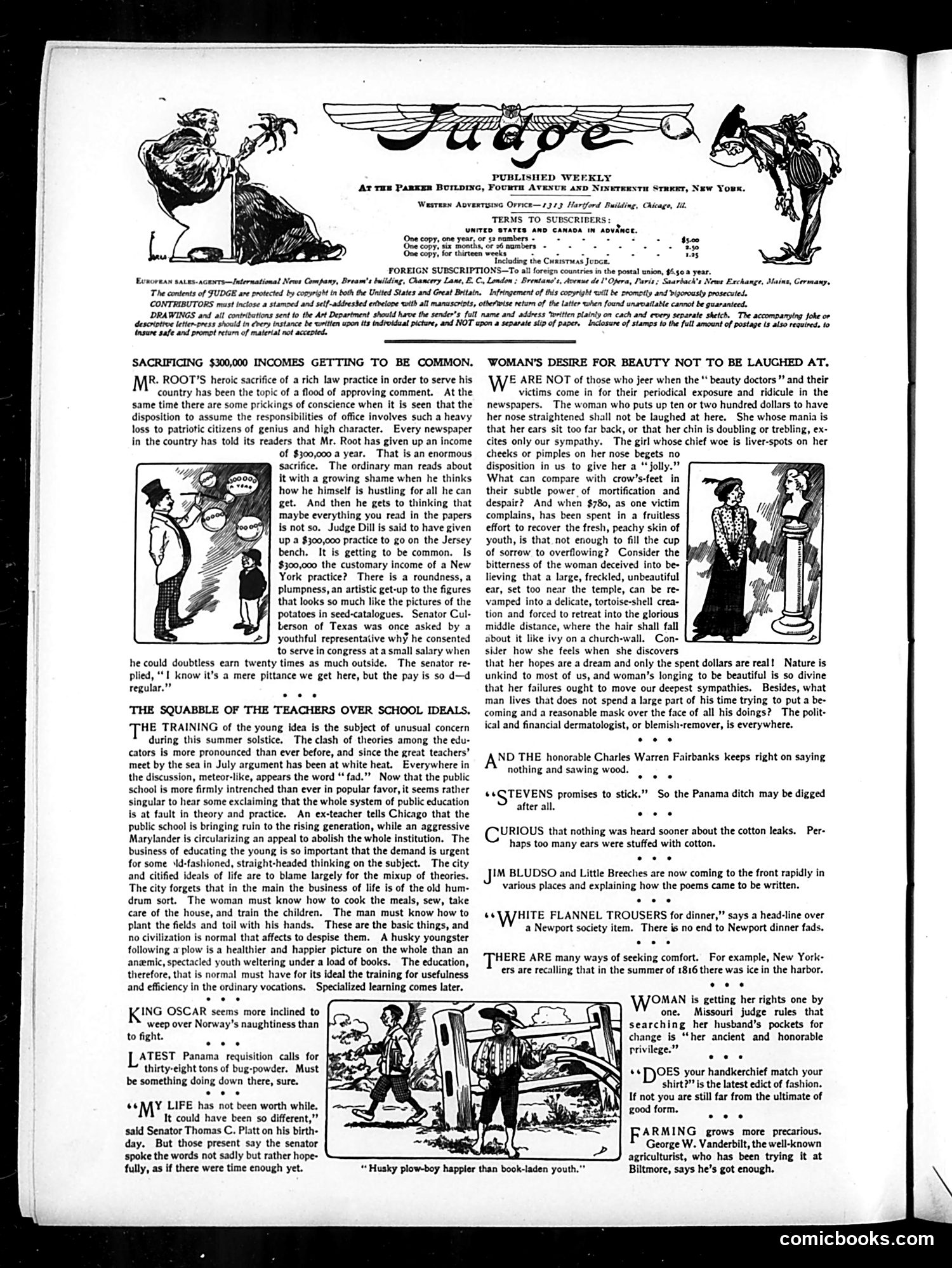
This page contains several satirical commentary pieces rather than single unified cartoons. Key items include: **"Sacrificing $300,000 Incomes Getting to Be Common"** critiques wealthy politicians claiming poverty. The text mocks a senator claiming he "hustled" to earn $250,000 yearly, suggesting this fabricated hardship narrative is becoming standard political rhetoric. **"The Squabble of the Teachers Over School Ideals"** satirizes educational debates, arguing that practical domestic skills matter more than ideological disputes among educators. The cartoon showing a "husky plow-boy happier than book-laden youth" illustrates this anti-intellectual position—valuing manual labor over academic education. **"Woman's Desire for Beauty Not to Be Laughed At"** defends women pursuing cosmetic improvements against social ridicule, presenting it as legitimate self-improvement rather than vanity. The overall tone mixes social criticism with period-typical gender commentary.
📄 Transcribed text from this page (OCR, searchable)
Machine-transcribed from the original scan — historical spelling and the odd misread are preserved.
PUBLISHED WEEKLY Av rae Paneer Boripixc, FoumTn AVENUE axp Niwereextn Staxer, New York. Westerns Avvertisinc Orrice—1313 Hartford Building, Chicage, lit One copy, one year, 7 oF sa numbers « ‘One copy, six months, or 26 numbers - ‘One copy, for thirteen weeks lading the Cunistoeas Junce. FOREIGN SUBSCRIPTIONS—To all foreign countries in the postal union, $40. year. Evnortan satts-acets—Jaternational News Company, Bream's building, Chancery Lane, E. C, London : Brentano's, Avenue del" Opera, Paris; Saarbach's News Exchange, Mains, Germany, The contents of FUDGE are protected by copyright in both the United States and Great Britain. Infringement of tis copyright wwill be promptly and digoroasly prosecuted. CONTRIBUTORS must inciose a stamsed and self-addressed ertvelope ‘otth all manuscripts, otherwise retum of the Latter when found unavailatle cannot be guaranteed. DRAWINGS and all contritations sent to the Art Department should have the sender's full name and address ‘written plainly on cach and every separate shetch. The accompanying Joke or descrintive letter press should in dvery instance be worltten upon tts tndroidaal pictare, and NOT upon a separate slip of paper. lnciosure of stames to the full amount of postage (3 also required, 10 tnsare safe and promot retarn of material not SACRIFICING $300,000 INCOMES GETTING TO BE COMMON. R. ROOTS heroic sacrifice of a rich law practice in order to serve his country has been the topic of a flood of approving comment. At the same time there are some prickings of conscience when it is seen that the disposition to assume the responsibilities of office involves such a heavy loss to patriotic citizens of genius and high character. Every newspaper in the country has told its readers that Mr. Root has given up an income of $300,000 a year. That is an enormous sacrifice. The ordinary man reads about it with a growing shame when he thinks how he himself is hustling for all he can get. And then he gets to thinking that maybe everything you read in the papers is not so. Judge Dill is said to have given up a $300,000 practice to go on the Jersey bench. It is getting to be common. Is $300,000 the customary income of a New York practice? There is a roundness, a plumpness, an artistic get-up to the figures that looks so much like the pictures of the Potatoes in seed-catalogues. Senator Cul- berson of Texas was once asked by a youthful representative why he consented to serve in congress at a small salary when he could doubtless earn twenty times as much outside. The senator re- plied, ‘1 know it’s a mere pittance we get here, but the pay is so d—d regular.”” es THE SQUABBLE OF THE TEACHERS OVER SCHOOL IDEALS. ‘THE TRAINING of the young idea is the subject of unusual concern during this summer solstice. The clash of theories among the edu- cators is more pronounced than ever before, and since the great teachers’ meet by the sea in July argument has been at white heat. Everywhere in the discussion, meteor-like, appears the word “fad.” Now that the public school is more firmly intrenched than ever in popular favor, it seems rather singular to hear some exclaiming that the whole system of public education is at fault in theory and practice. An ex-teacher tells Chicago that the public school is bringing ruin to the rising generation, while an aggressive Marylander is circularizing an appeal to abolish the whole institution. The business of educating the young is so important that the demand is urgent for some ‘ld-fashioned, straight-headed thinking on the subject. The city and citified ideals of life are to blame largely for the mixup of theories. The city forgets that in the main the business of life is of the old hum- drum sort. The woman must know how to cook the meals, sew, take care of the house, and train the children. The man must know how to plant the fields and toil with his hands. These are the basic things, and no civilization is normal that affects to despise them. A husky youngster following a plow is a healthier and happier picture on the whole than an anaemic, spectacled youth weltering under a load of books. The education, therefore, that is normal must have for its ideal the training for usefulness and efficiency in the ordinary vocations. Specialized learning comes later. cee ING OSCAR seems more inclined to weep over Norway's naughtiness than to fight. LATEST Panama requisition calls for thirty-eight tons of bug-powder. Must be something doing down there, sure. eee ¢6MAY LIFE has not been worth while. It could have been so different,” said Senator Thomas C. Platt on his birth- day. But those present say the senator spoke the words not sadly but rather hope- fully, as if there were time enough yet. “Husky plow-boy happler than book-laden youth."* ‘WOMAN'S DESIRE FOR BEAUTY NOT TO BE LAUGHED AT. WE ARE NOT of those who jeer when the “ beauty doctors ” and their victims come in for their periodical exposure and ridicule in the newspapers. The woman who puts up ten or two hundred dollars to have her nose straightened shall not be laughed at here. She whose mania is that her ears sit too far back, or that her chin is doubling or trebling, ex- cites only our sympathy. The girl whose chief woe is liver-spots on her cheeks or pimples on her nose begets no disposition in us to give her a “jolly.” What can compare with crow’s-feet in their subtle power of mortification and despair? And when $780, as one victim complains, has been spent in a fruitless effort to recover the fresh, peachy skin of youth, is that not enough to fill the cup of sorrew to overflowing? Consider the bitterness of the woman deceived into be- lieving that a large, freckled, unbeautiful ear, set too near the temple, can be re- vamped into a delicate, tortoise-shell crea- tion and forced to retreat into the glorious middle distance, where the hair shall fall about it like ivy on a church-wall. Con- sider how she feels when she discovers that her hopes are a dream and only the spent dollars are real! Nature is unkind to most of us, and woman’s longing to be beautiful is so divine that her failures ought to move our deepest sympathies. Besides, what man lives that does not spend a large part of his time trying to put a be- coming and a reasonable mask over the face of all his doings? The polit- ical and financial dermatologist, or blemish-remover, is everywhere. ND THE honorable Charles Warren Fairbanks keeps right on saying nothing and sawing wood. | | s+GTEVENS promises to stick.” So the Panama ditch may be digged after all. eee CURIOUS that nothing was heard sooner about the cotton leaks. Per- haps too many ears were stuffed with cotton. eee JIM BLUDSO and Little Breeches are now coming to the front rapidly in various places and explaining how the poems came to be written. oe HITE FLANNEL TROUSERS for dinner,” says a head-line over a Newport society item. There is no end to Newport dinner fads. ‘THERE ARE many ways of seeking comfort. For example, New York- ers are recalling that in the summer of 1816 there was ice in the harbor. eee WOMAN is getting her rights one by one. Missouri judge rules that searching her husband’s pockets for change is “her ancient and honorable rivilege.”” m es eee “e Does your handkerchief match your shirt?” is the latest edict of fashion. If not you are still far from the ultimate of good form. oe ARMING grows more precarious. George W. Vanderbilt, the well-known agriculturist, who has been trying it at Biltmore, says he’s got enough. comicbooks.com